


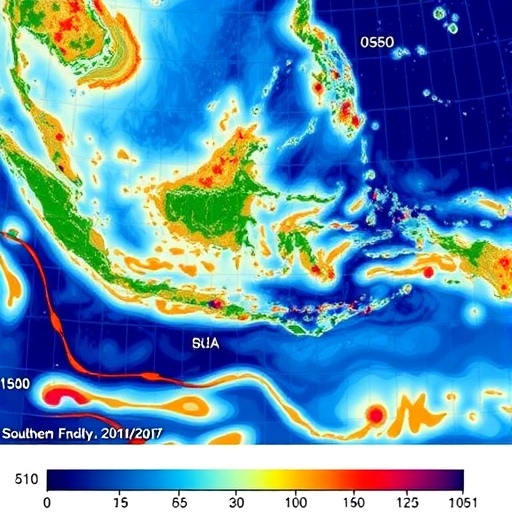
In a groundbreaking study published in Nature Communications, scientists have unveiled compelling evidence highlighting the significant contribution of the Southern Hemisphere to the Indonesian Throughflow (ITF) over the past 800,000 years. This discovery fundamentally reshapes our understanding of global oceanic circulation and has profound implications for reconstructing Earth’s climatic past as well as predicting future climate dynamics.
The Indonesian Throughflow stands as the sole conduit at low latitudes facilitating water exchange between the Pacific and Indian Oceans. It plays a pivotal role in regulating heat, salinity, and nutrient distribution across both ocean basins. Current understanding posits that this oceanic corridor predominantly transports water masses originating from the North Pacific. However, until now, the precise hemispheric provenance of these waters throughout geological time remained ambiguous.
Utilizing state-of-the-art nitrogen isotope analysis of sediment cores retrieved from the Banda Sea, a crucial node within the ITF system, researchers led by Prof. Markus Kienast from Dalhousie University and collaborators worldwide have decoded the isotopic signatures locked in ancient nitrate deposits. Nitrogen isotopes, symbolized as δ15N, vary significantly between hemispheres due to disparate biogeochemical processes, allowing scientists to trace the hemispheric origin of subsurface nitrate with unprecedented temporal resolution.
Dr. Martina Hollstein, corresponding author of the study, explains that the distinct isotopic fingerprints embedded in the subsurface nitrate enabled the team to identify the relative contributions of Northern and Southern Hemisphere waters to the ITF. Their analysis spanned an extraordinary time frame, extending back 800,000 years, offering a continuous record of ocean circulation over multiple glacial-interglacial cycles.
One of the most striking revelations from this research is the stability of the nitrogen cycle along the equatorial Pacific across this extensive period, with subsurface waters sourced dominantly from the Southern Hemisphere contributing substantially to the overall ITF transport. This challenges longstanding assumptions that the ITF predominantly channels North Pacific waters, underscoring a more intricate and hemispherically balanced mechanism than previously appreciated.
PD Dr. Mahyar Mohtadi from MARUM and the University of Bremen emphasized the broader climate implications of these findings. The substantial Southern Hemisphere contribution suggests a direct pathway through which climatic signals originating in the high southern Pacific can be transmitted via the Indonesian Seas to the Indian and ultimately the Atlantic Oceans. This pathway can therefore modulate climate patterns across several ocean basins, influencing global heat distribution and carbon cycling.
The methodology employed in this study hinged on precise geochemical techniques to quantify δ15N values in deep-sea sediment cores. The Banda Sea samples’ isotopic data were cross-referenced against known hemispheric nitrate isotope baselines to reconstruct the relative proportions of water mass origins through time. Such reconstructions necessitate careful calibration to account for potential local diagenetic effects and ensure the reliability of paleoceanographic proxies.
Beyond nitrogen isotopes, the researchers are also engaged in broader efforts to elucidate the transport mechanisms governing elemental fluxes between the ocean interior and seafloor sediments. This research forms part of the Cluster of Excellence titled “The Ocean Floor – Earth’s Uncharted Interface,” coordinated by MARUM and the Institute of Marine Chemistry and Biology at the University of Oldenburg. Understanding these transport pathways is critical for assessing the ocean’s role in regulating Earth’s biogeochemical cycles under past and future environmental conditions.
The implications of this study extend to improving climate models by incorporating a more nuanced representation of ITF dynamics and hemispheric interplay. Enhanced models can better simulate ocean-atmosphere feedback mechanisms responsible for driving large-scale climate variability. This is particularly relevant as contemporary climate change increasingly disrupts ocean circulation patterns with effects cascading across regional and global scales.
This newly recognized Southern Hemisphere influence on the ITF brings fresh perspectives on how ocean gateways modulate Earth’s climate system over glacial and interglacial periods. It suggests that paleoceanographic archives can yield vital clues to understanding the complex interactions shaping our planet’s climate history, helping to unravel how natural variability and anthropogenic influences intertwine.
Collaborative contributions from institutions spanning Canada, Germany, Australia, the United States, China, and Taiwan underscore the global significance and interdisciplinary nature of this research initiative. The synthesis of oceanography, geochemistry, and climate science exemplified in this project highlights how international cooperation advances our knowledge of Earth systems.
MARUM’s commitment to fundamental, unbiased marine research aligns with its mission to disseminate quality scientific data and foster dialogue with society. By publishing these findings and making data openly accessible, the research not only advances academic understanding but also informs policy dialogues pertaining to ocean stewardship and sustainable development aligned with United Nations goals.
In conclusion, the elucidation of a significant Southern Hemisphere contribution to the Indonesian Throughflow over the last 800,000 years marks a substantial pivot in oceanographic science. Recognizing this underappreciated flow component enriches our conception of inter-ocean exchanges and their impact on global climatic evolution, inviting further inquiry into the dynamic relationships underpinning Earth’s vast and interconnected ocean system.
News Publication Date: 14-Apr-2026
Web References:
DOI Link to Article
Cite Scienmag News
Violet Maxwell. (April 20, 2026). New Study Reveals Impact of Southern Hemisphere Waters on the Indonesian Throughflow. Scienmag. https://scienmag.com/new-study-reveals-impact-of-southern-hemisphere-waters-on-the-indonesian-throughflow/
Violet Maxwell. "New Study Reveals Impact of Southern Hemisphere Waters on the Indonesian Throughflow." Scienmag, 20 April 2026, https://scienmag.com/new-study-reveals-impact-of-southern-hemisphere-waters-on-the-indonesian-throughflow/. Accessed 5 September 2026.
Violet Maxwell. "New Study Reveals Impact of Southern Hemisphere Waters on the Indonesian Throughflow." Scienmag. April 20, 2026. https://scienmag.com/new-study-reveals-impact-of-southern-hemisphere-waters-on-the-indonesian-throughflow/


