


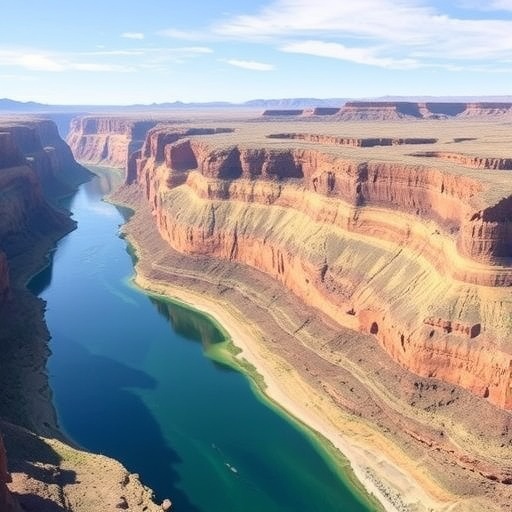
Geologists have long grappled with the elusive history of the Colorado River, one of North America’s most vital waterways, particularly concerning its ancient course and emergence into the Grand Canyon. A recent breakthrough study published in Science unveils new geological insights that trace the river’s journey millions of years ago, illuminating how it transitioned into the continental-scale river known today, carving vast landscapes and sustaining ecosystems across the American West.
For over five million years, the exact path the Colorado River took between its origin in western Colorado and its eventual exit through the Grand Canyon remained a profound enigma. Through the innovative use of detrital zircon geochronology—a sophisticated method that analyzes microscopic zircon crystals to determine sediment source and deposition age—researchers have reconstructed the river’s ancient flow dynamics. These tiny zircon fragments act as precise chronometers and geochemical fingerprints embedded within sandstone deposits, revealing the provenance of sediment and mapping fluvial routes lost to time.
Previously, geological formations suggested that the Colorado River existed in western Colorado as early as 11 million years ago, but it was unclear how and when it finally carved a path through the imposing Kaibab Arch, a natural topographical high that posed a significant barrier to its advance. The new evidence compellingly supports a model in which the river formed a substantial lake to the east of the current Grand Canyon, known as ancient Bidahochi Lake, during the late Miocene period. The accumulation of sediments within this basin, now on Navajo Nation land, confirms that the river pooled here before eventually spilling over and establishing its route through the Grand Canyon around 5.6 million years ago.
The mystery surrounding the Grand Canyon’s incision has spurred over a dozen hypotheses, reflecting the complex interplay of geological processes. Among them, the spillover lake hypothesis gains fresh credibility thanks to this study. It posits that the Colorado River filled the Bidahochi Lake basin until water levels breached the Kaibab Arch, initiating the river’s dramatic westward carve through the canyon. This sequence likely involved additional erosional mechanisms including karst piping, which entails subterranean water transport through soluble rock, and headward erosion, whereby river channels progressively extend upstream.
The investigative journey began when researchers from UCLA, the U.S. Geological Survey (USGS), and other academic institutions encountered sandstone remnants from Bidahochi Lake during fieldwork. Despite significant erosion leaving only fragmentary deposits, the team sought to decode the puzzle of the lake’s sediment sources. By isolating zircon particles from these sandstones and conducting uranium-lead isotope dating, they gleaned a distinctive detrital zircon signature congruent with sediments known to have originated from the ancestral Colorado River.
This sedimentary fingerprint closely matched zircon profiles from upstream and downstream deposits of the historic Colorado River corridor, including the Browns Park Formation in northern Utah and Colorado. Notably, the Bidahochi sediments’ ages clustered around 6.6 million years ago, corroborating a timeframe when the river actively fed the lake. The presence of ripple marks in these sedimentary layers indicated the action of strong, flowing currents entering a standing body of water, while fossil discoveries of large, fast-water fish species further validated the hydrological vigor of this prehistoric river system.
The implication of the findings is revolutionary. They suggest that before its integration into the Grand Canyon, the Colorado River was already a dynamic, momentum-gathering watercourse, supplying sediments and life to an emerging ecosystem within the lake basin. The eventual spillover and breakthrough of the Kaibab Arch were pivotal, allowing the river to initiate its profound landscape transformations that would shape the topography of the Western United States and sustain biodiversity and human civilizations that relied on its waters.
As John He, the study’s lead author and UCLA geologist, articulated, this event marks the “birth” of the Colorado River as a continental-scale river system. Unlike smaller, isolated streams, the continuous flow of the Colorado River created a hydrological and ecological corridor, knitting together disparate habitats and catalyzing evolutionary and environmental change over millions of years.
Moreover, this research underscores the importance of integrating multiple lines of evidence—ranging from sedimentology and geochronology to paleontology—in unlocking Earth’s hidden histories. The zircon dating technique, in particular, proves invaluable in sediment provenance studies, enabling scientists to reconstruct discharge patterns, sediment transport pathways, and river dynamics that conventional field observations alone cannot resolve.
The multidisciplinary approach also reflects growing collaboration between academic institutions and governmental agencies such as the USGS, which provides advanced analytical capabilities and comprehensive geological datasets. The involvement of researchers from the Navajo Nation land further highlights the critical role indigenous territories play in preserving geological archives essential to understanding continental evolution.
Beyond its geological significance, unraveling the Colorado River’s ancient path has profound implications for contemporary water resource management. The understanding of the river’s formative processes enhances the contextual knowledge needed for managing its modern flow regimes amidst increasing demands and climate variability, as the Colorado River basin continues to supply water for millions of people and diverse ecosystems in the arid American Southwest.
In sum, this landmark study redefines a hidden chapter of North American geology, illustrating how ancient rivers shape continents through their persistent erosion, sediment transport, and ecosystem connectivity. The Colorado River’s journey from a disconnected basin lake to the iconic river carving the Grand Canyon represents not only a geological tale but also a testament to the Earth’s ever-changing landscape driven by hydrological forces across deep time.
News Publication Date: [Not explicitly stated in original text]
Web References: http://www.science.org/doi/10.1126/science.adz6826
References: Zircon geochronology studies; sediment analysis from Bidahochi Lake and Browns Park Formation; fossil records of Miocene aquatic species
Cite Scienmag News
Violet Maxwell. (April 16, 2026). The Colorado River Vanished from the Geological Record for 5 Million Years — Scientists Have Finally Traced Its Lost Path. Scienmag. https://scienmag.com/the-colorado-river-vanished-from-the-geological-record-for-5-million-years-scientists-have-finally-traced-its-lost-path/
Violet Maxwell. "The Colorado River Vanished from the Geological Record for 5 Million Years — Scientists Have Finally Traced Its Lost Path." Scienmag, 16 April 2026, https://scienmag.com/the-colorado-river-vanished-from-the-geological-record-for-5-million-years-scientists-have-finally-traced-its-lost-path/. Accessed 4 September 2026.
Violet Maxwell. "The Colorado River Vanished from the Geological Record for 5 Million Years — Scientists Have Finally Traced Its Lost Path." Scienmag. April 16, 2026. https://scienmag.com/the-colorado-river-vanished-from-the-geological-record-for-5-million-years-scientists-have-finally-traced-its-lost-path/


