


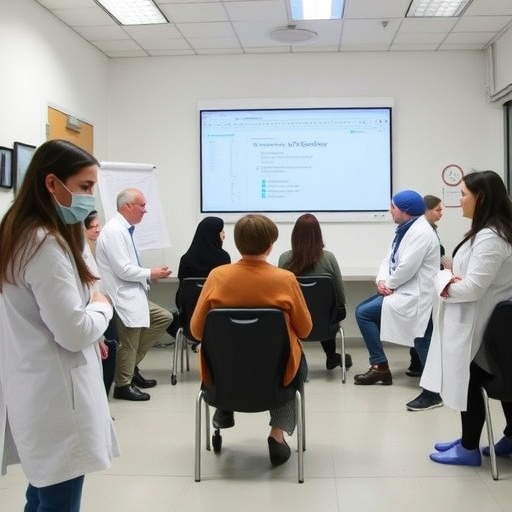
The University of Tartu Institute of Family Medicine and Public Health has pioneered a groundbreaking continuing education course titled “Foreign nationals in Estonian health system,” a first-of-its-kind initiative built upon the World Health Organization’s (WHO) global competency standards for refugee and migrant health. This innovative program responds to the growing demand within healthcare sectors for specialized knowledge and skills tailored to the unique challenges posed by increasingly diverse patient populations. The course’s formation marks a significant advancement in the integration of migration-sensitive approaches into mainstream medical education, representing an international model for best practices.
Designed primarily for doctors, resident doctors, and a broad spectrum of healthcare professionals, the curriculum addresses the complexities faced when providing medical care to patients originating from various cultural and migratory contexts. This demographic shift necessitates a profound reconsideration of traditional healthcare delivery frameworks, especially in how social, cultural, and linguistic barriers intersect with clinical practices. By incorporating the latest WHO directives, the course equips practitioners with the competencies to navigate these challenges effectively, improving outcomes for migrant and refugee patients.
Assistant in Family Medicine at the University of Tartu, Dr. Tarmo Loogus, who spearheads the course, emphasizes the increasing relevance of migration-aware healthcare protocols. The course delivers an exhaustive examination of how migration influences health status and medical needs, highlighting conditions that may arise from traumatic displacement, disrupted continuity of care, and exposure to unfamiliar health risks. Additionally, it guides practitioners on managing situations where patients present without conventional health records, such as vaccination certificates, a common obstacle in migrant health management.
One of the more technical aspects of the curriculum concerns the development and application of cross-cultural communication skills. Recognizing that effective communication is foundational to accurate diagnosis and treatment adherence, the course elaborates strategies to overcome language barriers. It provides practical training in collaborating with interpreters and cultural mediators, professions that remain underutilized but critical within European health institutions. These communication modalities are framed as essential tools in delivering equitable healthcare and avoiding medical errors that stem from misunderstanding or misinterpretation.
The course’s flexible online format is deliberately structured to accommodate the demanding schedules of healthcare professionals. Delivered by a distinguished panel of international public health and migration experts, the program combines theoretical foundations with empirical insights drawn from global health contexts. This pedagogical approach ensures that participants not only grasp foundational knowledge but also appreciate the nuanced realities of migrant health issues as experienced across diverse healthcare systems worldwide.
Since its launch, the course has attracted significant interest, registering 218 participants to date. This enthusiasm underscores the contemporary urgency to embed migrant health competencies within medical practice. Associate Professor Kadri Suija of the University of Tartu, who completed the course earlier this year, attests to its transformative impact on daily clinical work. Suija recounts interactions with patients whose linguistic and cultural backgrounds diverge from mainstream Estonian society, illustrating the practical challenges and ethical imperatives in providing culturally competent care.
Suija reflects on how the course deepened her understanding of the socio-cultural determinants of health. It illuminated how differing expectations and prior healthcare experiences influence patient behavior and treatment outcomes. Equally important, the program fostered confidence in her capacity to navigate these complexities while ensuring that all patients receive respectful, dignified, and unbiased medical treatment consistent with ethical standards.
Dr. Loogus highlights that the overwhelmingly positive feedback from course participants confirms the pressing need for specialized training modules in migrant and refugee health. Beyond its national significance, the course has garnered international attention, signaling the universal relevance of its themes. The program’s success illustrates the potential for collaborative models between academic institutions and international bodies, like WHO, to address systemic global health challenges through targeted education.
The course explicitly acknowledges the critical role played by intermediaries who bridge linguistic and cultural divides in healthcare settings. By integrating training on working effectively with interpreters and cultural mediators, it addresses a persistent gap in healthcare delivery. This focus aspires to build capacity within Estonian health services to meet emergent demographic realities, thereby fostering inclusivity and enhancing patient safety.
Technically, the curriculum explores how migration-related stressors—such as displacement trauma, acculturation difficulties, and legal vulnerabilities—can contribute to complex health presentations that differ markedly from native populations. Participants learn to apply a holistic lens when assessing patient histories, incorporating psychosocial factors alongside biomedical data. This integrative perspective aligns with WHO’s emphasis on social determinants of health as crucial to effective medical intervention.
Furthermore, the course proposes methodological frameworks for health professionals to engage in ethical decision-making when confronted with incomplete or absent patient data. This includes strategies for reconstructing medical histories and making informed clinical judgments amidst uncertainty. Such competencies are increasingly vital in contexts where conventional healthcare infrastructures may be inaccessible or inconsistent for migrant populations.
Importantly, the program contributes to aligning Estonia’s healthcare practices with EU-wide commitments to equitable health access for migrants and refugees. By fostering awareness and skill development at the practitioner level, the initiative supports broader public health goals of reducing health disparities and promoting social cohesion. Its success story provides a scalable template for other nations seeking to enhance their migration-sensitive healthcare capabilities.
In sum, the University of Tartu’s innovative education course on foreign nationals within the Estonian health system sets a new benchmark in integrating global health policies with localized professional training. Its comprehensive approach, combining technical knowledge, communication skills, and ethical frameworks, represents an essential evolution in preparing healthcare workers for the realities of our increasingly mobile and multicultural world.
Cite Scienmag News
Courtney Benton. (April 16, 2026). University of Tartu Trains Doctors to Provide WHO-Standard Care for Refugees and Migrants. Scienmag. https://scienmag.com/university-of-tartu-trains-doctors-to-provide-who-standard-care-for-refugees-and-migrants/
Courtney Benton. "University of Tartu Trains Doctors to Provide WHO-Standard Care for Refugees and Migrants." Scienmag, 16 April 2026, https://scienmag.com/university-of-tartu-trains-doctors-to-provide-who-standard-care-for-refugees-and-migrants/. Accessed 4 September 2026.
Courtney Benton. "University of Tartu Trains Doctors to Provide WHO-Standard Care for Refugees and Migrants." Scienmag. April 16, 2026. https://scienmag.com/university-of-tartu-trains-doctors-to-provide-who-standard-care-for-refugees-and-migrants/


