


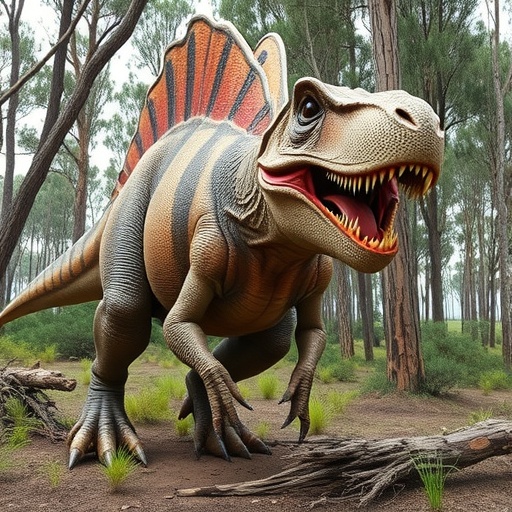
Australia’s most renowned herbivorous dinosaur, Muttaburrasaurus langdoni, long celebrated as a symbol of Queensland’s prehistoric fauna, has recently undergone an extensive re-examination that challenges long-held perceptions about its feeding habits, sensory capabilities, and evolutionary lineage. This large-bodied ornithopod, which roamed the continent approximately 96 million years ago during the mid-Cretaceous period, reveals through cutting-edge imaging and fossil analysis a complexity far beyond previous understanding.
The foundation of this pivotal insight arises from novel fossil discoveries excavated from historic dig sites near the town of Muttaburra in central Queensland. Previously incomplete, these newly recovered skeletal elements, particularly parts of the cranial anatomy, have unveiled unexpected features that prompt a radical reinterpretation of Muttaburrasaurus’s ecology and behavior. The investigation employed advanced CT scanning, neutron scattering, and synchrotron technologies to generate high-resolution, three-dimensional digital reconstructions of the dinosaur’s skull, jaws, teeth, and inner ear structures, enabling scientists to delve deeper into its biology than was ever before possible.
One of the most striking revelations is Muttaburrasaurus’s possession of teeth at the very front of its snout, a feature previously thought absent in this genus. Unlike many large ornithopods, including well-studied Northern Hemisphere taxa such as Iguanodon and hadrosaurs, which exhibit toothless beak tips adapted for cropping vegetation efficiently, Muttaburrasaurus’s narrow, toothy beak suggests a more selective feeding strategy. This particular adaptation indicates a dietary preference that may have entailed precise browsing for specific leaves, seeds, and possibly small invertebrates, representing a deviation from the bulk-feeding herbivory traditionally ascribed to large Cretaceous ornithopods.
The dental arrangement has profound taxonomic implications. It positions Muttaburrasaurus closer to earlier evolutionary offshoots within the ornithopod clade, which retained toothed beaks, reminiscent of smaller-bodied ornithischians that preceded the beak-toothless condition seen in more derived species. This nuanced understanding aids in refining its phylogenetic position on the ornithopod family tree, hinting at convergent evolutionary dynamics in distant dinosaur populations.
Beyond the dentition, the internal cranial anatomy provides remarkable clues about Muttaburrasaurus’s sensory capacities and locomotion. The endocast of the braincase reveals exceptionally large olfactory bulbs, among the most substantial recorded in dinosaurs, indicative of an acute sense of smell. Accompanying this, the nasal region comprises novel bony structures not observed in other dinosaur genera, including two complex air chambers above the primary airflow pathways. These anatomical peculiarities likely functioned to modulate inhaled air, potentially enhancing olfactory sensitivity to detect food sources, predators, or even to assist in navigation across the Mid-Cretaceous Australian landscape.
The inner ear structure, meticulously reconstructed using synchrotron imaging, resembles that of bipedal theropods such as Tyrannosaurus rex more than the quadrupedal ornithischians it might be compared to. This suggests that Muttaburrasaurus was predominantly bipedal, capable of walking and running on its two hind limbs while employing its shorter forelimbs for support during feeding or locomotion near the ground—highlighting a dynamic locomotor repertoire adapted to its environment.
Vision analysis based on the morphology and positioning of the eye sockets shows a wide lateral field of view, typical of large herbivores requiring broad environmental awareness to detect threats and maintain herd cohesion. However, forward binocular vision was limited, which may have influenced social interactions and predator evasion tactics, suggesting behavioral parallels with extant large herbivorous mammals that rely on panoramic views for survival.
Geological data and stratigraphic context place Muttaburrasaurus within the ecosystem surrounding the ancient Eromanga Sea, an inland seaway that inundated much of central Australia between 140 and 90 million years ago. The innovative CT examination of the nasal cavities hints at specialized salt glands facilitating the excretion of excess salt, enabling the consumption of coastal vegetation and possibly crustaceans inhabiting brackish environments on the sea’s margins. This physiological adaptation underlines a versatile dietary strategy tuned to unique environmental pressures not observed in many contemporaneous dinosaur faunas.
The detailed analysis of the cheek teeth conveys a grinding mechanism akin to that used by modern herbivores such as horses, cows, and kangaroos, rather than a shearing or cutting function. This grinding capability implies a more advanced and efficient processing of fibrous plant material, reinforcing the image of Muttaburrasaurus as a sophisticated herbivore exploiting a diverse vegetative diet while potentially supplementing it with animal matter, as hinted by the beak’s toothed morphology.
While these comprehensive findings illuminate numerous facets of Muttaburrasaurus’s biology, aspects such as social behavior remain enigmatic. Unlike some hadrosaurids and ceratopsians, where herd living is well-documented, current evidence is insufficient to confirm whether Muttaburrasaurus lived in social groups or exhibited solitary tendencies. Future work integrating bonebed analysis and further fossil discoveries may resolve such ecological questions.
Behind this groundbreaking research stands a multidisciplinary team integrating expertise from Australian and American institutions. The spearheading efforts of Dr. Matthew Herne and colleagues incorporated not only paleontological expertise but also advanced imaging physics and comparative anatomy. Their work, published in the esteemed journal PeerJ, sets a new precedent for reconstructing dinosaur paleobiology with a synthesis of traditional fossil analysis and next-generation imaging technologies.
Together, these insights reshape the portrait of Muttaburrasaurus from a generalized herbivore with a simple toothless beak to a nuanced, highly adapted dinosaur with remarkable cranial adaptations, complex sensory ecology, and sophisticated feeding mechanics. This work not only enriches our understanding of Australian dinosaur fauna but also contributes significantly to the global narrative of ornithopod evolution, highlighting how isolated landmasses fostered unique evolutionary trajectories in the Cretaceous.
In conclusion, the re-investigation of Muttaburrasaurus langdoni exemplifies how technological advancements can revolutionize paleontology, revealing hidden anatomical details that challenge preconceived notions. As the iconic fossil emblem of Queensland, Muttaburrasaurus now offers a compelling case study in dinosaur evolutionary biology, highlighting the interplay of anatomy, behavior, and environment in shaping the lives of these ancient giants.
Cite Scienmag News
Gavin Prescott. (April 15, 2026). Massive Aussie Dinosaur Perfectly Adapted to Feast on Native Bush Tucker. Scienmag. https://scienmag.com/massive-aussie-dinosaur-perfectly-adapted-to-feast-on-native-bush-tucker/
Gavin Prescott. "Massive Aussie Dinosaur Perfectly Adapted to Feast on Native Bush Tucker." Scienmag, 15 April 2026, https://scienmag.com/massive-aussie-dinosaur-perfectly-adapted-to-feast-on-native-bush-tucker/. Accessed 4 September 2026.
Gavin Prescott. "Massive Aussie Dinosaur Perfectly Adapted to Feast on Native Bush Tucker." Scienmag. April 15, 2026. https://scienmag.com/massive-aussie-dinosaur-perfectly-adapted-to-feast-on-native-bush-tucker/


