


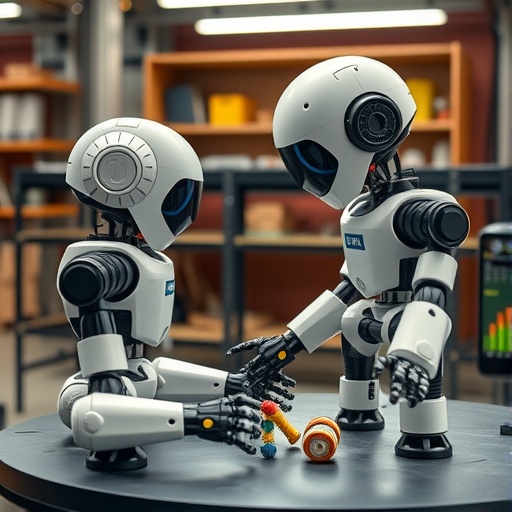
In the ever-evolving landscape of manufacturing, where the race is always on to optimize efficiency and minimize downtime, a pioneering breakthrough in robotics is poised to revolutionize how robotic systems are deployed and upgraded. The challenge has long been that transferring a skill or task from one robot to another often requires extensive reprogramming due to differences in mechanical structures, joint configurations, and movement constraints. This repetitive and resource-intensive process not only drives up costs but also prolongs implementation times. Enter Kinematic Intelligence: a transformative robotic control framework developed by the Learning Algorithms and Systems Laboratory (LASA) at EPFL, which promises to shatter these barriers and redefine how robots learn and adapt.
Traditional robotics setups have struggled with the heterogeneity of robot designs. Even when two machines are tasked with similar objectives, differences in their physical makeups—ranging from articulated joint limits to varied kinematic chains—mean that a programming effort for one robot cannot simply be copied to another. This fragmentation compels developers to redefine movement strategies, painstakingly calibrate operational boundaries, and conduct safety validations anew with every hardware iteration. The LASA team tackled this complexity head-on by developing an approach that abstracts demonstrated human tasks into a robotic-agnostic representation, effectively disentangling the movement strategy from the specifics of individual robots.
Kinematic Intelligence works by first capturing human demonstrations using motion-capture technology. These demonstrations encompass a variety of object manipulation tasks such as placing, pushing, and throwing—actions that embody dexterous human motor skills. What makes this approach groundbreaking is the subsequent mathematical conversion of these recorded movements into generalized, adaptable movement strategies. By building a comprehensive kinematic classification system that rigorously outlines the joint ranges, mechanical constraints, and stable configurations of different robot architectures, the framework enables automatic tailoring of these generalized strategies to the physical realities of each robot design.
This mathematical framework ensures that every robot, regardless of its structure, can safely perform a demonstrated task without breaching any mechanical limits. In an elegant experiment mimicking a manufacturing assembly line, a human demonstrated a multi-step task involving pushing a wooden block from a conveyor belt onto a workbench, repositioning it onto a table, and finally throwing it into a basket. Kinematic Intelligence enabled three commercially available robots with different physical makeups to autonomously reproduce this sequence, each interpreting and executing the task within its own safe operational envelope. Remarkably, even when the researchers altered which robot performed which step, the system maintained flawless performance, showcasing its robustness and adaptability.
The implications of this research extend far beyond the laboratory setting. Robots equipped with Kinematic Intelligence could operate seamlessly in dynamic environments where hardware is frequently upgraded or replaced. This agility significantly reduces the need for high-level programming expertise, enabling operators to transfer skills effortlessly across diverse robotic platforms. Moreover, this technology hints at a future where robots in domestic or industrial settings could be commanded through natural language or simple instructions, bypassing the heavy technical overhead traditionally associated with robotic deployment.
Underlying this transformative capability is a crucial guarantee of safety and predictability. The framework holistically integrates knowledge about robot kinematics, stability criteria, and operational limits, allowing the system to autonomously verify whether a planned movement is feasible and compliant with mechanical boundaries before execution. This intrinsic safety check mitigates risks of damage, malfunction, or hazardous behaviors, which are paramount in real-world applications where humans and robots increasingly interact closely.
The scientific article detailing this work, recently published in Science Robotics, breaks new ground by addressing an enduring problem: how to endow robots with the ability to learn once and execute on many platforms. The LASA team’s multidisciplinary approach leverages advances in motion capture, robot modeling, kinematics, and control theory to construct an architecture that is both theoretically rigorous and practically viable. The work exemplifies how mathematical abstraction can serve as a bridge, transforming heterogeneous robotic hardware into a unified canvas for skill execution.
Beyond industrial robotics, the research paves the way for future developments in human-robot collaboration. Imagine a domestic scenario where a user could demonstrate a task once—say, sorting laundry items or preparing ingredients—and have their home robots replicate it flawlessly regardless of model variations. Alternatively, in collaborative manufacturing, different robots could dynamically share task responsibilities without necessitating reprogramming, dramatically enhancing operational flexibility. Furthermore, as robotic hardware continues to evolve rapidly with new designs entering the market, frameworks like Kinematic Intelligence will be critical in sustaining backward compatibility and protecting investments in robotic skills development.
This technology can also reshape the economics of robotic deployment. By drastically lowering the skill and time investments required to program new tasks or upgrade robot fleets, companies can reduce both capital expenditures and labor costs. The automation of task adaptation will likely accelerate innovation cycles, allowing factories and service providers to keep pace with shifting demands and technology rollouts. In a marketplace increasingly sensitive to sustainability, Kinematic Intelligence also supports more sustainable robotics by extending the lifespan and utility of robotic skills across multiple generations of hardware.
Reflecting on the broader vision behind this work, LASA’s leadership sees a future where the cognitive barrier separating human intentions from robotic execution is effectively eliminated. “Our goal is to remove the need for technical expertise while still ensuring safe and reliable operation,” summarizes Durgesh Haribhau Salunkhe, co-first author of the study. The user simply provides the idea and desired behavior—through demonstration or simple commands—and the robot autonomously adapts and executes the task within its mechanical and safety constraints. This vision not only democratizes robotics but also aligns with the growing trend toward more intuitive, human-centered automation.
As researchers continue to refine Kinematic Intelligence, future iterations may integrate additional sensory modalities and richer contextual understanding. Combining this framework with advances in artificial intelligence, natural language processing, and real-time sensory feedback could make robots even more versatile partners in the workplace and home. This integration will enable robots to better understand task nuances, adapt on the fly to unforeseen circumstances, and learn incrementally from ongoing interactions with humans and the environment.
In sum, Kinematic Intelligence represents a majestic leap forward in robotic skill transfer and control. By mathematically translating human demonstration into a universally adaptable skill representation and rigorously respecting each robot’s physical limits, this framework ushers in a new era of scalable, sustainable, and user-friendly robotics. Its capacity to endow distinctly different robots with a shared repertoire of skills transforms the paradigm of robotic programming, opening doors to unprecedented efficiency and flexibility across industries. As research unfolds and the approach is adopted worldwide, Kinematic Intelligence holds the promise to become the cornerstone technology of next-generation robotic systems.
News Publication Date: 15-Apr-2026
Web References: DOI – 10.1126/scirobotics.aea1995
Cite Scienmag News
Denise Maddox. (April 15, 2026). Training Diverse Robots to Master the Same Skill. Scienmag. https://scienmag.com/training-diverse-robots-to-master-the-same-skill/
Denise Maddox. "Training Diverse Robots to Master the Same Skill." Scienmag, 15 April 2026, https://scienmag.com/training-diverse-robots-to-master-the-same-skill/. Accessed 5 September 2026.
Denise Maddox. "Training Diverse Robots to Master the Same Skill." Scienmag. April 15, 2026. https://scienmag.com/training-diverse-robots-to-master-the-same-skill/


