


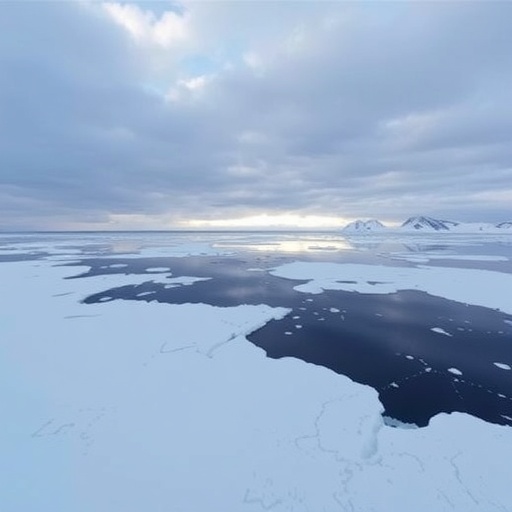
In a groundbreaking study recently published in Communications Earth & Environment, researchers have unveiled compelling evidence linking the extreme retreat of Antarctic sea ice to forcing mechanisms originating in the tropical regions. This investigation delves deeply into the intricacies of climate dynamics connecting disparate geographic regions, providing fresh insights into the rapid and alarming changes occurring at the southernmost extremities of our planet. The study’s findings underscore the complex interplay between tropical climate variability and polar environmental responses, posing significant implications for understanding future sea ice trends amid accelerating global warming.
Antarctic sea ice, a critical component of the Earth’s climate system, plays an essential role in regulating global temperatures, ocean circulation, and marine ecosystems. Historically, Antarctic sea ice displayed a relative insensitivity to increasing greenhouse gas concentrations, often manifesting trends distinct from the more consistently retreating Arctic ice. However, recent years have marked a pronounced shift with episodes of dramatic sea ice loss, particularly in regional hotspots around Antarctica. The research conducted by Liang and colleagues meticulously explores these regional extreme retreats, focusing on how tropical climatic forcings remotely influence Antarctic ice conditions.
Previous studies have highlighted that tropical climate anomalies such as El Niño–Southern Oscillation (ENSO) events can induce atmospheric and oceanic teleconnections influencing Antarctic weather patterns. Building upon these established links, the current research employs robust climate models and observational datasets to quantify the extent and mechanisms by which tropical variability drives Antarctic sea ice extremes. By synthesizing satellite observations, atmospheric reanalysis, and coupled climate model simulations, the authors offer an unprecedentedly detailed depiction of the causal chain linking tropical forcing to polar ice response.
Central to the investigation is the identification of atmospheric circulation anomalies triggered in the tropical Pacific and Indian Oceans, which propagate poleward, modifying wind patterns and ocean currents around Antarctica. These alterations can lead to intensified westerly winds or shifts in the Amundsen Sea Low, a persistent low-pressure system influential in dictating sea ice distribution and melt regimes. The study reveals that during strong tropical forcing events, especially intense El Niño phases, anomalous surface wind stress disrupts the usual sea ice extent, promoting rapid retreat by increased ice export and enhanced melting.
The researchers further explore the thermodynamic processes accompanying this dynamic response. They argue that tropical-induced atmospheric changes lead to localized warming both in the lower atmosphere and sea surface temperatures near Antarctica. This warming effect accelerates ice melt beyond what would be expected from greenhouse gas forcing alone. The synergy between dynamic wind anomalies and thermodynamic heating fosters conditions conducive to the observed extreme regional sea ice retreat, particularly centered in the Amundsen and Bellingshausen Seas sectors.
Importantly, the study sheds light on the nonlinear behavior of sea ice response to tropical forcing, highlighting episodic extreme events rather than gradual long-term decline. Such event-driven retreats pose unique challenges for prediction and risk assessment, as they can precipitate rapid ecosystem disruptions and feedback loops influencing regional climate variability. This nuanced understanding calls for enhanced monitoring of tropical variability as a critical predictor of Antarctic ice conditions, which has not been sufficiently integrated into existing forecasting frameworks.
Methodologically, the research employs state-of-the-art coupled climate models with high spatial resolution to capture the detailed feedbacks between the ocean, atmosphere, and cryosphere. These models are validated against satellite-derived sea ice concentration and extent datasets spanning recent decades, confirming their capacity to reproduce key observed patterns. Moreover, advanced statistical techniques isolate the tropical signals from other confounding influences, strengthening confidence in the causal linkages identified.
The implications of these findings extend well beyond Antarctic sea ice dynamics. Given that Antarctic ice influences global thermohaline circulation, changes in ice extent mediated by tropical forcing could reverberate through the oceans, affecting heat and carbon uptake and even mid-latitude weather systems. Increased understanding of these teleconnections enhances climate predictability on a global scale, informing models that underpin international policy decisions regarding climate mitigation and adaptation strategies.
Another compelling dimension explored in the study is how ongoing climate change may modify the strength and frequency of tropical forcing events themselves. Some projections suggest intensified ENSO variability under warming scenarios, potentially increasing the occurrence of Antarctic sea ice extremes through the mechanisms outlined. This feedback loop underscores the critical need to consider interactions between tropical climate dynamics and polar responses in climate impact assessments.
The study’s robust approach combines empirical observation with theoretical understanding, offering a holistic picture of the climate interplay at work. By establishing the tropical origins of specific Antarctic sea ice retreat episodes, the research challenges the previously dominant narrative that localized polar processes or greenhouse gas forcing alone drive these changes. Instead, it demonstrates a far-reaching climatic connectivity, reinforcing the notion that no region acts in isolation within the Earth system.
Scientists anticipate that these insights will catalyze further research into coupled tropical-polar climate dynamics, promoting interdisciplinary efforts combining oceanography, atmospheric science, and cryospheric studies. The urgency of this pursuit is heightened given Antarctica’s role as a harbinger of climate tipping points and accelerator of global sea level rise. Improved understanding will facilitate better resilience planning for communities sensitive to changes driven by polar ice variability, including emerging patterns in fisheries and global weather phenomena.
In parallel, the study advocates for enhanced observational infrastructure in both tropical and polar regions to capture real-time variability and validate model predictions. Satellite missions, oceanic floats, and atmospheric monitoring stations will form critical components of this strategy, enabling more precise attribution and improved early warning capabilities. Concerted international collaboration will be essential given the logistic and financial challenges inherent in polar research.
To summarize, the research undertaken by Liang et al. represents a landmark contribution to climate science, exposing a significant tropical fingerprint on Antarctic sea ice extremes. As the world grapples with the multifaceted impacts of climate change, elucidating such inter-regional connections is paramount. This study not only enriches our scientific understanding but also nudges policymakers to consider cross-hemispheric influences when developing climate resilience frameworks, underscoring the interconnectedness of Earth’s climate puzzle.
As climate systems continue to evolve under anthropogenic influence, deciphering these kinds of teleconnections equips humanity with critical knowledge to anticipate forthcoming environmental thresholds and mitigate their effects with informed strategies. The stark reality of Antarctic sea-ice retreat triggered, in part, by tropical forcing signals the need for integrated climate action spanning diverse latitudes and disciplines. Only through such holistic perspectives can we hope to navigate the challenges posed by our changing planet.
Cite Scienmag News
Violet Maxwell. (April 15, 2026). Tropical Forces Drive Antarctic Sea-Ice Retreat. Scienmag. https://scienmag.com/tropical-forces-drive-antarctic-sea-ice-retreat/
Violet Maxwell. "Tropical Forces Drive Antarctic Sea-Ice Retreat." Scienmag, 15 April 2026, https://scienmag.com/tropical-forces-drive-antarctic-sea-ice-retreat/. Accessed 4 September 2026.
Violet Maxwell. "Tropical Forces Drive Antarctic Sea-Ice Retreat." Scienmag. April 15, 2026. https://scienmag.com/tropical-forces-drive-antarctic-sea-ice-retreat/


