


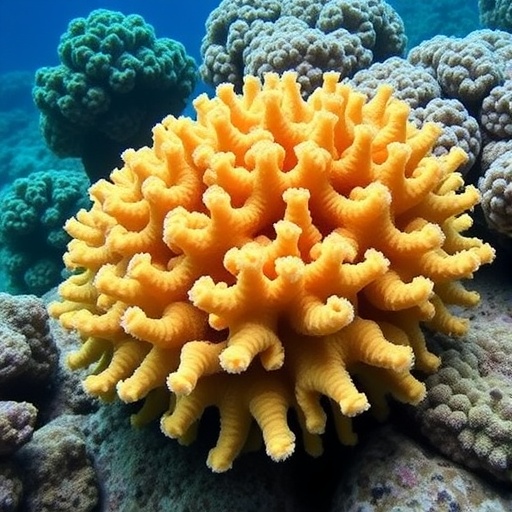
In the vast, underwater expanses where coral reefs flourish, monumental organisms silently endure, often unbeknownst to the scientific community. These colossal coral colonies, some spanning several meters, represent centuries of marine biological history, yet they have remained elusive and under-documented. A groundbreaking initiative spearheaded by researchers at the University of Milano-Bicocca is now shedding light on these giants. Their project, titled “Map the Giants,” stands as a pioneering citizen-science platform dedicated to identifying, cataloging, and ultimately safeguarding these ancient coral behemoths before they vanish amid intensifying environmental stressors.
Despite their remarkable sizes—colonies extending a minimum of five meters in length—giant coral colonies have remained conspicuously absent from formal scientific registries. This omission places them at heightened risk, as conservation efforts frequently fail to account for organisms lacking official recognition. “Map the Giants” emerged from this realization, aiming to change the narrative by leveraging community participation and advanced validation protocols to systematically discover and record these underwater titans. By engaging a diverse range of contributors, from researchers to diving enthusiasts, the initiative offers a scalable approach to coral ecosystem documentation previously unimaginable.
The urgency behind recognizing these colossal corals cannot be overstated. While these colonies have withstood natural elements for centuries, recent decades have introduced a host of unprecedented threats, both local and global. Pollution, ocean acidification, temperature anomalies, and destructive fishing practices accelerate coral degradation at an alarming pace. The researchers emphasize the dire need to locate and document these giants before they succumb to such pressures, underscoring a race against time to preserve irreplaceable genetic and ecological legacies embodied in these living archives.
Central to the scientific objectives of “Map the Giants” is the concept of coral resilience. Large, aged coral colonies act as biological time capsules, with their calcium carbonate skeletons containing layered records of historical climate fluctuations and environmental stress events. By pinpointing and studying these resilient colonies, scientists hope to unravel the adaptive mechanisms that have allowed certain individual corals to endure environmental upheavals that have decimated others. Unlocking these genetic and phenotypic secrets holds promise for informing reef restoration strategies and bolstering reef resistance in the face of global climate change.
The methodology employed in this initiative hinges on collaborative data collection combined with rigorous expert validation. Contributors submit observations, photographs, and measurements through an accessible digital platform, where each submission undergoes multi-expert review to ensure data integrity. This hybrid approach preserves scientific robustness while democratizing participation, enabling even non-specialists to contribute meaningfully to marine conservation science. This model exemplifies how citizen science can bridge gaps between academic research and public engagement, catalyzing broader awareness and responsibility for ocean health.
Equally important is the project’s ambition to translate scientific findings into actionable conservation policy. By establishing a publicly accessible database of verified giant coral locations, “Map the Giants” prepares the groundwork for official protective measures. Researchers plan to collaborate with environmental agencies, local stakeholders, and policymakers to designate these monumental colonies as marine protected monuments, thereby securing legal safeguards that could mitigate anthropogenic impacts. Such initiatives underscore the cultural and ecological value attributed to coral giants beyond their scientific significance.
Early results from the initiative have been nothing short of extraordinary. Within its first eighteen months, “Map the Giants” received nearly two hundred submissions from contributors spanning twenty-two countries, culminating in over one hundred verified giant coral records. Among these are significantly oversized Porites species measuring over 60 meters in linear dimension and a Pavona cf. clavus with a staggering perimeter exceeding 195 meters. These discoveries not only enrich scientific understanding but also stimulate public imagination, inspiring renewed enthusiasm for coral reef conservation worldwide.
The project illustrates the transformative power of citizen involvement in scientific discovery. The vast spatial distribution and sheer scale of coral reef ecosystems render comprehensive professional surveys impractical or cost-prohibitive. By empowering divers, snorkelers, and coastal communities to act as coral seekers, “Map the Giants” achieves a coverage scale unattainable through conventional means. This collective endeavor epitomizes the democratization of science, fostering an inclusive approach where curiosity and commitment fuel meaningful contributions to marine ecology.
Participation in the initiative is designed to be straightforward and inclusive. The dedicated online portal offers intuitive submission tools, educational resources, and community interaction features, enhancing user engagement. Contributors provide critical data such as colony size, location coordinates, and photographic evidence, facilitating precise documentation. The platform adapts to varying user expertise levels, ensuring that even novices can participate without compromising data quality. This adaptability strengthens the initiative’s potential as a long-term monitoring and research resource.
From a technical standpoint, the verified datasets generated by “Map the Giants” provide a validated sampling frame vital for subsequent peer-reviewed research. Such data sets are invaluable for studies exploring the physiological, genetic, and ecological traits underpinning coral resilience. Understanding these factors at a fine scale could revolutionize restoration approaches, enabling the selection or genetic engineering of “super-corals” tailored to withstand future oceanic challenges. Therefore, this citizen-science endeavor not only bolsters immediate conservation but also nurtures scientific breakthroughs with far-reaching implications.
The urgent call to document and protect giant coral colonies reflects broader concerns about global marine biodiversity under accelerating climate crises. Coral reefs, often termed the “rainforests of the sea,” support immense biological diversity and provide critical ecosystem services including coastal protection, fisheries, and tourism revenue. The loss of these ancient coral giants would signify an irreplaceable erosion of natural heritage and resilience capacity, compromising reef ecosystems’ ability to recover from disturbances and sustain their myriad dependent species.
In conclusion, the “Map the Giants” initiative represents a timely, innovative response to an escalating conservation challenge. By merging citizen engagement with scientific rigor, it not only uncovers hidden marine treasures but also fosters a deeper societal understanding of and commitment to marine ecosystems. As environmental pressures continue to mount, such integrative, community-driven scientific endeavors will be essential pillars in the global movement to safeguard ocean biodiversity and secure a sustainable future for coral reefs and the communities they support.
News Publication Date: 6-Mar-2026
Web References:
- Project website: https://www.mapthegiants.com/
- Journal: https://natureconservation.pensoft.net/
- DOI link: http://dx.doi.org/10.3897/natureconservation.63.182923
References:
Siena FM, Gabbiadini A, Fallati L, Galli P, Montano S (2026) Map the Giants: a new citizen-science portal to map, study and protect the largest coral colonies. Nature Conservation 63: 127-151. DOI: 10.3897/natureconservation.63.182923
Cite Scienmag News
Margaret Porter. (April 15, 2026). Centennial Corals Unveiled: New Citizen Science Initiative Explores the Giants of the Reef. Scienmag. https://scienmag.com/centennial-corals-unveiled-new-citizen-science-initiative-explores-the-giants-of-the-reef/
Margaret Porter. "Centennial Corals Unveiled: New Citizen Science Initiative Explores the Giants of the Reef." Scienmag, 15 April 2026, https://scienmag.com/centennial-corals-unveiled-new-citizen-science-initiative-explores-the-giants-of-the-reef/. Accessed 4 September 2026.
Margaret Porter. "Centennial Corals Unveiled: New Citizen Science Initiative Explores the Giants of the Reef." Scienmag. April 15, 2026. https://scienmag.com/centennial-corals-unveiled-new-citizen-science-initiative-explores-the-giants-of-the-reef/


