


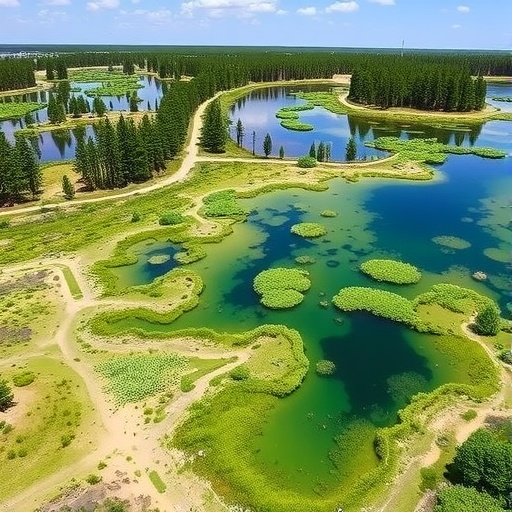
For the past six decades, urea has been the backbone of global nitrogen fertilization, underpinning the astonishing growth of human populations by boosting agricultural productivity. Yet, despite its widespread application, the impact of this synthetic nitrogen fertilizer on freshwater ecosystems has remained obscure—until now. A recent groundbreaking study has illuminated how urea, when introduced at environmentally relevant concentrations into water bodies, dramatically alters aquatic ecosystems in ways previously unseen. This revelation raises urgent questions about the interactions between agricultural practices and freshwater health, with implications stretching far beyond North America.
The comprehensive investigation conducted by Gushulak et al. focused on a series of agricultural reservoirs in central North America, regions typified by intense crop production and consequently heavy urea usage. Results demonstrated a staggering threefold increase in summer phytoplankton abundance in reservoirs treated with urea compared to control sites. Notably, this escalation involved the proliferation of various eukaryotic algal species while leaving cyanobacteria populations and their associated toxins conspicuously unchanged. This differential response challenges conventional expectations, which have often implicated cyanobacteria as the primary culprits in agriculturally fueled eutrophication events.
Phytoplankton, the microscopic plant-like organisms forming the basis of aquatic food webs, respond sensitively to nutrient inputs. The observed surge in algal abundance following urea enrichment suggests that urea acts as a powerful nitrogen source, bypassing limitations that previously constrained phytoplankton growth during summer months. Yet, the study’s nuanced mass budgeting approach revealed that the nitrogen surplus did not merely accumulate in the water column. Instead, most of the added nitrogen was lost to the atmosphere, likely through volatilization as ammonia (NH3), a pathway often underestimated in nitrogen cycling models.
Importantly, the reservoirs under scrutiny did not exhibit phosphorus limitation during fertilization, a critical ecological nuance shaping productivity. The continuous release of phosphorus from sediments sustained nutrient availability, allowing phytoplankton to exploit the extra nitrogen without constraint. This insight punctuates the fact that eutrophication is often a complex interplay between nitrogen inputs and phosphorus availability, underscoring the necessity of holistic nutrient management in aquatic systems.
Such pervasive nutrient enrichment carries wide-reaching consequences. Elevated phytoplankton levels can trigger cascades through the ecosystem, altering oxygen dynamics, disrupting aquatic food webs, and impairing water quality. Notably, the absence of cyanobacterial blooms in this study suggests that distinct phytoplankton communities might govern eutrophication responses when urea predominates as the nitrogen source. This finding has profound implications for understanding bloom dynamics and associated water quality degradation.
Broadening the perspective, spatial analyses across the region revealed that these reservoirs are emblematic of shallow water bodies prevalent within Canada’s largest agricultural regions. Alarmingly, over 40% of surface waters in these areas are vulnerable to degradation resulting from urea inputs combined with phosphorus availability. This vulnerability translates into a pronounced risk of extreme eutrophication events, jeopardizing freshwater resources critical for biodiversity, human consumption, and recreation.
Globally, regions sharing similar agricultural footprints, including parts of China, India, and North America, are likely witnessing comparable ecological perturbations. Elevated urea use in conjunction with phosphorus-rich waters sets a stage ripe for explosive phytoplankton growth and eutrophic conditions. This global context reinforces the urgency of reassessing nutrient management policies in agricultural landscapes to mitigate downstream aquatic ecosystem degradation.
The study’s revelations challenge entrenched paradigms that have, until now, fixated predominantly on nitrogen or phosphorus independently. Instead, it highlights the intricate synergy dictating nutrient-driven productivity and ecosystem health. Management strategies must therefore adopt integrated approaches that consider both nitrogen forms, including urea’s unique chemical behavior and its atmospheric loss pathways.
Furthermore, understanding the fate of nitrogen following urea application reshapes our view of nutrient cycling. The significant volatilization to ammonia underscores a potential source of nitrogen loss not traditionally accounted for in eutrophication models, demanding refined biogeochemical frameworks. Such refinements could improve predictions of nutrient fluxes and inform targeted interventions.
As agriculture continues to intensify globally, these findings sound an alarm about the unintended biogeochemical consequences of fertilization beyond soil and crop management. The aquatic environment, often the downstream recipient of agricultural runoff, manifests the cumulative impacts of nutrient enrichment, with ramifications for ecosystem resilience and human wellbeing.
This study also accentuates the importance of long-term, ecologically relevant experiments to unravel complex nutrient interactions in freshwater. By bridging controlled manipulations with large-scale spatial assessments, researchers offer compelling evidence that artificial fertilizer inputs transcend their terrestrial targets, reshaping aquatic worlds with profound environmental cost.
In conclusion, the burgeoning dominance of urea as the world’s nitrogen fertilizer demands a paradigm shift in how we conceptualize and manage nutrient flows within agroecosystems. The dramatic eutrophication of freshwater bodies revealed here signals the need for harmonized nutrient stewardship that safeguards both food security and freshwater integrity. As humanity grapples with growing populations and changing climates, such integrative knowledge will be pivotal for crafting sustainable futures.
This profound exploration of urea’s ecological legacy unveils a hidden chapter in the narrative of modern agriculture. It compels scientists, policymakers, and stakeholders to rethink nutrient use and its far-reaching ecological footprints. Far from being a benign agricultural input, urea emerges as a potent driver of aquatic ecological transformation, warranting urgent attention and action.
The findings represent a critical stride in understanding nitrogen’s multifaceted role in freshwater systems and open pathways for innovative mitigation strategies. These may include optimizing fertilizer application rates, enhancing sediment management to reduce phosphorus release, and monitoring atmospheric ammonia emissions to close nitrogen budgets.
Moreover, this study highlights the value of interdisciplinary approaches, melding environmental chemistry, aquatic ecology, and landscape-scale analyses. Such comprehensive perspectives are essential to decipher the complex feedbacks entwining human activities with ecosystem processes, particularly in the Anthropocene epoch.
As the global community aspires to balance agricultural productivity with environmental stewardship, this research presents a compelling case for re-evaluating the dominant fertilizers shaping our landscapes. Urea’s ubiquity carries both the promise of nourishment and the peril of freshwater degradation—an ecological dilemma demanding immediate scientific and societal response.
Cite Scienmag News
Gavin Prescott. (April 15, 2026). Major Nitrogen Fertilizer Drives Severe Water Eutrophication. Scienmag. https://scienmag.com/major-nitrogen-fertilizer-drives-severe-water-eutrophication/
Gavin Prescott. "Major Nitrogen Fertilizer Drives Severe Water Eutrophication." Scienmag, 15 April 2026, https://scienmag.com/major-nitrogen-fertilizer-drives-severe-water-eutrophication/. Accessed 4 September 2026.
Gavin Prescott. "Major Nitrogen Fertilizer Drives Severe Water Eutrophication." Scienmag. April 15, 2026. https://scienmag.com/major-nitrogen-fertilizer-drives-severe-water-eutrophication/


