


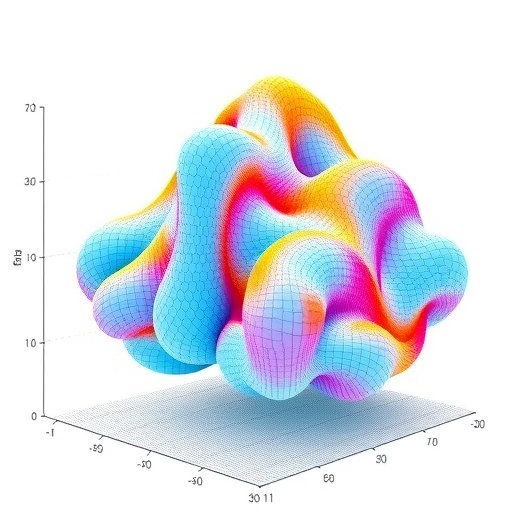
In a groundbreaking advance at the crossroads of thermodynamics and machine learning, a team of researchers led by Hoffmann, Specht, Göttl, and colleagues has unveiled a thermodynamically consistent machine learning model capable of predicting excess Gibbs energy with unprecedented accuracy and reliability. Published in the prestigious journal Nature Communications in 2026, this work marks a pivotal shift in how complex thermodynamic properties are modeled, harnessing the power of artificial intelligence while ensuring compliance with fundamental physical laws.
Understanding excess Gibbs energy is crucial for a myriad of applications ranging from materials science and chemical engineering to pharmacology and environmental chemistry. It quantifies the deviation from ideal mixing behavior in multicomponent systems, thereby governing phase equilibria, reaction equilibria, and separations processes. However, traditional methods to compute this quantity often rely on empirical correlations or simplified models that can fall short in capturing real-world complexity. The new model developed by Hoffmann’s team bridges this gap by embedding thermodynamic consistency directly into the machine learning architecture.
At its core, the research addresses a pivotal challenge in scientific machine learning: ensuring that data-driven models do not merely interpolate experimental data, but also adhere strictly to the fundamental laws of physics. Previous attempts to model thermodynamic properties with neural networks often produced predictions that violated energy conservation or showed thermodynamic inconsistency under certain conditions, limiting their practical utility. By integrating a rigorous thermodynamic framework into their machine learning model, the researchers have surmounted these limitations.
The methodology hinges on a novel architecture that enforces thermodynamic constraints—such as convexity and Gibbs-Duhem relations—within the learning process. Rather than treating the problem as a pure black-box prediction, the model incorporates prior domain knowledge as hard constraints, effectively guiding the learning algorithm and pruning out physically impossible predictions. This integration ensures that, irrespective of the complexity of the dataset or chemical system, the model’s outputs remain thermodynamically plausible.
One of the most remarkable strengths of this approach lies in its versatility across diverse chemical spaces and temperature-pressure conditions. The authors tested their model on extensive datasets spanning binary to multicomponent mixtures, showcasing outstanding prediction accuracy for excess Gibbs energy across wide compositional ranges. The model successfully captured subtle interactive effects that commonly evade traditional models, offering a transformative tool for probing phase behavior in complex mixtures.
Moreover, this machine learning model significantly reduces the computational burden compared to conventional molecular simulation or empirical-fitting methods. The training phase benefits from modern high-performance computing resources, but once trained, the model delivers rapid predictions suitable for real-time process design and optimization. This breakthrough is poised to accelerate innovation cycles in fields where thermodynamic property estimation is traditionally a bottleneck.
The implications of Hoffmann et al.’s work are extensive. In the chemical process industry, accurate knowledge of excess Gibbs energy is vital for designing separation units such as distillation columns and extractors. By providing swift and reliable predictions, this model can enhance process efficiency, lower energy consumption, and reduce operational costs. Similarly, in materials science, understanding phase diagrams accurately enables the rational design of alloys and functional materials with tailored properties.
Thermodynamics has long been regarded as a discipline grounded in robust physical principles, often resistant to purely data-driven approaches due to the stringent nature of its laws. This study exemplifies a harmonious alliance between physics-based reasoning and modern artificial intelligence, showing how machine learning can be embedded within scientific theory rather than replacing it. Such an approach is likely to inspire similar frameworks in other domains of physical sciences, such as fluid dynamics, kinetics, and quantum chemistry.
The researchers also emphasize the interpretability of their model, which stands in contrast to many opaque machine learning solutions. By embedding known thermodynamic laws, the model parameters and outputs remain physically meaningful, facilitating insightful analysis rather than treating the system as a mysterious black box. This interpretability is critical for adoption by engineers and scientists who need to understand and trust the model’s predictions.
In addition, the model exhibits robust extrapolation abilities. While most machine learning models falter when predicting outside the training data regime, the thermodynamic constraints act as a governing guide that prevents unphysical behavior during extrapolation. This capability is particularly important in exploratory design scenarios where new chemical systems or process conditions are evaluated.
Looking ahead, Hoffmann and collaborators propose several exciting future directions to enhance and expand their approach. These include extending the framework to dynamic thermodynamic properties, integrating uncertainty quantification, and coupling the model with process simulators for fully automated design workflows. The potential for customization to specific industries or chemical families could further broaden the applicability of this technology.
The study represents a harbinger of a new generation of scientific machine learning models that do not merely mimic experimental data but embody the essence of scientific understanding. It paves the way for greater adoption of AI-driven tools rooted in fundamental physical laws, thereby ensuring trustworthiness and continued scientific rigor in computational modeling.
As industries increasingly rely on digital twins and AI-enhanced simulation environments, this model sets a new standard for hybrid physics-data approaches. The ability to combine experimental, simulation, and theoretical data into a unified, consistent predictive tool promises to revolutionize how engineers and scientists approach complex thermodynamic challenges.
In conclusion, the thermodynamically consistent machine learning model for excess Gibbs energy developed by Hoffmann et al. is a landmark contribution that merges the rigor of classical thermodynamics with the flexibility and power of modern AI. Its accuracy, interpretability, and efficiency unveil new horizons for computational thermodynamics, spanning academic research, industrial applications, and beyond. This exemplary work embodies how collaborative interdisciplinary innovation can unlock solutions to scientific problems once deemed intractable to purely data-driven or purely theoretical approaches.
Cite Scienmag News
Blake Davidson. (April 14, 2026). Thermodynamically Consistent Machine Learning Models for Gibbs Energy. Scienmag. https://scienmag.com/thermodynamically-consistent-machine-learning-models-for-gibbs-energy/
Blake Davidson. "Thermodynamically Consistent Machine Learning Models for Gibbs Energy." Scienmag, 14 April 2026, https://scienmag.com/thermodynamically-consistent-machine-learning-models-for-gibbs-energy/. Accessed 3 September 2026.
Blake Davidson. "Thermodynamically Consistent Machine Learning Models for Gibbs Energy." Scienmag. April 14, 2026. https://scienmag.com/thermodynamically-consistent-machine-learning-models-for-gibbs-energy/


