


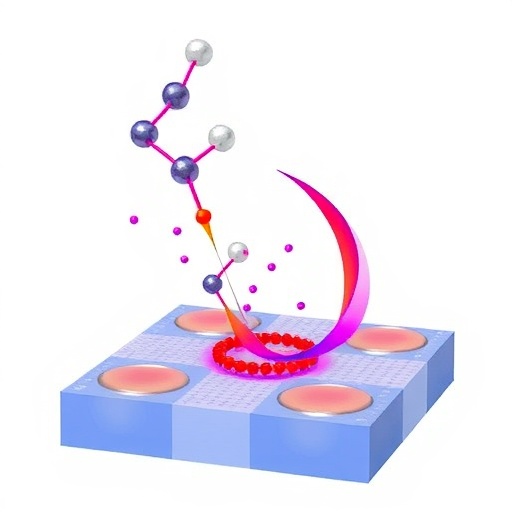
In a groundbreaking breakthrough poised to revolutionize the field of heterogeneous catalysis, researchers have unveiled a new strategy that challenges a long-standing obstacle—the inherent limitations posed by static scaling relationships in surface-adsorbate interactions. This innovation centers on the use of dynamic surface polarization under oscillating electric potentials, which effectively disrupts the conventional constraints that have historically hampered the selectivity and efficiency of catalytic chemical processes.
Chemical catalysis, particularly on metal surfaces, has relied heavily on understanding the interaction energies between adsorbed species and catalytic surfaces. Traditionally, static scaling correlations have governed these interactions, dictating proportional relationships between adsorption energies of chemically related surface intermediates. While useful for predicting trends in catalytic activity, these correlations inherently impose a trade-off, limiting the simultaneous optimization of selectivity and conversion rates. This challenge is particularly acute in the semi-hydrogenation of acetylene, a reaction of paramount industrial importance for producing ethylene, an essential feedstock in polymer manufacturing.
The collaborative team spearheaded by Xu, Hülsey, and Chen has demonstrated that by applying time-dependent electric fields to palladium (Pd) catalysts, it is possible to transcend these static limitations. Unlike prior approaches relying on fixed electric fields—which produced only marginal improvements in reaction selectivity—the application of oscillating potentials induces dynamic surface polarization. This, in turn, enables a periodic modulation of the Pd electronic environment, thereby dynamically tuning adsorption energies in a time-resolved manner, an approach never before realized at this scale.
Specifically, the innovation exploits the ability to alternate the catalyst surface between two distinct electronic states: one characterized by a strong binding affinity for acetylene under positive polarization, and another with a weakened adsorbate affinity under negative polarization during the formation of ethylene. This dual-state cycling significantly suppresses the over-hydrogenation pathway, a common problem where ethylene is further reduced to less desirable products such as ethane. The result is an outstanding improvement in ethylene selectivity, achieved without compromising acetylene conversion rates, thereby delivering exquisite control over the reaction pathway.
Mechanistic elucidation of this phenomenon was accomplished through a multifaceted experimental and computational approach. Kinetic measurements of hydrogenation reactions illustrated enhanced selectivity under dynamic polarization conditions. Complementing these studies, in situ diffuse reflectance infrared Fourier transform spectroscopy (DRIFTS) provided molecular-level insights into the adsorption states and the transient formation of reaction intermediates. X-ray absorption spectroscopy (XAS) enabled observation of real-time changes in the electronic structure of Pd atoms on the catalyst surface, revealing how electronic states oscillate in synchrony with applied potentials.
On the theoretical front, density functional theory (DFT) simulations were instrumental in deciphering the energy landscapes governing adsorption and reaction steps. These calculations confirmed that dynamic polarization shifts the energy levels of adsorbed species, breaking the linear scaling relationships that otherwise tightly correlate binding energies. This decoupling effect is paramount because it allows the optimization of one adsorption energy independently of another—a feat previously unachievable with static catalysts.
The implications of this work stretch far beyond acetylene hydrogenation. The concept of dynamically tuning catalyst surface electronic properties holds enormous promise for various adsorption-mediated processes in energy conversion, chemical synthesis, and environmental remediation. By enabling fine control over intermediate binding energies with temporal precision, dynamic surface polarization could pave the way for designing catalysts with unprecedented selectivity and activity profiles.
Moreover, this strategy reinforces the growing realization that catalytic performance cannot be fully understood or optimized from static descriptors alone. The ability to harness time-dependent phenomena introduces an entirely new dimension to catalysis design, transforming traditional paradigms that have guided catalyst development for decades. Dynamic modulation opens exciting possibilities where catalysts can be “programmed” to respond to temporal stimuli, tailoring reaction environments on the fly to maximize performance.
Practically, the researchers implemented this concept on Pd catalysts operating under oscillating electric potentials ranging from positive to negative values. The dynamic systems were meticulously engineered to synchronize the electric field oscillations with the reaction kinetics of acetylene hydrogenation. This harmonization ensures that the catalyst surface exhibits optimal binding characteristics precisely when each reaction intermediate dominates, thus steering the reaction pathway toward selectively producing ethylene.
This approach also addresses one of the fundamental challenges in catalysis scaling relations—the inherent linear correlations that limit simultaneous optimization of adsorption energies. By dynamically breaking these static scaling relationships, the team effectively decoupled the binding energies of acetylene and ethylene, thus overcoming a fundamental limitation imposed by the Sabatier principle and traditional catalyst design rules.
The reported high ethylene productivity achieved via dynamic polarization corresponds to significant industrial relevance. Traditional catalysts often face a performance compromise between selectivity and yield; here, the dualistic binding modes facilitated by surface polarization enable efficiency gains without sacrificing throughput. This could translate to reduced energy consumption, lower catalyst loading, and diminished by-product formation in industrial semi-hydrogenation processes.
Intriguingly, the dynamic polarization methodology can also inspire new catalyst architectures capable of responding to external electrical stimuli. For instance, integrating this technology with electrocatalytic and photoelectrocatalytic systems could further harness synergistic effects, advancing sustainable chemical manufacturing powered by renewable electricity.
Future research directions may explore applying dynamic surface modulation to other reaction systems plagued by scaling relation constraints, such as ammonia synthesis, CO2 reduction, or selective oxidation reactions. Tailoring oscillation frequencies, amplitudes, and duty cycles could optimize catalyst performance to specific reaction landscapes, ushering in a new era of responsive, adaptive catalysis.
In conclusion, the work by Xu, Hülsey, Chen, and colleagues signifies a transformative breakthrough in tailoring heterogeneous catalytic processes through time-dependent electric surface modulation. By breaking static adsorption-energy correlations, this strategy unlocks unprecedented control over catalysis selectivity and activity. Their pioneering findings suggest that embracing dynamic phenomena and electronic surface engineering could become a universal approach to advancing chemical synthesis, energy technologies, and environmental applications worldwide.
This study fundamentally challenges the dogma of static catalyst design, proving that the future of catalysis lies in the realm of dynamic control and temporal precision. As industries strive toward more sustainable, efficient chemical processes, the paradigm-shifting innovation of dynamic surface polarization demonstrates how coupling advanced materials science with time-resolved electrochemistry can radically enhance catalytic outcomes and open new frontiers in chemical engineering.
Cite Scienmag News
Bethany Barker. (April 14, 2026). Dynamic Surface Polarization Disrupts Acetylene Hydrogenation Scaling. Scienmag. https://scienmag.com/dynamic-surface-polarization-disrupts-acetylene-hydrogenation-scaling/
Bethany Barker. "Dynamic Surface Polarization Disrupts Acetylene Hydrogenation Scaling." Scienmag, 14 April 2026, https://scienmag.com/dynamic-surface-polarization-disrupts-acetylene-hydrogenation-scaling/. Accessed 4 September 2026.
Bethany Barker. "Dynamic Surface Polarization Disrupts Acetylene Hydrogenation Scaling." Scienmag. April 14, 2026. https://scienmag.com/dynamic-surface-polarization-disrupts-acetylene-hydrogenation-scaling/


