


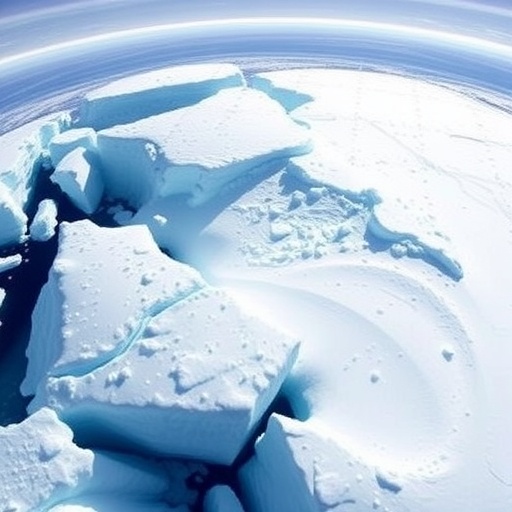
In an unprecedented breakthrough, recent research has illuminated the profound impact of Antarctic sea-ice loss on large-scale climatic phenomena, specifically indicating that the ongoing decline of Antarctic sea ice is intricately linked to a significant positive shift in the Pacific Decadal Oscillation (PDO). This discovery, published in Communications Earth & Environment in 2026 by Jeong, Park, Yeh, and colleagues, offers a pioneering perspective on how polar changes may cascade through global climate systems, reshaping ocean-atmosphere interactions and influencing weather patterns far beyond the Southern Hemisphere.
The Antarctic has long been recognized as a sentinel of climate variability, with its sea-ice cover oscillating naturally on seasonal and decadal scales. However, mounting evidence suggests that anthropogenic climate change is accelerating sea-ice loss at unprecedented rates. This diminishing ice cover alters the Southern Ocean’s albedo, disrupts marine ecosystems, and modifies heat exchange between ocean and atmosphere. What was previously elusive, until this study, was a clear mechanistic understanding of how these polar transformations could influence climatic oscillations occurring thousands of kilometers away in the North Pacific region.
Central to the research is the Pacific Decadal Oscillation, a dominant mode of climate variability in the North Pacific Ocean characterized by alternating phases that persist over intervals of 20 to 30 years. The PDO exerts extensive control over temperature and precipitation patterns across North America and Asia, making its phase state critically important for understanding and predicting regional climate variability. By analyzing comprehensive climate model simulations coupled with satellite-derived datasets of sea-ice extent, the authors trace a statistically robust relationship pinpointing the negative correlation between Antarctic sea-ice reduction and the positive phase predominance of the PDO.
The physical mechanisms underlying this linkage revolve around complex atmospheric teleconnections initiated by polar sea-ice loss. As Antarctic sea ice retreats, the resultant warming of the Southern Ocean surface modifies the polar jet stream and the distribution of baroclinic waves, effectively altering Rossby wave trains that propagate into the higher latitudes of the Northern Hemisphere. These shifts influence the Aleutian Low pressure system, a key driver of the PDO phase dynamics. Consequently, the feedback loops initiated at the poles culminate in the increased frequency and intensity of positive PDO events, characterized by warmer sea surface temperatures in the central and eastern North Pacific.
This study integrates advanced coupled atmosphere-ocean general circulation models (AOGCMs) with high-resolution sea-ice concentration products, employing novel statistical techniques to isolate the contribution of Antarctic sea-ice variations from other climatic forcings such as tropical Pacific variability and anthropogenic greenhouse gas emissions. The robustness of the detected signal is highlighted through extensive model ensemble experiments, which consistently demonstrate that declining Antarctic sea-ice trends precede and arguably precipitate upward shifts in PDO indices.
Implications of this polar-to-Pacific teleconnection are far-reaching. The positive phase of the PDO is intimately associated with increased coastal erosion, altered marine ecosystem dynamics, and variability in fisheries productivity along the western coasts of North America. Moreover, shifts in North Pacific storm tracks driven by PDO phases influence wildfire regimes and drought severity in the American West. Understanding that Antarctic processes play a hitherto unrecognized role in modulating these phenomena offers a novel pathway for improving climate prediction models and adapting regional climate resilience strategies.
The interplay between Antarctic sea-ice cover and the Pacific Decadal Oscillation also underscores the intrinsic linkage between high-latitude processes and mid-latitude climate variability. Traditionally, Antarctic and North Pacific climate systems were often studied in isolation due to the vast spatial separation and assumed hemispheric independence of climate modes. This research shatters that paradigm, elucidating how Southern Hemisphere cryospheric changes resonate through global atmospheric circulation patterns to influence distant ocean basins.
Beyond the immediate climatic consequences, this discovery bears powerful implications for the future trajectory of global climate under a warming world. As the Antarctic continues to shed ice mass and reduce sea-ice coverage, we may anticipate a more frequent predominance of positive PDO phases. Such a regime shift could enhance the pace of ocean warming in the North Pacific, triggering feedbacks that further accelerate Arctic sea-ice loss, disrupt the hydrological cycle, and jeopardize climate stability on continental scales.
In methodological terms, the research leverages breakthrough analytical frameworks combining machine learning classification algorithms with classical climate teleconnection indices to parse out subtle yet meaningful signals buried within complex climate datasets. This interdisciplinary fusion of computational science with physical climatology signals a new epoch in climate research, wherein AI-driven data mining complements conventional model simulations to uncover interconnections once deemed intractable.
Critically, the study also addresses uncertainties and potential confounders. While Antarctic sea-ice loss emerges as a central driver in PDO phase shifts, the authors acknowledge the contributions of other factors such as volcanic forcing, solar irradiance variability, and anthropogenic aerosol emissions. The quantitative partitioning of these influences remains an active field of inquiry, with ongoing observational campaigns and enhanced satellite missions poised to refine this knowledge further.
From a policy and societal standpoint, these findings elevate the urgency of integrating polar ice monitoring into broader climate forecasting efforts. National and international agencies charged with climate adaptation can harness insights from this study to better anticipate and mitigate regional climate risks associated with PDO variability—ranging from agricultural productivity shocks to infrastructure vulnerabilities induced by extreme weather events.
Equally, the research invites renewed scientific focus on Antarctic sea-ice dynamics themselves. Understanding the nonlinear feedbacks governing sea-ice formation, melt processes, and interactions with oceanic heat flux is critical. Enhanced observational networks in the Southern Ocean, combined with improved coupled climate model resolutions, will be key to capturing these processes with fidelity and advancing predictive capabilities.
In summary, this seminal work by Jeong and colleagues offers a transformative view of how Antarctic sea-ice decline fundamentally recalibrates a major Pacific climate oscillation, highlighting the interconnectedness of Earth’s climate system across hemispheres. As climate change accelerates, unraveling these complex teleconnections is not only a scientific imperative but also vital for guiding humanity’s response to the shifting dynamics of weather, ecosystems, and global environmental stability.
Cite Scienmag News
Violet Maxwell. (April 11, 2026). Antarctic Ice Loss Drives Pacific Decadal Oscillation Shift. Scienmag. https://scienmag.com/antarctic-ice-loss-drives-pacific-decadal-oscillation-shift/
Violet Maxwell. "Antarctic Ice Loss Drives Pacific Decadal Oscillation Shift." Scienmag, 11 April 2026, https://scienmag.com/antarctic-ice-loss-drives-pacific-decadal-oscillation-shift/. Accessed 3 September 2026.
Violet Maxwell. "Antarctic Ice Loss Drives Pacific Decadal Oscillation Shift." Scienmag. April 11, 2026. https://scienmag.com/antarctic-ice-loss-drives-pacific-decadal-oscillation-shift/


