


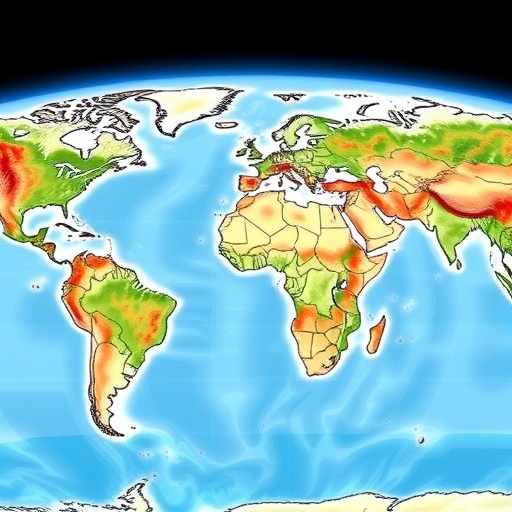
The ocean’s oxygen minimum zones (OMZs) are critical regions shaping marine ecosystems and biogeochemical cycles, yet their dynamics in the face of global change remain enigmatic. A new groundbreaking study led by Dr. Ma Jun and Dr. Song Jinming from the Institute of Oceanology at the Chinese Academy of Sciences sheds unprecedented light on the factors driving OMZs worldwide. The research offers a detailed examination of the oxygen concentration thresholds defining OMZs, their spatial heterogeneity, underlying formation mechanisms, and how their expansion is intricately linked to climate-driven changes in the ocean system. This comprehensive work promises to redefine current understanding and forecasting of hypoxia in the global ocean.
The researchers identify dissolved oxygen (DO) concentration ranges between 20 and 100 micromoles per liter as the defining threshold for OMZs across various marine regions. Notably, the study emphasizes the heterogeneity in both horizontal and vertical distributions of oxygen minimum zones, which differ substantially across ocean basins. These spatial disparities reflect complex interactions between physical, chemical, and biological processes. The team carefully analyzed these patterns to unravel the distinct characteristics particular to different seas, highlighting the importance of regional studies for global assessments.
At the heart of the OMZ formation lie two interwoven core mechanisms. The first is the relentless respiration-driven depletion of oxygen in the ocean interior where organic matter degradation consumes available oxygen. The second mechanism is ocean stratification, which limits vertical mixing and hence the replenishment of oxygen from surface waters. Stratification acts as a physical barrier, trapping low-oxygen waters at intermediate depths and preventing their dilution. These processes combine to establish and sustain the hypoxic conditions characteristic of OMZs.
Beyond formation, OMZ persistence depends on positive feedback loops involving microbial and chemical oxygen consumption. Microbial communities enhance oxygen depletion through increased respiration rates under low-oxygen conditions. Concurrently, anaerobic metabolites generated in hypoxic zones further intensify oxygen demand by facilitating biochemical pathways that consume remaining oxygen. These biological and chemical feedbacks create a self-reinforcing hypoxic state, stabilizing OMZs once established and complicating their breakdown.
The interplay between these biophysical mechanisms and global climate change is accelerating the evolution of OMZs. Rising ocean temperatures contribute directly to the expansion of these zones by several interconnected pathways. Increased temperature lowers the solubility of oxygen in seawater, reducing the maximum oxygen capacity of the ocean. Additionally, warmer temperatures accelerate microbial respiration and organic matter remineralization rates, which in turn intensify oxygen consumption. Ocean warming also strengthens the stratification of the upper ocean, further restricting oxygen ventilation to deeper layers.
Ocean circulation, a primary driver of oxygen transport and distribution, is undergoing profound global modifications due to climate warming. Alterations in thermohaline circulation profoundly influence the ventilation of intermediate waters, which supply oxygen to OMZ regions. Changes in wind-driven circulation and coastal upwelling dynamics also reshape the delivery and removal patterns of hypoxic waters. These circulation shifts modulate not only the formation but the spatial extent and severity of OMZs.
Moreover, mesoscale ocean features such as eddies and vortices introduce additional layers of complexity by locally modulating water column structure and oxygen gradients. Wind stress variability impacts surface mixing and nutrient delivery, indirectly influencing oxygen dynamics in subsurface waters. Freshwater flux from rivers and melting ice alters salinity-driven stratification, changing the physical environment controlling oxygen distribution. These interacting factors underline the multifaceted nature of OMZ regulation.
Addressing future challenges necessitates a refined framework for defining and monitoring OMZs. The authors advocate for establishing gradient thresholds and classification systems that capture the nuanced deoxygenation processes observed worldwide. Such criteria will enable consistent comparisons across regions and time, aiding in the synthesis of long-term trends and variability. Advancing the multidimensional quantification of OMZ spatiotemporal dynamics is essential for anticipating ecological impacts and biogeochemical feedbacks.
In particular, the Western Pacific Ocean, characterized by relatively weaker OMZ intensity but significant sensitivity to climate variability, demands increased scientific focus. Understanding how OMZs develop and shift in this region, which is strongly influenced by global change, will enhance the predictive capacity regarding hypoxia-driven ecosystem responses. Intensified observational campaigns and modeling efforts in this area are critical for filling knowledge gaps.
This study’s implications extend to marine resource management and conservation strategies. Hypoxic conditions adversely affect marine biodiversity, fisheries productivity, and carbon cycling. Accurate depictions of OMZ evolution provide foundational insights for developing mitigation and adaptation policies addressing ocean health under future climate scenarios. Enhanced interdisciplinary cooperation leveraging this new understanding is paramount.
Ultimately, the comprehensive integration of physical, chemical, and biological drivers presented in this research represents a significant stride in oceanographic science’s ability to decode OMZ dynamics under a rapidly changing Earth system. By charting the mechanisms and feedbacks controlling ocean deoxygenation, it lays the groundwork for future explorations that could transform how humanity safeguards oceanic oxygen reserves, ensuring more resilient marine ecosystems.
Continued investment in observational platforms, modeling capabilities, and interdisciplinary research will be essential to unravel remaining complexities concerning OMZ behavior. Only by advancing systematic, high-resolution monitoring and analysis can the global scientific community stay ahead of the evolving challenge posed by ocean deoxygenation. This pivotal research by Dr. Ma Jun and Dr. Song Jinming thus serves as both a benchmark and clarion call in marine sciences, highlighting the urgent need to apprehend and manage the modern oxygen crisis in the oceans.
Cite Scienmag News
Violet Maxwell. (April 10, 2026). Comprehensive Insights into Key Traits and Drivers of Oxygen Minimum Zones Amid Global Change. Scienmag. https://scienmag.com/comprehensive-insights-into-key-traits-and-drivers-of-oxygen-minimum-zones-amid-global-change/
Violet Maxwell. "Comprehensive Insights into Key Traits and Drivers of Oxygen Minimum Zones Amid Global Change." Scienmag, 10 April 2026, https://scienmag.com/comprehensive-insights-into-key-traits-and-drivers-of-oxygen-minimum-zones-amid-global-change/. Accessed 4 September 2026.
Violet Maxwell. "Comprehensive Insights into Key Traits and Drivers of Oxygen Minimum Zones Amid Global Change." Scienmag. April 10, 2026. https://scienmag.com/comprehensive-insights-into-key-traits-and-drivers-of-oxygen-minimum-zones-amid-global-change/


