


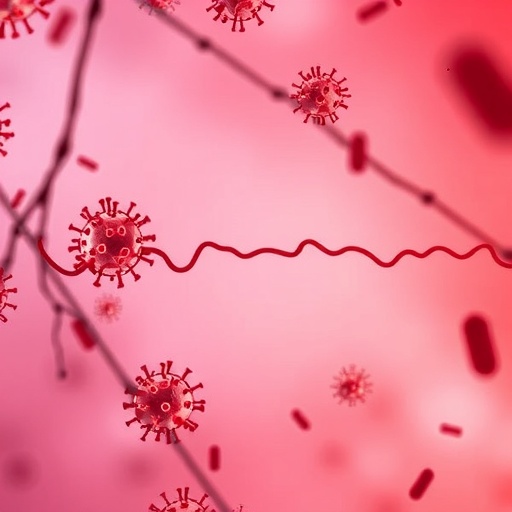
In the ever-evolving microbial battleground, bacteria like Vibrio cholerae face relentless assaults from viruses, or bacteriophages, that seek to invade and disrupt their cellular machinery. To counter these viral threats, bacteria have developed intricate antiviral defense systems encoded within their genomes. Among these, the sedentary chromosomal integron (SCI) in V. cholerae stands out as a genetic marvel, harboring a vast repertoire of gene cassettes—small, mobile DNA units neatly arranged in a linear array reminiscent of a delicate chain of pearls. Each cassette holds the potential to encode proteins that fortify the bacterial immune response, yet intriguingly, only a fraction of these cassettes are actively expressed under typical conditions, with the majority lying dormant deep within the integron’s length.
Researchers have long grappled with the question of how these silent gene cassettes might be mobilized and activated to bolster the bacterium’s defenses. Earlier hypotheses posited that internal reshuffling of the cassette array might bring dormant antiviral genes to the forefront for expression. However, rigorous genetic analyses revealed a conspicuous absence of such rearrangement events within the pandemic lineage of V. cholerae—known as the 7PET lineage—for over six decades. This puzzling finding prompted a fundamental reconsideration of how V. cholerae diversifies its antiviral arsenal and integrates new defensive elements into its genome.
A groundbreaking study helmed by Melanie Blokesch and her team at the Laboratory of Molecular Microbiology at EPFL provides compelling evidence that the diversity and replenishment of SCIs in V. cholerae are achieved not through internal reshuffling but via horizontal gene transfer facilitated by natural competence. The team explored whether V. cholerae could acquire gene cassettes directly from extracellular DNA that pervades aquatic environments—a scenario mimicked in their laboratory using chitin-coated surfaces, which naturally induce competence in V. cholerae. This state enables bacteria to uptake naked DNA fragments from other bacteria and incorporate them into their own genomes.
By exposing competent V. cholerae cells to DNA derived from a variety of strains and related Vibrio species, the researchers meticulously tracked the integration of novel gene cassettes into the first position of the SCI array. This front-loading insertion mode is critical as it positions the cassette for immediate expression, effectively activating new antiviral systems without the need for gene shuffling. The results were striking: V. cholerae demonstrated remarkable efficiency in assimilating foreign DNA fragments, thereby continuously enriching its genomic toolkit with fresh immunity factors.
The ecological implications of this mechanism are profound. In natural aquatic habitats where V. cholerae thrives, DNA is abundantly released into the environment following bacterial cell lysis induced by viral predation, antimicrobial substances, or antagonistic bacterial competition. The uptake of such liberated genetic material by competent V. cholerae cells serves as a dynamic route for immune innovation, enabling bacteria to acquire and express defense genes that have been trialed and tested by their microbial kin. As Blokesch poetically analogizes, this process is akin to receiving a “farewell gift” of collective immunity, empowering recipient bacteria with protections honed over generations.
Notably, the study confirmed that the newly integrated gene cassettes are not merely passive passengers; the encoded defense systems actively confer protection against vibriophages—viruses that specifically infect Vibrio species. This functional validation underscores the adaptive value of competence-mediated gene cassette acquisition, which serves as an evolutionary accelerant for bacterial antiviral defense expansion, circumventing the constraints of slow mutational processes and genomic rearrangements.
Yet, the panorama is not universal across all V. cholerae lineages. The pandemic 7PET lineage was found to harbor a comparatively static SCI, with limited cassette flux. This relative genomic rigidity likely reflects the adaptation of this lineage to the human host environment, where exposure to extracellular DNA and environmental triggers for competence are reduced. The authors propose that under specific environmental encounters, even pandemic strains could rekindle cassette acquisition capabilities, enabling diversification of their defense systems in response to emerging viral threats.
This nuanced understanding of V. cholerae’s defense mechanisms bears significant implications for public health strategies, especially those leveraging phage therapy to curb cholera infections. Evolutionary flexibility stemming from competence-mediated horizontal gene transfer could potentially undermine the long-term efficacy of bacteriophage-based interventions by fostering rapid bacterial adaptation and resistance. Therefore, integrating insights from microbial ecology and evolutionary genetics into therapeutic development is vital to anticipate and mitigate such adaptive responses.
In conclusion, the revelation that natural competence drives the acquisition and activation of antiviral gene cassettes in Vibrio cholerae illuminates a sophisticated layer of microbial survival strategy. It highlights horizontal gene transfer as a cornerstone of bacterial immunity diversification, reshaping our conceptual frameworks of microbial evolution and offering new angles to confront infectious diseases. This study not only deepens our grasp of microbial genomic plasticity but also informs future directions in antimicrobial intervention and ecosystem-level pathogen management.
News Publication Date:
9-Apr-2026
Web References:
DOI: 10.1126/science.aed0645
References:
Laurie Righi, Sandrine Stutzmann, Loriane Bader, Alexandre Lemopoulos, Melanie Blokesch. Competence-mediated DNA uptake diversifies Vibrio cholerae sedentary chromosomal integrons. Science, 09 April 2026.
Cite Scienmag News
Juliet Wilcox. (April 9, 2026). How Cholera Bacteria Exchange Viral Defense Mechanisms. Scienmag. https://scienmag.com/how-cholera-bacteria-exchange-viral-defense-mechanisms/
Juliet Wilcox. "How Cholera Bacteria Exchange Viral Defense Mechanisms." Scienmag, 9 April 2026, https://scienmag.com/how-cholera-bacteria-exchange-viral-defense-mechanisms/. Accessed 3 September 2026.
Juliet Wilcox. "How Cholera Bacteria Exchange Viral Defense Mechanisms." Scienmag. April 9, 2026. https://scienmag.com/how-cholera-bacteria-exchange-viral-defense-mechanisms/


