


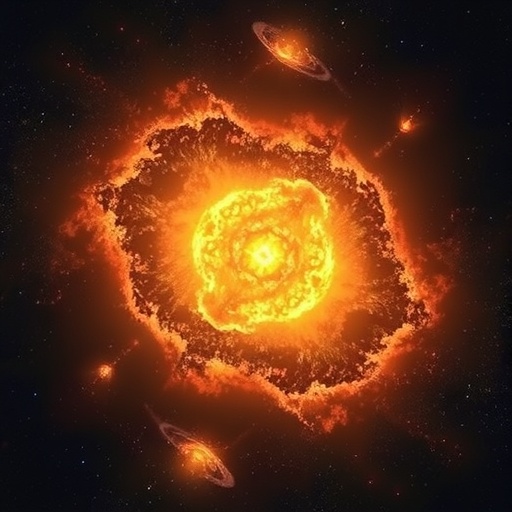
In a groundbreaking discovery nestled in the distant outskirts of our Milky Way galaxy, astronomers have identified the most metal-poor star ever recorded, a celestial relic that offers a rare glimpse into the universe’s earliest epochs. Located near the Large Magellanic Cloud, a neighboring satellite galaxy, the star named SDSS J0715-7334 is a chemical time capsule, composed almost entirely of hydrogen and helium with minuscule traces of heavier elements. This remarkable find, unveiled through the Sloan Digital Sky Survey, promises to shed light on the elusive Population III stars—the first generation of stars birthed after the Big Bang—whose existence until now has been theoretical rather than observed.
Population III stars are thought to have formed from pristine hydrogen and helium gas, untouched by the heavier elements forged in subsequent stellar generations. These early stars are believed to have evolved rapidly, ending their lives in powerful supernovae, but none have been directly observed due to their immense distances and ephemeral lifespans. SDSS J0715-7334, while not a primordial Population III star itself, closely mimics the chemical signature astronomers expect from stars influenced by them, making it an unparalleled proxy for exploring the dawn of stardom in the cosmos.
The newly studied star’s composition is astonishingly sparse in metals—defined in astronomy as any element heavier than helium—registering at less than 0.005% of the Sun’s metallicity. This chemical profile denotes that SDSS J0715-7334 likely emerged from a gas cloud that had been recently contaminated by the supernova debris of a massive Population III progenitor star. By carefully analyzing the ratios of carbon, iron, and other trace elements within SDSS J0715-7334, researchers can reconstruct the mass and explosive energy of the Population III star that seeded its birth cloud. This reverse-engineering approach provides an unprecedented window into the properties and behaviors of the very first stars.
Observations were carried out using the Magellan Clay Telescope equipped with the high-resolution Magellan Inamori Kyocera Echelle spectrograph, tools capable of parsing the faintest spectral fingerprints emitted by this ancient star. These data confirm that SDSS J0715-7334’s atmosphere is overwhelmingly dominated by hydrogen and helium, with only the most negligible proportions of carbon and iron, underscoring its ultra-metal-poor status. The implications are profound: the progenitor Population III star was likely among the most massive of its kind, ending its life in a supernova of exceptional intensity, dispersing the nascent heavier elements into the cosmos.
Positioned approximately 80,000 light-years from Earth, SDSS J0715-7334 resides in a dynamic galactic neighborhood near the Large Magellanic Cloud. This dwarf galaxy, one of a host of smaller satellite galaxies orbiting the Milky Way, offers a unique environment for the formation and preservation of ancient, low-metallicity stars. Having recently entered the gravitational influence of the Milky Way itself, the Magellanic Clouds have long histories of relative isolation, enabling them to accumulate and process primordial intergalactic gas over extended timeframes—conditions favoring the creation of ultra-metal-poor stars like SDSS J0715-7334.
The presence of stars such as SDSS J0715-7334 in these satellite galaxies raises exciting prospects about where astronomers might most effectively search for relics of the early universe. According to astrophysicist Kevin Schlaufman of Johns Hopkins University, who initially flagged the star’s significance in 2014, the Magellanic Clouds may harbor a higher abundance of such chemically primitive stars compared to our own galactic plane. This hypothesis is driving renewed interest in focused surveys around satellite systems, seeking to map the distribution of these stellar fossils in the nearby universe.
This discovery is far more than a curiosity. It profoundly deepens our understanding of how the first stars influenced subsequent generations and the broader galactic ecosystems. By studying stars formed from gas clouds enriched by Population III supernovae, astronomers piece together the chemical and energetic footprints left behind by these ancient explosions, which in turn shaped galaxy formation, star formation, and the chemical evolution of the universe on grand scales. As such, SDSS J0715-7334 is not just an astronomical oddity; it is a vital clue in decoding cosmic history.
The Sloan Digital Sky Survey’s ongoing exploration represents one of the most ambitious initiatives in modern astrophysics, systematically charting the structure and composition of stars within and beyond our galaxy. With SDSS J0715-7334 as a milestone, the survey’s fifth phase highlights the ever-expanding capabilities of modern telescopes and spectrographs. This synergy between observational precision and theoretical modeling enables scientists to venture ever closer to witnessing the conditions of the universe shortly after the Big Bang.
The stellar team behind this research comprises experts from leading institutions worldwide—including the University of Chicago, the Max Planck Institute for Astronomy, Johns Hopkins University, and many others—who collectively harnessed data from multiple telescopes and advanced spectrographic technologies. Their collaborative efforts underscore the global nature of astrophysics and the importance of international investment in understanding our cosmic origins.
Despite this significant advance, much about the universe’s formative years remains shrouded in mystery. Questions linger over the exact mass distribution of Population III stars, the frequency of different types of early supernovae, and how these first cosmic furnaces influenced the fabric of galaxy formation and the reionization epoch. Researchers urge caution, acknowledging that the discovery of SDSS J0715-7334 is but a first step—a catalyst urging deeper surveys and more refined models to unravel the universe’s earliest chapters fully.
As the Sloan Digital Sky Survey continues to probe deeper into the Milky Way and its environs, astronomers are optimistic that more such ancient relics will come to light, each providing incremental clues to the primordial cosmos. Investigations into stars like SDSS J0715-7334 not only refine astrophysical models of star formation and chemical evolution but also illuminate the grand narrative of how matter evolved from simple hydrogen and helium to the richly diverse universe that hosts planets, life, and conscious observers.
“Understanding what transpired in those earliest epochs is critical to our grasp of cosmic history,” said Schlaufman. “This discovery is a landmark, but it also reminds us how much we have yet to learn about the universe’s first stars and the forces that shaped them.” As researchers expand their search through the phases of the Sloan Digital Sky Survey and beyond, the discovery of SDSS J0715-7334 stands as a beacon guiding astronomers toward unlocking the deepest mysteries of star birth and galactic evolution.
News Publication Date: 3-Apr-2026
Web References:
Keywords
Population III stars, ultra-metal-poor star, SDSS J0715-7334, Large Magellanic Cloud, early universe, stellar archaeology, Sloan Digital Sky Survey, cosmic chemical evolution, galactic formation, astrophysics, supernova remnants, primordial stars
Cite Scienmag News
Grant Pearson. (April 8, 2026). Astronomers Discover the Most Ancient Star Ever Recorded. Scienmag. https://scienmag.com/astronomers-discover-the-most-ancient-star-ever-recorded/
Grant Pearson. "Astronomers Discover the Most Ancient Star Ever Recorded." Scienmag, 8 April 2026, https://scienmag.com/astronomers-discover-the-most-ancient-star-ever-recorded/. Accessed 3 September 2026.
Grant Pearson. "Astronomers Discover the Most Ancient Star Ever Recorded." Scienmag. April 8, 2026. https://scienmag.com/astronomers-discover-the-most-ancient-star-ever-recorded/


