


Freestanding oxide membranes have rapidly garnered attention as a transformative component in next-generation electronic devices, flexible sensors, and multifunctional oxide-based platforms. These ultrathin, single-crystalline oxide films offer a unique avenue for integrating the robust physical properties of complex oxides with unprecedented mechanical flexibility and compatibility with heterogeneous substrates. By detaching these membranes from rigid growth substrates, manufacturers can exploit new opportunities in device engineering, paving the way for flexible electronics with enhanced functionalities and adaptability.
Despite the promising technological outlook, the fabrication and handling of freestanding oxide membranes present critical challenges. Particularly, the processes involved in membrane release and transfer often introduce structural defects such as microcracks, wrinkles, and bulges. These imperfections, while sometimes invisible under low-magnification optical microscopy, significantly impact the local electrical transport properties, strain distribution, and overall device reliability. The presence of such defects undermines device performance and longevity, necessitating highly sensitive and efficient inspection methods to ensure material integrity.
Answering this critical need, a pioneering collaborative study led by researchers at the University of Science and Technology of China, including Prof. Lingfei Wang, Prof. Wenbin Wu, and Prof. Dazhi Hou, has developed an innovative lock-in thermography (LIT) technique for rapid and high-throughput mapping of microscopic structural imperfections in freestanding oxide membranes. Published in Science Bulletin, this work offers a leap forward in non-destructive, quantitative defect characterization over millimeter-scale areas with exceptional sensitivity.
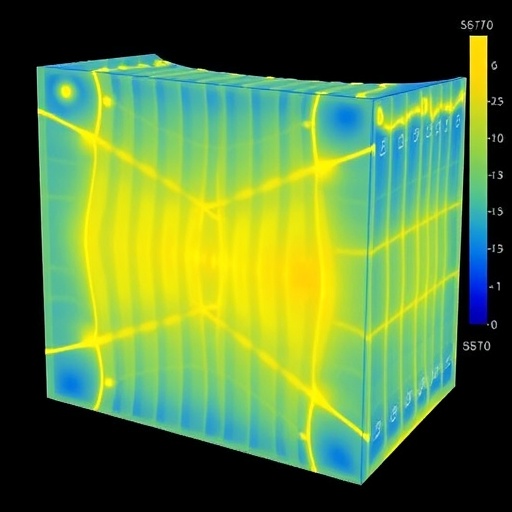
The LIT method fundamentally relies on the injection of a time-modulated, square-wave electrical current into a conductive oxide membrane. As this current traverses the membrane, localized Joule heating occurs, resulting in measurable temperature oscillations. Utilizing an infrared camera synchronized with the current modulation, spatially resolved temperature amplitude and phase information are obtained. Structural anomalies such as cracks or wrinkles perturb local current flow, altering Joule heating patterns and creating distinctive thermal signatures that serve as reliable indicators of otherwise concealed defects.
In demonstrating the technique’s efficacy, the researchers examined various freestanding oxide membranes exemplified by conductive perovskite oxides such as SrRuO₃, La₂/₃Sr₁/₃MnO₃, and high-temperature superconducting YBa₂Cu₃O₇−δ. Their investigations revealed that different defect types produce unique thermographic patterns: microcracks induce butterfly-shaped thermal anomalies due to current blocking and crowding effects near crack tips, whereas wrinkles manifest as stripe-like contrast related to strain-induced resistivity modulation. These characteristic signatures enable not only detection but also classification of defect morphology.
To deepen understanding, the team combined LIT imaging data with finite-element modeling, allowing correlation of thermal features with physical parameters such as crack length, orientation, and wrinkle topography. This comprehensive approach facilitated the quantification of defect dimensions with unprecedented accuracy. Importantly, LIT was capable of resolving crack-related thermal disturbances even when optical microscopy failed to discern physical openings, underscoring its superior sensitivity.
Compared to conventional optical or electron microscopy techniques, lock-in thermography offers several practical advantages. It enables rapid, non-contact wide-field inspection over millimeter-scale regions with modest infrared optical magnification. This significantly accelerates defect screening, as typical imaging of a target area can be completed in mere tens of seconds following electrode fabrication. Consequently, LIT promises to streamline quality control and process optimization workflows in the manufacturing of freestanding oxide films and devices.
The scope of this technique extends beyond inherently conductive membranes. The researchers explored its feasibility on insulating oxide membranes by depositing ultrathin conductive silver capping layers onto SrTiO₃ membranes. Remarkably, crack-related thermal contrasts successfully manifested through the silver layer, indicating that the approach may be adapted for qualitative defect inspection in insulating systems, broadening the method’s applicability across diverse material platforms.
This advancement in nondestructive defect visualization offers a compelling toolset for researchers and engineers aiming to elevate the performance, reliability, and fabrication yield of flexible oxide electronics. By enabling high-resolution thermal imaging correlated to electrical and mechanical membrane integrity, LIT empowers systematic investigations into failure mechanisms, process-induced damage, and materials’ nanoscale heterogeneity, thereby guiding innovations in device architectures.
As the field of flexible and multifunctional oxide electronics continues to expand, such scalable diagnostic techniques will be indispensable. The demonstrated lock-in thermography approach can catalyze the development of large-area flexible electronic arrays, high-throughput screening protocols, and real-time process monitoring, facilitating the transition from laboratory-scale prototypes to commercially viable, robust oxide devices adaptable to bending, stretching, and unconventional form factors.
The integration of thermal-based sensing into characterization toolkits represents a paradigm shift, harnessing fundamental electothermal interactions to reveal inconspicuous structural defects with clarity and speed. This study charts a promising course for future research endeavors, where combining precision imaging with computational modeling will unlock deeper insights into the complex interplay between microstructure and device performance in freestanding oxide membranes.
In summary, the introduction of lock-in thermography for assessing structural defects in freestanding oxide membranes marks a significant milestone for flexible oxide electronics. This method delivers a sensitive, high-throughput, and easy-to-implement solution for mapping microcracks and wrinkles, overcoming the limitations of traditional microscopy and accelerating quality assurance practices. Its ability to extend across conductive and insulating membranes further amplifies its potential impact, offering a versatile diagnosis tool that aligns seamlessly with the evolving demands of next-generation oxide-device fabrication and integration.
Web References: DOI: 10.1016/j.scib.2026.05.038
Keywords
Freestanding oxide membranes, lock-in thermography, microcracks, wrinkles, Joule heating, thermal imaging, flexible electronics, nondestructive defect detection, perovskite oxides, SrRuO₃, La₂/₃Sr₁/₃MnO₃, YBa₂Cu₃O₇−δ, SrTiO₃, finite-element simulation, infrared camera, structural characterization
Cite Scienmag News
Bethany Barker. (June 8, 2026). Thermal Imaging Uncovers Hidden Flaws in Freestanding Oxide Membranes. Scienmag. https://scienmag.com/thermal-imaging-uncovers-hidden-flaws-in-freestanding-oxide-membranes/
Bethany Barker. "Thermal Imaging Uncovers Hidden Flaws in Freestanding Oxide Membranes." Scienmag, 8 June 2026, https://scienmag.com/thermal-imaging-uncovers-hidden-flaws-in-freestanding-oxide-membranes/. Accessed 4 September 2026.
Bethany Barker. "Thermal Imaging Uncovers Hidden Flaws in Freestanding Oxide Membranes." Scienmag. June 8, 2026. https://scienmag.com/thermal-imaging-uncovers-hidden-flaws-in-freestanding-oxide-membranes/


