

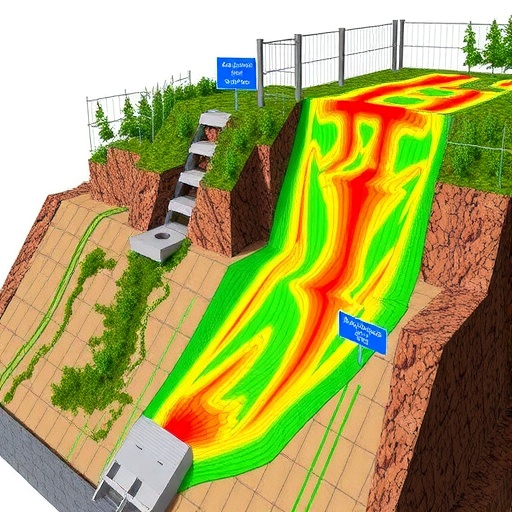
In a groundbreaking advancement at the intersection of civil engineering and seismology, new research spearheaded by Y. Wang offers profound insights into the dynamic stability of slope stabilization structures subjected to seismic forces. This investigation, published in Scientific Reports in 2026, delves deeply into the numerical evaluation of an integrated slope stabilization system, unraveling complex interactions under earthquake-induced stress that have long challenged engineers and disaster mitigation professionals worldwide.
Slope failures triggered by seismic events pose significant threats to human lives, infrastructure, and the environment, particularly in geologically unstable and seismically active regions. Traditional methods of slope stabilization often rely on empirical approaches or static analyses, which fall short when predicting structural performance during earthquakes. Wang’s work stands out by adopting a sophisticated numerical methodology that simulates realistic seismic effects, thereby shedding light on the nuanced mechanical behaviors of integrated stabilization structures during such catastrophic incidents.
The study centers on a composite slope stabilization system designed to synergize multiple reinforcement techniques—such as retaining walls, soil nails, and geosynthetic layers—into a unified structure. By employing advanced finite element modeling enhanced with dynamic loading parameters obtained from real seismic records, the research captures the transient response of the slope under realistic earthquake scenarios. This holistic approach enables a comprehensive understanding of failure mechanisms, deformation patterns, and energy dissipation within the structure.
One pivotal aspect of Wang’s research is the meticulous calibration of the numerical model against empirical data derived from laboratory shaking tables and field case studies. This calibration ensures high fidelity between predictions and actual behaviors, lending credibility and applicability to the findings. The model accounts for soil heterogeneity, non-linear material properties, and time-dependent effects, enabling precise simulation of the intricate soil-structure interaction phenomena under seismic duress.
The results reveal several critical behaviors. First, the integrated stabilization approach significantly enhances the slope’s resilience to seismic loading compared to isolated reinforcement methods. The cooperative action among structural components distributes stress concentrations more evenly, mitigating localized failures. Second, the nonlinear dynamic analysis exposes a delay in failure onset during strong shaking, suggesting that the integrated system can absorb and dissipate seismic energy more effectively than previously anticipated.
Moreover, the study elucidates the role of key design variables, such as the stiffness and placement of support elements, in controlling slope stability during seismic events. Variations in these parameters dramatically influence deformation modes and failure surfaces, emphasizing the need for tailored engineering solutions adapted to site-specific seismic hazards. Wang’s findings advocate for design strategies that optimize these variables to maximize structural performance and safety.
Intriguingly, the investigation uncovers the influence of seismic wave characteristics—frequency content, amplitude, and duration—on slope response. Certain frequency ranges exacerbate resonant vibrations within the stabilization system, heightening the risk of failure. This insight opens new research avenues focusing on seismic wave tailoring through geo-engineering measures or the incorporation of damping technologies to shield slopes from damaging vibrations.
The advancements pioneered in this research carry vast implications for disaster risk reduction. Implementing integrated slope stabilization systems built upon Wang’s numerical framework can enhance the safety of critical infrastructure such as highways, pipelines, and urban developments in earthquake-prone regions. The proactive mitigation of slope failures spurred by this work promises to reduce economic losses and save lives by preventing landslides and related secondary disasters.
Additionally, the integration of realistic seismic inputs into slope stability analysis heralds a paradigm shift in geotechnical engineering. It elevates the standard of safety assessments by moving beyond static or quasi-static criteria toward dynamic, scenario-based evaluations that replicate actual earthquake behaviors. This transition is vital as global urbanization orients more populations and infrastructure toward unstable slopes where seismic hazards are prevalent.
Wang’s approach also underscores the importance of interdisciplinary collaboration, blending geotechnical engineering, computational mechanics, and earthquake seismology principles. The synergy created by this fusion empowers more robust predictive capabilities and innovative structural solutions that can withstand nature’s unpredictability. Such holistic studies are urgently needed to build resilient communities prepared for future seismic events.
Despite the promising outcomes, the research invites further exploration. Extending the numerical framework to accommodate multi-hazard scenarios such as concurrent seismic and heavy rainfall events could yield insights into compounded slope failure mechanisms. Similarly, integrating real-time monitoring data with predictive models may enable adaptive stabilization strategies that evolve based on ongoing seismic risk assessments.
In conclusion, Y. Wang’s 2026 study marks a landmark contribution to the field of slope stabilization under seismic influence. By harnessing cutting-edge numerical evaluation techniques to simulate complex dynamic soil-structure interactions, this work paves the way for smarter, safer, and more durable slope management solutions worldwide. Its influence will resonate across academic, engineering, and regulatory domains as societies strive to mitigate seismic hazards and protect critical infrastructure from devastating landslides.
Future infrastructure projects situated in seismically active regions will undoubtedly benefit from the design prescriptions illuminated in this research. Customizing integrated stabilization systems that incorporate multicomponent synergy, dynamic response optimization, and seismic wave mitigation strategies will set a new standard in geotechnical engineering excellence. Wang’s findings empower engineers with the knowledge required to anticipate seismic impacts more accurately and to engineer slopes capable of enduring nature’s harshest tests.
Ultimately, the integration of such sophisticated numerical evaluations into the routine design and assessment processes offers a transformative path forward. It signifies a shift from reactive, post-disaster measures toward proactive resilience-building frameworks fortified by computational advancements. As seismic risk escalates globally due to population growth and climate change-induced geological disturbances, such innovations will become cornerstone contributions to safety, sustainability, and disaster preparedness initiatives for decades to come.
Cite this news
SCIENMAG. (April 5, 2026). Seismic Impact on Integrated Slope Stabilization: Numerical Study. https://scienmag.com/seismic-impact-on-integrated-slope-stabilization-numerical-study/
SCIENMAG. "Seismic Impact on Integrated Slope Stabilization: Numerical Study." Scienmag, 5 April 2026, https://scienmag.com/seismic-impact-on-integrated-slope-stabilization-numerical-study/. Accessed 27 August 2026.
SCIENMAG. "Seismic Impact on Integrated Slope Stabilization: Numerical Study." Scienmag. April 5, 2026. https://scienmag.com/seismic-impact-on-integrated-slope-stabilization-numerical-study/


