


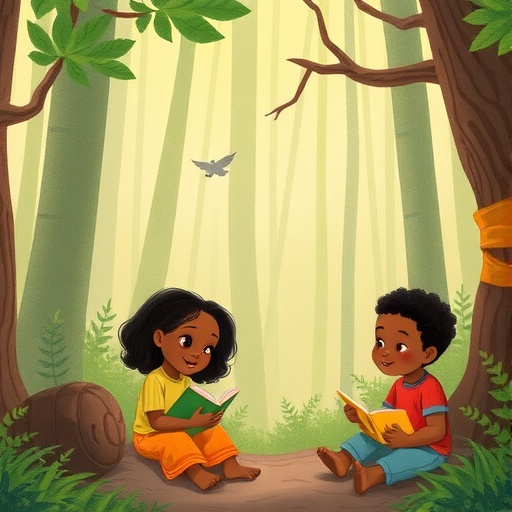
A new analysis of children’s outdoor picturebooks is challenging one of the most familiar assumptions in nature writing for young readers: that the woods, rivers and mountains are automatically spaces where everyone belongs. By examining award-winning and honored titles from the National Outdoor Book Awards between 1997 and 2024, researchers found a powerful cultural question hiding inside stories about hiking, wildlife and adventure—who gets to be seen as an outdoor person in the first place?
The study, published in the Early Childhood Education Journal, focuses on the children’s literature category of the National Outdoor Book Awards, commonly known as NOBA. Its authors argue that picturebooks do more than introduce children to plants, animals or landscapes. Through characters, illustrations, dialogue and plot, they also communicate social ideas about identity, ability, family life, wealth and access. A book may show a child exploring a forest, for example, while simultaneously suggesting—intentionally or not—which bodies, communities and experiences are considered natural participants in outdoor life.
Ashley Farris, Courtney Shimek, Andrew Bobilya, Paul Stonehouse and Jennifer Stone used a critical content analysis to examine these patterns. This approach differs from simply counting how many boys, girls or characters from particular racial groups appear in a set of books. Critical content analysis also asks how characters are positioned, what roles they are given, whose knowledge is treated as authoritative and which possibilities remain absent. It treats stories as cultural artifacts that can reflect existing social structures while helping to reproduce or question them.
The researchers concentrated on representations of race, gender, class, ability and outdoor participation. These categories are not isolated variables. A child’s experience of nature can be shaped by several identities at once, a relationship researchers describe as intersectional. A Black girl with a disability, for instance, may encounter different assumptions about safety, independence and belonging than a white, nondisabled boy, even if both appear in the same landscape. An intersectional reading therefore looks for overlapping patterns rather than treating diversity as a series of separate checkboxes.
That distinction matters because outdoor recreation has often been presented as a universal good while access to it remains uneven. Transportation, money, neighborhood design, equipment, cultural expectations and physical accessibility can all influence whether families spend time in natural spaces. Social histories also matter: public landscapes may carry memories of exclusion, surveillance or danger for some communities. When children’s books repeatedly portray outdoor adventure through a narrow social lens, they can make that lens seem like a neutral picture of reality rather than one version of it.
Picturebooks are especially influential because young readers absorb meaning from both words and images. In the technical language of children’s-literature research, the relationship between text and illustration is multimodal: meaning emerges from the interaction of written language, composition, color, perspective, facial expression and the placement of bodies within a scene. A caption might describe cooperation while an image assigns leadership to one character and passive observation to another. A book might celebrate nature as open to all while depicting only one kind of family, body or economic life moving comfortably through it.
The study’s title, “Everyone Outside,” captures the tension at the center of the analysis. Outdoor-themed literature is increasingly being asked to support diversity, equity, inclusion and belonging, yet the field has long been shaped by a dominant narrative. That narrative can portray nature as a pristine refuge visited by confident individual adventurers, often leaving out the practical barriers and collective traditions that shape how different communities experience the outdoors. The researchers’ goal is not to dismiss stories of exploration, but to widen the range of stories children encounter.
Award recognition gives those stories an additional layer of influence. Books selected for prizes and honors can become more visible to families, libraries, teachers and early-childhood classrooms. Awards act as cultural filters: they signal which works deserve attention and can help determine what is stocked, read aloud and remembered. A critical examination of award lists therefore asks not only what individual books contain, but also what a literary institution presents as exemplary outdoor literature.
The authors connect their analysis to a broader concern in early education: representation can shape children’s perceptions of belonging, identity and possibility. Books cannot by themselves remove the structural barriers that limit access to parks, camps, trails or waterways. They can, however, influence the mental map children carry into those spaces. Seeing characters who resemble them taking part in discovery may help children imagine themselves as observers, caretakers, scientists, leaders or adventurers. Encountering only a narrow cast of outdoor participants can send the opposite message, even when no exclusion is stated directly.
The researchers describe their work as part of an effort to support a more equitable outdoor community through the continued creation of inclusive narratives. Their findings do not suggest that a single book must represent every identity or resolve every question of access. Rather, the analysis encourages educators, publishers, authors, illustrators and award organizations to consider the cumulative effect of the books placed before children. A diverse shelf is not merely a collection of different faces; it is a collection of different relationships to land, knowledge, family, risk, play and responsibility.
That broader definition of inclusion is crucial. Diversity can be superficial if characters from underrepresented groups appear only at the edges of a story, lack agency or are used to teach a lesson to a more central character. Meaningful representation involves narrative presence and narrative power: who initiates action, who interprets the natural world, who solves problems, who receives care and who is allowed to be complex. It also includes the visual design of bodies and environments, from mobility devices and adaptive equipment to clothing, housing and transportation.
The analysis arrives as outdoor education and environmental organizations increasingly confront the social dimensions of nature access. Research cited by the authors has documented inequalities in contact with nature and examined how race, class and gender shape outdoor recreation. Other scholarship has explored the limited diversity of children’s literature and the ways award-winning nonfiction can present a restricted social world. By placing outdoor picturebooks within that research landscape, the new study treats children’s environmental reading not as a side issue, but as part of the formation of environmental citizenship.
There is also a scientific reason to take these stories seriously. Human relationships with nature are learned through repeated experience, and books can help organize that experience before children have the freedom to explore widely on their own. They introduce species, landscapes and ecological processes, but they also establish expectations about who is competent outdoors and what kinds of behavior count as legitimate. Those expectations can affect motivation and self-efficacy—the belief that one can act successfully in a given setting—which are important to participation in outdoor learning.
For teachers and caregivers, the study offers a way to make reading more analytical without stripping books of their pleasure. Children can be invited to notice who appears in an illustration, who speaks, who is missing and how the landscape is being used. They can compare several books about the same environment and ask whether the characters have different ways of knowing it. Such questions turn picturebook reading into a form of evidence-based cultural observation, allowing young readers to recognize that stories are constructed and that alternative stories are possible.
The researchers ultimately point toward an outdoor literature landscape in which every child can see a credible place for themselves beneath the open sky. That ambition extends beyond adding more inclusive characters. It calls for stories that portray many forms of expertise, different family structures, varied bodies and abilities, urban as well as rural relationships with nature, and outdoor experiences shaped by cooperation rather than solitary conquest. As the award-winning canon continues to evolve, the books children open may help determine whether the natural world feels like someone else’s territory—or a shared home.
Cite Scienmag News
Courtney Benton. (August 27, 2026). Study Analyzes Diversity in Children’s Literature Honored by National Outdoor Book Awards. Scienmag. https://scienmag.com/study-analyzes-diversity-in-childrens-literature-honored-by-national-outdoor-book-awards/
Courtney Benton. "Study Analyzes Diversity in Children’s Literature Honored by National Outdoor Book Awards." Scienmag, 27 August 2026, https://scienmag.com/study-analyzes-diversity-in-childrens-literature-honored-by-national-outdoor-book-awards/. Accessed 4 September 2026.
Courtney Benton. "Study Analyzes Diversity in Children’s Literature Honored by National Outdoor Book Awards." Scienmag. August 27, 2026. https://scienmag.com/study-analyzes-diversity-in-childrens-literature-honored-by-national-outdoor-book-awards/


