


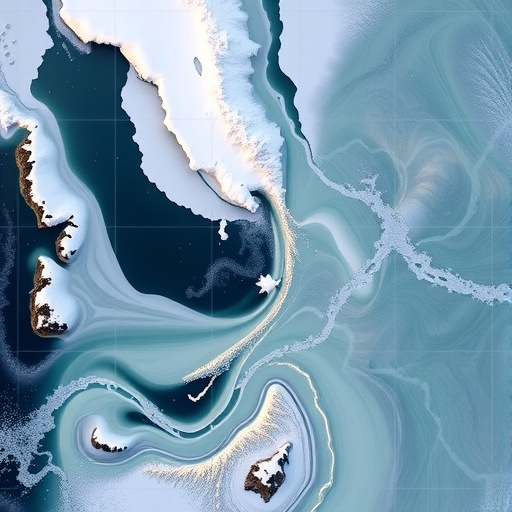
In a groundbreaking study poised to reshape our understanding of Antarctic ice sheet dynamics, researchers have unearthed the complex interplay between atmospheric river phenomena and föhn winds in driving unprecedented melting over the Larsen C Ice Shelf. Larsen C, one of Antarctica’s largest ice shelves, has long been a focal point for glaciologists due to its sensitivity to climatic variations and potential to contribute significantly to global sea-level rise. The new findings elucidate how the morphology and trajectory of atmospheric rivers critically modulate föhn-induced melting processes, underscoring multifaceted atmospheric controls over ice shelf stability.
Föhn winds, warm and dry downslope winds occurring on the lee side of mountain ranges, have historically been recognized as catalysts for localized, rapid surface melting on Antarctic ice shelves. However, the nuanced mechanisms by which föhn events amplify or attenuate melting, particularly in conjunction with large-scale atmospheric phenomena, remained elusive. The study highlights that atmospheric rivers—narrow corridors of concentrated water vapor transport from the tropics to polar latitudes—play an instrumental role in shaping the intensity and spatial distribution of föhn-induced melt.
Atmospheric rivers are remarkable hydrometeorological features that deliver copious amounts of moisture and energy into polar regions. As these atmospheric rivers encounter the Antarctic Peninsula’s formidable orography, their moisture-laden air masses are forced upslope, where condensation and precipitation occur. Subsequently, the leeward descents spawn föhn winds characterized by sharply elevated temperatures and reduced humidity, which can cause surface melting of the ice shelf. Crucially, the study reveals that variations in the shape, orientation, and landfall location of these atmospheric rivers strongly influence the strength and persistence of föhn winds.
The researchers employed advanced remote sensing technologies, coupled with in-situ observations and high-resolution atmospheric modeling, to dissect these interactions with unprecedented granularity. Their comprehensive analysis demonstrated that atmospheric rivers with a more elongated shape directed along the Antarctic Peninsula generated more sustained föhn events, engendering extensive melting over Larsen C. Conversely, atmospheric rivers arriving with more variable orientations or landfalling further south exhibited diminished föhn activity, thus mitigating melt impact.
This sensitivity to atmospheric river morphology pinpoints a critical atmospheric control mechanism previously underappreciated in ice shelf mass balance assessments. The study’s sophisticated climate models incorporated dynamic water vapor fluxes and thermodynamic feedbacks, enabling an accurate representation of föhn-induced boundary layer conditions. Such modeling is pivotal as it transcends simplistic temperature-based melt estimations, capturing the thermodynamic complexity inherent to these mesoscale atmospheric events.
The findings further indicate that shifts in large-scale atmospheric circulation patterns, potentially driven by ongoing climate change, could alter the frequency and pathways of atmospheric rivers reaching Antarctica. This climatological variability could thus amplify or reduce föhn-induced melting episodes over Larsen C in coming decades. The study suggests that an increase in elongated, direct atmospheric river incursions could accelerate surface melting, heightening the risk of ice shelf destabilization.
Larsen C’s susceptibility to these intersecting atmospheric processes carries profound implications for sea-level projections. Ice shelf thinning and retreat can precipitate the acceleration of grounded glaciers feeding the shelf, thereby augmenting ice discharge into the ocean. This feedback loop could contribute substantially to global sea-level rise, especially if similar föhn-atmospheric river interactions occur across other vulnerable sections of Antarctic ice shelves.
Importantly, the research underscores the necessity of integrating high-resolution atmospheric process understanding into ice sheet models. Capturing föhn wind events and their modulation by atmospheric rivers allows for more precise simulation of meltwater production, which influences ice structural integrity and potential hydrofracture processes—key factors in catastrophic ice shelf collapse scenarios. The enhanced predictive capacity born from this integration equips scientists and policymakers with vital tools to anticipate and mitigate future climatic impacts.
The interdisciplinary nature of the study, combining atmospheric science, glaciology, and climate modeling, exemplifies the collaborative approach required for unraveling Earth’s complex cryosphere dynamics. Moreover, the implementation of novel observational platforms—such as UAVs equipped with meteorological instruments and satellite-borne spectrometers—enabled a holistic examination of surface and atmospheric conditions influencing melt rates.
Intriguingly, the study also notes that atmospheric river characteristics—such as width and moisture content—may evolve with rising global temperatures, thereby altering föhn wind dynamics in ways that remain challenging to predict. This adds layers of uncertainty to future projections but equally emphasizes the critical need for sustained monitoring and model refinement.
Beyond Antarctica, the elucidation of föhn and atmospheric river interactions offers broader insights for other mountainous polar and subpolar regions where similar phenomena influence cryospheric and hydrological cycles. Understanding these mechanisms across diverse contexts promotes a more cohesive picture of how localized atmospheric processes can propagate significant climate feedback.
As the climate system evolves, the identification of atmospheric rivers as modulators of föhn-induced melting advances our comprehension of atmospheric-ice interactions and the vulnerabilities of polar ice masses. These insights provide a crucial framework for interpreting observed melting patterns and anticipating potential thresholds beyond which irreversible ice shelf degradation could occur.
Future research avenues highlighted by the study include probing the seasonal variability of atmospheric river trajectories and their coupling with föhn events, as well as the integration of ocean-atmosphere feedback mechanisms influencing ice shelf basal melting in tandem with surface melt. Comprehensively addressing these components will be instrumental in refining Antarctic ice mass loss estimates and global sea-level rise scenarios.
In the era of escalating climatic uncertainties, this study represents a pivotal stride toward unraveling the interconnected atmospheric controls over ice shelf melt, emphasizing that even subtle shifts in atmospheric river behavior can cascade into profound cryospheric consequences. The implications reverberate not only through polar science but also resonate globally as nations grapple with the multifaceted challenges posed by changing sea levels.
By advancing predictive capabilities and fostering an enriched understanding of polar weather extremes and their impacts, the research sets a new standard for integrating atmospheric physics into glaciological frameworks. As the planetary climate continues its tumultuous course, such integrative studies become invaluable in charting humanity’s adaptive responses and resilience strategies.
In summary, the intricate dance between atmospheric rivers and föhn winds emerges as a critical determinant of Larsen C Ice Shelf melt dynamics, offering fresh perspectives on polar climate interactions. This revelation underscores the imperative of sustained scientific inquiry into atmospheric drivers of cryospheric change and elevates the discourse surrounding Antarctic ice shelf vulnerability within the global climate arena.
Cite Scienmag News
Russell Cooper. (April 3, 2026). Föhn Melting on Larsen C Shaped by Atmospheric Rivers. Scienmag. https://scienmag.com/fohn-melting-on-larsen-c-shaped-by-atmospheric-rivers/
Russell Cooper. "Föhn Melting on Larsen C Shaped by Atmospheric Rivers." Scienmag, 3 April 2026, https://scienmag.com/fohn-melting-on-larsen-c-shaped-by-atmospheric-rivers/. Accessed 4 September 2026.
Russell Cooper. "Föhn Melting on Larsen C Shaped by Atmospheric Rivers." Scienmag. April 3, 2026. https://scienmag.com/fohn-melting-on-larsen-c-shaped-by-atmospheric-rivers/


