


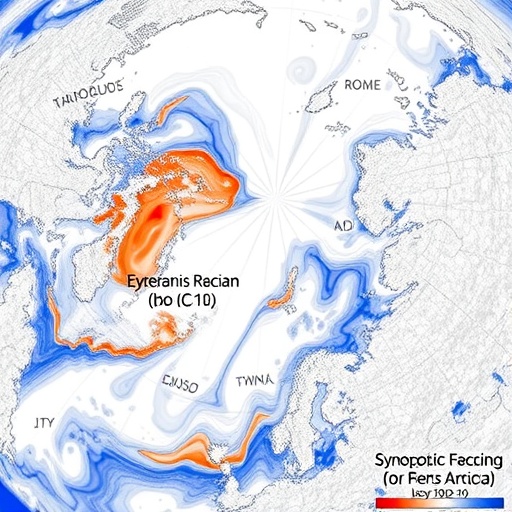
In a groundbreaking study published in Communications Earth & Environment (2026), researchers Liu, Müller, Shu, and colleagues have unveiled compelling new evidence of pronounced ocean thermal variability in the Eastern Eurasian Arctic. This variability, the team reports, is tightly linked to synoptic-scale atmospheric forcing, a phenomenon that profoundly alters the thermal landscape of one of the most climatically sensitive and rapidly changing regions on Earth. As climate change accelerates, understanding these dynamic ocean-atmosphere interactions becomes ever more crucial, particularly in the context of Arctic amplification and its global implications.
The Arctic Ocean has long been recognized as a barometer of global climate health, where small shifts in thermal properties can cascade into substantial ecological and atmospheric consequences. Liu and colleagues’ research advances this understanding by focusing on the synoptic forcing mechanisms—those associated with high- and low-pressure systems and their movement—which play a pivotal role in modulating ocean temperatures. These atmospheric processes can trigger abrupt changes in ocean heat content, reshaping regional circulation patterns and impacting sea ice dynamics.
At the heart of this investigation lies a sophisticated analysis of ocean thermal variability along the Eastern Eurasian Arctic shelf seas, an area marked by complex interactions among ocean currents, sea ice extent, and atmospheric conditions. Using a blend of long-term observations, satellite data, and high-resolution climate models, the authors dissect the frequency and intensity of synoptic events and correlate these with measured ocean temperature fluctuations. Their multidisciplinary approach enables a nuanced view of how transient atmospheric forces induce substantial subsurface warming or cooling.
One of the study’s critical findings highlights the episodic nature of these thermal anomalies. Rather than a steady, gradual oceanic warming, the team documents sharp variability linked to passing weather systems that alter wind patterns, cloud cover, and surface heat fluxes. These events can rapidly redistribute heat within the ocean column, enhancing vertical mixing or, conversely, promoting stratification depending on the synoptic characteristics. Such high-intensity thermal variability challenges simplistic models of Arctic ocean warming and underscores the need for improved temporal resolution in observational networks.
Furthermore, Liu and colleagues detail the interplay between synoptic forcing and sea ice conditions. The sea ice acts both as a barrier and an amplifier in this thermal exchange process. When synoptic winds drive ice melt, the underlying ocean absorbs increased solar radiation, intensifying warming. Conversely, in periods of ice growth, the ocean surface cools, reflecting an equally dynamic but contrasting seasonal thermal signature. This feedback loop is essential for predicting the evolution of Arctic sea ice cover amid ongoing climatic shifts.
Importantly, the paper delves into the potential cascading impacts of this thermal variability on marine ecosystems. Fluctuations in ocean temperature influence nutrient cycling and primary productivity in the Arctic shelf seas, which in turn affect higher trophic levels, including commercially important fish species and marine mammals. The synoptically-driven thermal shifts may thus introduce unprecedented stressors on an already vulnerable biota, signaling critical areas for future ecological research and conservation efforts.
The research team utilizes advanced numerical simulations to project future scenarios under varying climate models. Their projections suggest that increased atmospheric variability under global warming will amplify synoptic forcing events, resulting in more frequent and pronounced ocean thermal fluctuations. Such a trend would complicate forecasting efforts and necessitate adaptive management strategies for Arctic maritime activities, from shipping routes to fishery operations.
Technically, the study emphasizes the need to refine parameterizations of atmospheric forcing in ocean circulation models, particularly within polar regions. By integrating observed synoptic patterns and their oceanic responses, model accuracy in capturing the timing and magnitude of thermal variations can be significantly improved. This integration is vital for enhancing predictive capabilities related not only to ocean temperature but also to broader climate system components.
Moreover, the authors highlight the limitations of current observational infrastructure in capturing high-frequency thermal changes driven by synoptic phenomena. They advocate for deploying autonomous sensor arrays capable of long-duration monitoring with fine temporal resolution. Combining these data with satellite remote sensing and atmospheric reanalysis will enable a more comprehensive real-time understanding of these complex interactions.
The study also challenges previous assumptions that Arctic ocean warming proceeds primarily through slower, large-scale processes. Instead, it reveals a pluralistic mechanism where rapid synoptic-scale atmospheric events intermittently disrupt and accelerate thermal dynamics. This paradigm shift has profound implications for interpreting climate trends and feedbacks in Arctic marine environments, advocating for a more integrative modeling framework.
A particularly striking aspect of Liu et al.’s work is its methodological innovation. The team employed novel machine learning algorithms to classify synoptic weather patterns and link them with oceanographic data, extracting subtle but significant relationships often masked in traditional analyses. This cross-disciplinary technique exemplifies the future trajectory in climate science, blending data science with physical understanding to unlock new insights.
Given the strategic importance of the Eastern Eurasian Arctic for global climate systems, shipping, and geopolitics, the findings presented herein cannot be overstated. As the Arctic undergoes rapid transformation, the recognition of synoptic forcing as a key driver of ocean thermal variability reshapes our approach to climate monitoring and adaptation in the region. This research paves the way for more targeted, synoptic-aware policies and scientific endeavors.
Finally, this landmark paper contributes to the urgent narrative of climate change by revealing how short-term atmospheric disturbances can induce long-term oceanic responses, feeding back into atmospheric processes in a potentially escalating cycle. The pronounced ocean thermal variability documented by Liu and colleagues serves as an emphatic reminder that the Arctic climate system is not only warming but also becoming more dynamically volatile.
In conclusion, the synergy between synoptic atmospheric forcing and ocean thermal variability elucidated in this study offers a critical piece of the complex Arctic climate puzzle. As scientific exploration continues, integrating these processes into predictive frameworks will be vital for forecasting climate impacts, safeguarding Arctic ecosystems, and developing adaptive strategies for human activities in this vulnerable region. The 2026 publication by Liu et al. sets a new benchmark in understanding Arctic ocean-atmosphere dynamics, signaling a leap forward in high-latitude climate science.
Cite Scienmag News
Violet Maxwell. (April 1, 2026). Synoptic Forcing Drives Eastern Eurasian Arctic Ocean Variability. Scienmag. https://scienmag.com/synoptic-forcing-drives-eastern-eurasian-arctic-ocean-variability/
Violet Maxwell. "Synoptic Forcing Drives Eastern Eurasian Arctic Ocean Variability." Scienmag, 1 April 2026, https://scienmag.com/synoptic-forcing-drives-eastern-eurasian-arctic-ocean-variability/. Accessed 4 September 2026.
Violet Maxwell. "Synoptic Forcing Drives Eastern Eurasian Arctic Ocean Variability." Scienmag. April 1, 2026. https://scienmag.com/synoptic-forcing-drives-eastern-eurasian-arctic-ocean-variability/


