


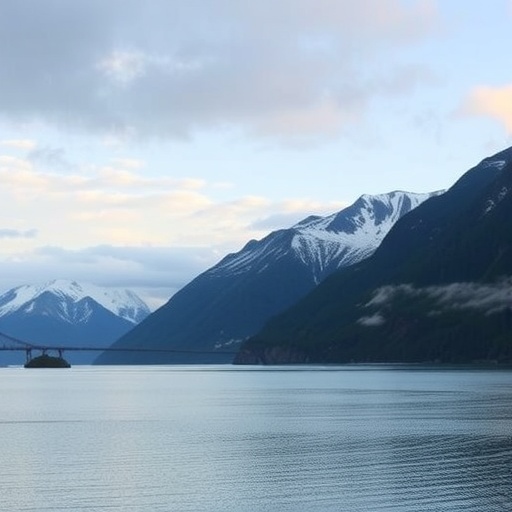
In a groundbreaking study published in Nature Communications in 2026, researchers have unveiled a remarkable discovery concerning the global nitrogen cycle, particularly focusing on fjords. The study, led by Cheung, Levin, Smeaton, and colleagues, reveals that long-term nitrogen burial in these unique coastal systems actually surpasses nitrogen removal through the process of denitrification. This finding not only reshapes our understanding of nitrogen dynamics in fjord environments but also holds profound implications for global biogeochemical cycles, atmospheric chemistry, and marine ecosystems.
Fjords, deep glacially formed inlets surrounded by steep mountain walls, are often recognized as hotspots for nutrient processing and carbon sequestration. They have been studied extensively for their role in trapping organic matter and influencing marine productivity. However, this new research shifts the spotlight onto their capacity to store nitrogen over extended geological periods. Nitrogen burial pertains to the process where nitrogen-containing compounds are incorporated into sediment layers, effectively removing them from active cycling in the ocean-atmosphere system.
Traditional models have emphasized denitrification — the microbial-mediated conversion of reactive nitrogen species back into inert nitrogen gas (N₂) — as the primary pathway for removing excess nitrogen from aquatic ecosystems. Denitrification is critical because it balances nitrogen inputs from terrestrial runoff, atmospheric deposition, and nitrogen fixation. The innovative work by Cheung et al. challenges this paradigm by demonstrating that in fjord sediments, the burial of nitrogen far outweighs the amount lost via denitrification, suggesting that these environments act as substantial long-term nitrogen sinks.
The research team employed a combination of extensive sediment core analyses, isotopic tracing, and advanced biogeochemical modeling to quantify nitrogen burial rates and denitrification processes across a range of global fjords. By examining sediment cores dating back thousands of years, they reconstructed historical nitrogen accumulation patterns, revealing consistent and widespread nitrogen burial beyond earlier estimates. This multidisciplinary approach enabled them to isolate nitrogen fluxes more accurately, accounting for complex sedimentary and microbial interactions that influence nitrogen retention.
One of the striking implications of this study is the reconsideration of nitrogen budgets on a planetary scale. With fjords covering only a small fraction of the world’s ocean surface but exhibiting disproportionately high nitrogen burial rates, their collective impact on nitrogen cycling is profound. The researchers argue that overlooking these environments in global models might have led to significant underestimations of nitrogen sequestration and, consequently, the availability of biologically active nitrogen in marine ecosystems.
From an ecological perspective, the enhanced nitrogen burial in fjords might influence productivity hotspots by modulating nutrient availability. Excessive nitrogen input can lead to eutrophication and harmful algal blooms, but fjords’ ability to sequester nitrogen suggests they may act as buffers, preventing such detrimental effects downstream. Moreover, their function as nitrogen reservoirs could help mitigate anthropogenic nitrogen pollution, offering valuable ecosystem services that have been underappreciated until now.
The geochemical mechanisms behind this extensive nitrogen burial were also explored in detail. In fjord sediments, organic matter decomposition occurs under varying redox conditions, which influence nitrogen compound transformations. The study highlights how organic nitrogen is stabilised through complex interactions with mineral matrices and microbial communities, enabling its preservation over millennia. These preservation pathways appear markedly more efficient in fjords compared to other sedimentary environments such as continental shelves.
Additionally, the team investigated how climate-driven changes might affect nitrogen burial in these regions. Fjords are sensitive to glacial meltwater input, temperature fluctuations, and shifts in sedimentation rates — all factors tied to broader climate dynamics. Understanding whether these environmental factors enhance or impair nitrogen storage is critical, especially in light of ongoing global warming and increased glacial retreat. The authors suggest that climate change could alter fjord nitrogen budgets in unpredictable ways, potentially disrupting established biogeochemical balances.
This discovery also has ramifications for carbon cycling, as nitrogen availability intimately influences primary production and organic carbon burial. Enhanced nitrogen sequestration in fjords implies a stronger coupling between nitrogen and carbon cycles than previously thought. Since fjords already account for a significant portion of global carbon burial, acknowledging their role in nitrogen removal enriches our comprehension of how these systems contribute to climate regulation via greenhouse gas mitigation.
Beyond ecological and biogeochemical concerns, these findings open new doors for environmental management and conservation strategies. Fjords, often subject to human disturbance such as aquaculture, mining, and tourism, now emerge as critical natural infrastructures safeguarding nitrogen equilibrium. Policymakers and stakeholders might leverage this knowledge to prioritize fjord protection and restoration efforts as part of integrated coastal zone management plans.
Finally, the paper by Cheung et al. stresses the importance of incorporating data from diverse, often overlooked ecosystems into Earth system models. Their work exemplifies how detailed sedimentary studies combined with modern analytical techniques can reveal hidden aspects of elemental cycling. As global environmental challenges intensify, such integrative research becomes crucial for accurately forecasting ecosystem responses and informing sustainable stewardship of natural resources.
In conclusion, the revelation that long-term nitrogen burial in global fjords exceeds the rate of denitrification transforms our understanding of nitrogen processing in marine environments. This research not only challenges existing scientific dogma but also highlights the underappreciated role of fjords as nitrogen sinks, with far-reaching consequences for nutrient cycling, climate regulation, and ecosystem health. As scientists delve deeper into the nuances of coastal sediment biogeochemistry, the importance of fjords shines through as a linchpin in Earth’s complex nitrogen network.
Cite Scienmag News
Violet Maxwell. (April 1, 2026). Global Fjords Store More Nitrogen Than Denitrify. Scienmag. https://scienmag.com/global-fjords-store-more-nitrogen-than-denitrify/
Violet Maxwell. "Global Fjords Store More Nitrogen Than Denitrify." Scienmag, 1 April 2026, https://scienmag.com/global-fjords-store-more-nitrogen-than-denitrify/. Accessed 3 September 2026.
Violet Maxwell. "Global Fjords Store More Nitrogen Than Denitrify." Scienmag. April 1, 2026. https://scienmag.com/global-fjords-store-more-nitrogen-than-denitrify/


