


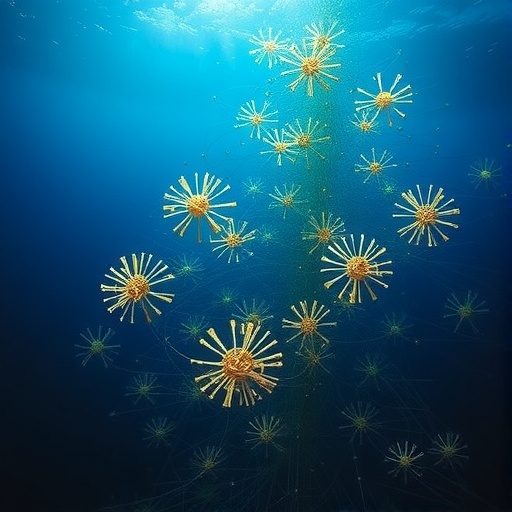
In a groundbreaking study emerging from the depths of the Sargasso Sea, researchers have unveiled surprising patterns in viral activity related to marine microorganisms. Contrary to long-standing expectations that viruses associated with photosynthetic bacteria would display heightened activity during daylight, the study found that an overwhelming majority of viruses exhibiting cyclical daily abundance peaks were most active under the cover of night. This discovery opens new avenues for understanding the complex interactions shaping oceanic ecosystems and challenges previously held assumptions about microbial ecology in marine environments.
The investigation involved intensive sampling of water from two distinct oceanic strata: the surface and the deep chlorophyll maximum (DCM), a critical zone rich in photosynthetic microbes. Over approximately five days, samples were collected at frequent intervals—every four hours from the surface, and every twelve hours from the DCM—to capture viral community dynamics with unprecedented temporal resolution. This high-frequency sampling regime allowed the characterization of over 48,000 viral species, among which around 3,100 demonstrated clear diel, or 24-hour, cyclical patterns.
The most striking pattern was that about 90% of these diel viruses reached peak abundance during nocturnal hours. Initially hypothesized to be associated predominantly with photosynthetic bacteria, investigations revealed the contrary. Instead, these nocturnally active viruses primarily infected heterotrophic bacteria—microorganisms unable to perform photosynthesis themselves and reliant on consuming organic material produced by other organisms. This insight highlights a nuanced viral-host relationship, where viral replication and infection cycles may be synchronized to the metabolic rhythms of heterotrophic populations, many of which may exhibit increased ecological activity during the night in response to shifts in organic matter availability and host physiology.
Notably, the viral community composition diverged significantly between the surface and DCM samples, reflecting distinct ecological niches and environmental gradients such as variations in light intensity, temperature, and oxygen concentration. These differences underscore the importance of depth-stratified sampling for comprehensive ecological interpretations. The Sargasso Sea setting—characterized by warmer, more acidic conditions—provides a critical natural laboratory for extrapolating these viral-host interactions to future ocean scenarios impacted by climate change and ocean acidification.
The study’s lead author, Alfonso Carrillo, a microbiology PhD candidate at The Ohio State University, emphasizes the transformative potential of these findings. “Recognizing these novel diel viral-host dynamics pushes us to revisit how we model oceanic microbial processes,” Carrillo remarked. The data suggest that viral influence on carbon cycling and nutrient fluxes in marine ecosystems involves intricate temporal frameworks that are essential to capture in predictive models, especially in the face of rapid environmental shifts.
Complementing this ecological investigation, advancements in viral classification methodologies have significantly enhanced researchers’ capacity to decode the vast and largely uncharacterized viral diversity in marine systems. Matthew Sullivan’s laboratory at The Ohio State University has pioneered a machine learning-based tool, vConTACT3, designed to classify viral genomes with remarkable speed and precision across broader taxonomic ranks. Where previous iterations limited classification to prokaryote-infecting viruses like bacteriophages, vConTACT3 now extends its reach to viruses that target eukaryotic hosts, encompassing animals, plants, and fungi.
Benjamin Bolduc, a computational scientist integral to this development, highlighted the significance of vConTACT3 in enabling virus genome fragment classification without necessitating complete genome sequences. This innovation overcomes a major bottleneck in virus ecology, as environmental sampling often produces fragmented genomic data due to technical limitations. By exploiting machine learning algorithms trained on vast datasets and sensitivity analyses, the tool discerns taxonomic relationships at the family, order, class, and phylum levels, delivering a refined and scalable framework for mapping viral diversity.
The integration of this advanced classification system and the detailed diel sampling techniques has illuminated not only ecosystem-level viral patterns but also the specific viral taxa driving these dynamics. Understanding which viral groups are replicating and interacting with their hosts on diurnal cycles allows for more informed hypotheses about viral contributions to biogeochemical processes, particularly carbon sequestration and nutrient cycling. These processes are pivotal in regulating global greenhouse gas levels and thus climate control.
The research underscores the profound impact of viruses in shaping marine microbiomes, ecosystems notoriously complex due to the sheer volume of microbial life and the multiplicity of interactions. Unlike traditional views that relegated viruses to minor ecological players, this study contributes to a growing recognition of viruses as central agents influencing microbial community structure, genetic exchange, and ecosystem function. The nocturnal preference of specific viral infections also invites reevaluation of previous metabolic and ecological models, many of which have been built on daytime-focused observations.
Crucially, the study heralds a methodological shift in marine virology—moving towards high-frequency, depth-specific sampling combined with cutting-edge computational tools. These advances permit real-time monitoring and more precise linking of viral genomic identity to ecological function. As ocean conditions continue to evolve under anthropogenic pressures, such tools and approaches become indispensable in forecasting marine ecosystem responses and resilience.
By elucidating these diel viral-host relationships and expanding computational virology capabilities, the research not only enriches fundamental biological knowledge but also equips scientists to better anticipate and mitigate the effects of global climate change on ocean health. The collaborative nature of this work, involving institutions across multiple countries and disciplines, reflects the complexity of addressing ecological questions at the interface of microbiology, oceanography, and environmental science.
In sum, this research reveals that the marine virosphere is a dynamic and temporally structured realm, where viral activity and host interactions are intricately modulated by diel cycles and depth-dependent environmental factors. The predominance of nighttime viral activity engaging heterotrophic bacteria challenges conventional paradigms and prompts a reevaluation of viral roles in marine ecosystems. Coupled with novel classification technologies, these discoveries mark a significant stride toward a holistic understanding of the ocean’s invisible yet vital microbial constituents driving planetary health.
News Publication Date: 6-Mar-2026.
Web References:
– https://journals.plos.org/plosbiology/article?id=10.1371/journal.pbio.3003474
– https://vcontact3.readthedocs.io/en/latest/
References:
Carrillo, A., Hageman, E., Mackey, A., Ndlovu, K., Tian, F., Vik, D., Sun, C., Pavan, R. et al. (2026). Sub-daily virus sampling at the Bermuda Atlantic Time Series reveals diel and depth-structured population dynamics without community-level shifts. PLOS Biology. DOI: 10.1371/journal.pbio.3003474.
Bolduc, B., et al. (2026). vConTACT3: An AI-enhanced viral genome classification tool expanding prokaryotic and eukaryotic virus taxonomy. Nature Biotechnology.
Cite Scienmag News
Kristina Jarvis. (March 31, 2026). Catching Viral Dance Patterns in the Depths of the Sargasso Sea. Scienmag. https://scienmag.com/catching-viral-dance-patterns-in-the-depths-of-the-sargasso-sea/
Kristina Jarvis. "Catching Viral Dance Patterns in the Depths of the Sargasso Sea." Scienmag, 31 March 2026, https://scienmag.com/catching-viral-dance-patterns-in-the-depths-of-the-sargasso-sea/. Accessed 3 September 2026.
Kristina Jarvis. "Catching Viral Dance Patterns in the Depths of the Sargasso Sea." Scienmag. March 31, 2026. https://scienmag.com/catching-viral-dance-patterns-in-the-depths-of-the-sargasso-sea/


