


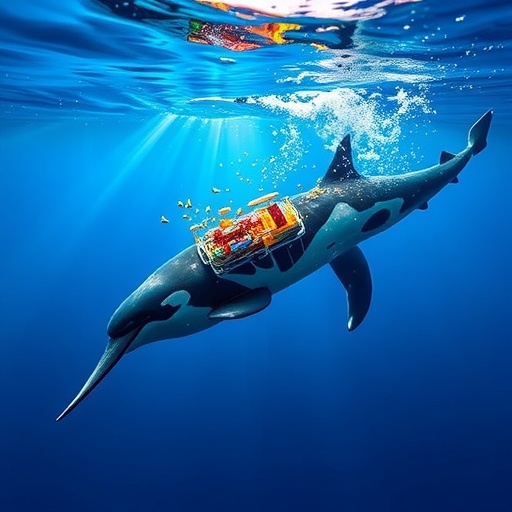
In the pursuit of understanding the complex interactions between persistent organic pollutants (POPs) and marine apex predators, recent research has unveiled a pioneering framework that bridges the gap between laboratory toxicity data and real-world organismal risk assessments. This innovative approach addresses critical challenges that have long hindered accurate evaluations of chemical threats to cetaceans, such as finless porpoises, and heralds a new era for marine toxicology grounded in mechanistic precision and ethical responsibility.
Cetaceans occupy a unique ecological niche as apex predators within marine ecosystems, resulting in the bioaccumulation of various environmental contaminants, notably POPs. These chemicals possess the alarming capacity to persist in biological tissues, posing escalating health threats. Historically, the ethical prohibition against conducting toxicity tests directly on these sentient creatures compelled scientists to rely heavily on in vitro cell culture models. However, translating results from these controlled laboratory conditions to the dynamic, complex in vivo environment of living cetaceans has posed formidable scientific challenges, primarily due to discrepancies in chemical bioavailability.
Traditionally, toxicity assessments juxtaposed the nominal concentrations of chemicals used in cell culture experiments with the total measured concentrations in cetacean tissues. This direct comparison inherently oversimplified complex biochemical interactions, disregarding critical factors such as the binding affinities of chemicals to proteins and lipids within the organism. Such oversights introduced significant uncertainties, undermining the reliability of risk estimations and complicating conservation efforts.
To overcome these limitations, the new research introduces a sophisticated quantitative framework emphasizing the concept of “freely dissolved concentration.” This parameter represents the fraction of chemicals unbound to biological macromolecules, thus biologically available to exert toxic effects. By focusing on the freely dissolved concentrations rather than nominal or total concentrations, the model achieves a more accurate reflection of the chemical’s true bioactivity within biological systems.
Central to this methodology was the selection of the finless porpoise as a representative cetacean species. Researchers meticulously quantified the protein and lipid content within the blood and blubber of these animals, drawing parallels with the composition of the culture media employed in laboratory bioassays. This detailed biochemical profiling enabled the construction of an advanced mass distribution model encompassing 15 different POPs, providing a comprehensive depiction of chemical partitioning and bioavailability.
Analyses derived from this mass distribution model revealed striking disparities between nominal, total measured, and freely dissolved concentrations. Specifically, freely dissolved POP concentrations in culture media, blood, and blubber were found to be exponentially lower—by two to three, four to six, and six to eight orders of magnitude, respectively—than their nominal and measured total counterparts. This discovery highlights the imperative of reassessing conventional toxicity data through the lens of chemical bioavailability to avoid gross overestimations of risk.
Capitalizing on these insights, the study formulated the concept of a “QIVIVE ratio,” a quantitative in vitro to in vivo extrapolation metric. This ratio rigorously compares actual chemical exposure levels in cetacean tissues with toxic effect thresholds established in cell culture experiments, all normalized by freely dissolved concentrations. The application of this ratio demonstrated that, under current environmental conditions, the mixed exposures to the studied POPs present minimal risk in terms of compromising cell viability or triggering programmed cell death (apoptosis).
The implications of this research are transformational. By integrating mass distribution modeling and freely dissolved concentration metrics, it establishes a mechanistically sound, ethically responsible framework for the risk assessment of chemical pollutants in marine mammals. This approach not only refines the predictive accuracy of in vitro studies but also obviates the need for invasive or harmful animal testing.
Looking toward the future, this framework offers promising adaptability. The incorporation of chronic toxicological endpoints, such as endocrine disruption and immunotoxicity, will further enhance its scope and applicability. Expansion of this model to encompass a broader suite of chemicals and biological effects could pave the way for comprehensive health risk assessments, offering vital tools for marine conservationists and environmental policymakers.
The novel methodology underscores the importance of interdisciplinary collaboration, intertwining environmental chemistry, marine biology, toxicology, and computational modeling. Such integrative research strategies are essential to unravel the nuances of chemical dynamics in complex living systems, particularly those as ecologically and ethically sensitive as cetaceans.
This study, published in Environmental Science & Technology, represents a quantum leap in environmental toxicology. It sets a new standard for evaluating the ecological impacts of persistent organic pollutants, reinforcing the critical role of mechanistic, data-driven modeling to inform conservation strategies and environmental regulations.
By illuminating the intricate biochemical interactions that govern pollutant bioavailability, the research offers a template for future studies of environmental contaminants in diverse species. It further demonstrates that advancing scientific understanding does not necessitate compromising animal welfare, affirming the potential for ethical innovation in ecological research.
As marine ecosystems face mounting threats from anthropogenic pollutants, the adoption of such advanced risk assessment tools is not merely desirable but indispensable. It equips scientists and stakeholders with the precision needed to identify genuine hazards, prioritize intervention efforts, and safeguard the health of marine life for generations to come.
News Publication Date: Not explicitly provided.
Web References: http://dx.doi.org/10.1021/acs.est.5c13935
References: Environ. Sci. Technol. 2026, 60, 11, 8353-8362
Cite Scienmag News
Violet Maxwell. (March 30, 2026). Creating an Advanced Predictive Model to Evaluate Chemical Risks in Cetaceans. Scienmag. https://scienmag.com/creating-an-advanced-predictive-model-to-evaluate-chemical-risks-in-cetaceans/
Violet Maxwell. "Creating an Advanced Predictive Model to Evaluate Chemical Risks in Cetaceans." Scienmag, 30 March 2026, https://scienmag.com/creating-an-advanced-predictive-model-to-evaluate-chemical-risks-in-cetaceans/. Accessed 4 September 2026.
Violet Maxwell. "Creating an Advanced Predictive Model to Evaluate Chemical Risks in Cetaceans." Scienmag. March 30, 2026. https://scienmag.com/creating-an-advanced-predictive-model-to-evaluate-chemical-risks-in-cetaceans/


