


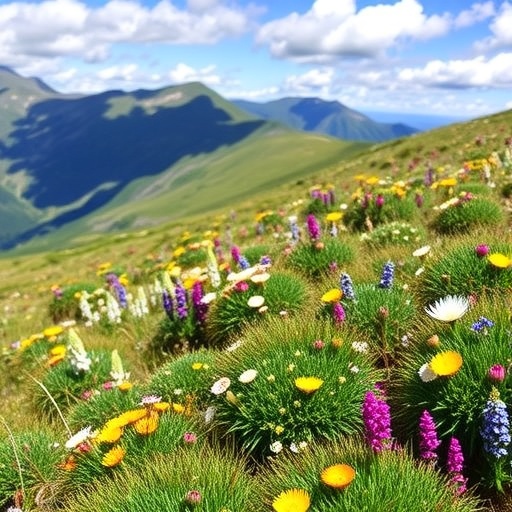
In the ever-evolving discourse surrounding carbon cycling and storage within terrestrial ecosystems, the role of soil microbial communities has emerged as a pivotal factor influencing long-term carbon sequestration. A groundbreaking study published in Communications Earth & Environment by Yan, Hautier, Chen, and colleagues underscores the intricate interplay between plant diversity and the accumulation of microbial necromass carbon in alpine grasslands, revealing critical insights with far-reaching implications for climate change mitigation strategies.
Alpine grasslands, characterized by their unique vegetation and harsh environmental conditions, have often been overlooked in global carbon cycle analyses despite their extensive spatial coverage and potential as carbon sinks. The research team’s meticulous field studies and sophisticated analytical techniques demonstrate that within these fragile ecosystems, plant diversity acts as a foundational component in enhancing microbial necromass carbon accrual. This carbon, derived from the remains of dead microbial cells, constitutes a significant and stable pool of soil organic carbon, underscoring the importance of biological complexity in soil carbon dynamics.
At the heart of this investigation is the recognition that microbial necromass carbon forms a resilient fraction of soil organic matter resistant to decomposition over extended periods. Unlike labile carbon sources which rapidly turnover, microbial necromass comprises chemically stabilized compounds that contribute substantially to soil carbon storage. The study meticulously quantifies this contribution across gradients of plant diversity, revealing that higher plant species richness correlates strongly with increased microbial necromass accumulation.
The mechanism underpinning this association involves diverse plant communities supporting a richer and more active soil microbial assemblage. Varied root exudates, litter inputs, and microhabitats created by diverse flora foster microbial heterogeneity and abundance, leading to higher microbial biomass generation. Upon microbial death, this biomass converts to necromass which, through physicochemical interactions with soil minerals, achieves a stabilization that protects carbon from rapid mineralization and release back into the atmosphere.
By employing advanced isotopic tracing and molecular markers, the researchers could dissect the contributions of different plant functional groups to overall necromass production. Their findings highlight that not only does species richness matter, but the composition of plant communities—particularly the presence of certain functional types such as legumes or grasses—influences microbial community structure and subsequent necromass stabilization in soil matrices.
Interpreting the data from high-altitude alpine grasslands is particularly compelling given these regions’ susceptibility to climate warming. Alpine soils are experiencing shifts in temperature and moisture regimes, which can accelerate carbon loss through enhanced microbial respiration and decomposition. By identifying plant diversity as a key modulator of microbial necromass carbon pools, the study offers a natural buffering mechanism that could mitigate the vulnerability of alpine carbon stocks under future climate scenarios.
Moreover, the research emphasizes the need to rethink grassland management and restoration practices with soil carbon preservation in mind. Preservation of plant diversity is not merely a botanical or ecological concern but a critical strategy to maintain robust microbial communities that underpin soil carbon storage. This approach represents a paradigm shift from traditional carbon sequestration efforts focused solely on aboveground biomass or soil organic carbon, highlighting microbial necromass as an essential but often underappreciated component.
The implications of this study extend beyond alpine grasslands to other terrestrial ecosystems where plant diversity gradients exist. As the global scientific community seeks novel pathways to enhance natural carbon sinks, harnessing the synergistic relationship between plant diversity and microbial processes emerges as a promising frontier. The insights delivered by Yan and colleagues provide a mechanistic understanding that can inform ecosystem models to more accurately predict carbon cycling feedbacks to climate.
One of the remarkable outcomes of the study is the quantitative scaling of microbial necromass carbon relative to total soil organic carbon stocks across different plant diversity levels. The authors show that soils under diverse plant cover can accrue significantly more necromass-derived carbon, which remains protected over decades if not centuries, thereby acting as a stabilizing carbon reservoir against atmospheric CO2 buildup.
Their approach integrates multidisciplinary methodologies, including high-throughput sequencing of soil microbial communities, spectroscopic analyses to characterize necromass chemical composition, and ecosystem-level carbon flux measurements. This integrative framework not only validates the importance of biodiversity but also reveals the underlying biochemical and ecological processes driving soil carbon stabilization dynamics.
In a broader scientific and policy context, this research raises awareness about the often-overlooked subterranean biodiversity and its global environmental significance. It challenges climate mitigation frameworks to include microbial necromass pathways in soil carbon accounting and to promote biodiversity-driven approaches in land use management, particularly in vulnerable biomes such as alpine grasslands.
Considering the alarming rate of biodiversity loss worldwide, the study’s findings caution that reductions in plant species richness may degrade soil microbial functions and decrease the efficacy of natural carbon sinks. Protecting and restoring plant diversity is hence pivotal not only for ecosystem resilience but also for maintaining and enhancing the earth’s capacity to regulate atmospheric greenhouse gases.
Furthermore, the study accentuates the interconnectedness of above- and belowground biotic components and advances the conceptual understanding that soil microbes act as critical intermediaries translating plant diversity into long-term carbon sequestration benefits. This holistic perspective is essential for designing effective conservation policies and climate adaptation measures that recognize soil biodiversity as an intrinsic element of ecosystem services.
The innovative technological tools utilized—ranging from stable isotope probing to metagenomics—demonstrate an evolving frontier in ecological research where precise quantification of microbial necromass becomes feasible. This progress opens new avenues for monitoring soil health and carbon dynamics in situ, enabling more informed and targeted interventions.
Overall, the compelling evidence presented in this pioneering research reveals that the preservation and enhancement of plant diversity in alpine grasslands is a strategic and scientifically validated pathway to bolster microbial necromass carbon accrual. Protecting the intricate web of soil microbial life holds the key to unlocking durable natural solutions for climate change mitigation, an insight that should galvanize ecological scientists, policymakers, and land managers alike.
As this research garners attention, it is poised to catalyze further investigations into microbial necromass carbon across diverse ecosystems worldwide, encouraging an integrated approach that bridges plant ecology, soil science, and global biogeochemical cycles. The deepening understanding of these complex interactions marks a significant leap towards harnessing ecosystem biodiversity as a cornerstone of planetary health.
Cite Scienmag News
Morgan Morrow. (March 30, 2026). Plant Diversity Drives Microbial Carbon in Alpine Grasslands. Scienmag. https://scienmag.com/plant-diversity-drives-microbial-carbon-in-alpine-grasslands/
Morgan Morrow. "Plant Diversity Drives Microbial Carbon in Alpine Grasslands." Scienmag, 30 March 2026, https://scienmag.com/plant-diversity-drives-microbial-carbon-in-alpine-grasslands/. Accessed 4 September 2026.
Morgan Morrow. "Plant Diversity Drives Microbial Carbon in Alpine Grasslands." Scienmag. March 30, 2026. https://scienmag.com/plant-diversity-drives-microbial-carbon-in-alpine-grasslands/


