


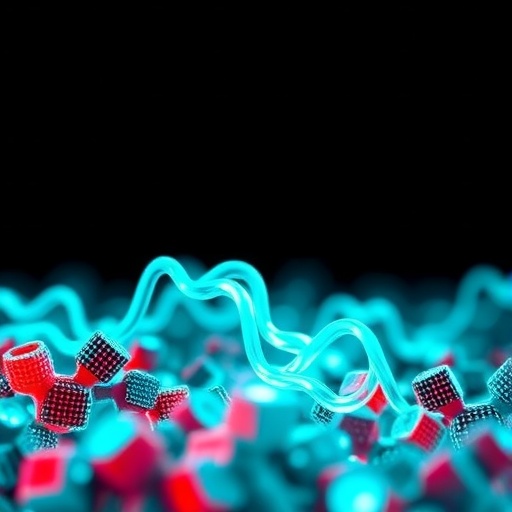
In a groundbreaking advancement poised to transform the field of radioactive waste management, researchers have engineered a smart metal–organic framework (MOF) capable of ultraselective thorium sensing and remediation, complete with real-time fluorochromic feedback. This novel material, denoted Eu-NDC, not only significantly optimizes thorium detection with a record-low nanomolar sensitivity but simultaneously offers superior adsorption capacity and selectivity against competing radionuclides, marking a monumental step forward in efficient and sustainable radioactive element separation.
The challenge of separating thorium ions from complex aqueous environments has long bedeviled efforts in nuclear waste treatment and environmental remediation. Thorium’s presence, typically in coexistence with a host of chemically similar cations like uranium, presents a formidable hurdle. Traditional separation technologies often grapple with poor selectivity and necessitate high consumption of adsorbent materials, thereby generating abundant secondary waste. This limits the practicality and ecological sustainability of conventional methods. Eu-NDC elegantly overcomes these obstacles by integrating sensing and capture functions within a single, smart framework architecture.
At the heart of this innovation is the Eu-NDC MOF’s unique fluorochromic property. Upon coordination with thorium ions, the material undergoes a striking visible color shift from red to blue in its emission profile. This luminous transformation serves as an intrinsic, self-indicating signal, providing an immediate and intuitive optical readout that directly corresponds to the degree of thorium adsorption. Unlike conventional sensors that require external instrumentation or separate detection steps, Eu-NDC’s built-in colorimetric feedback allows continuous, real-time monitoring of adsorbent performance without interrupting the purification process.
Analytical investigations demonstrate the MOF’s phenomenal sensitivity, achieving a detection limit for Th(IV) as low as 9.2 nM. This level of precision enables trace-level monitoring in contaminated water systems, potentially facilitating earlier detection and more targeted removal efforts. Even more remarkable is Eu-NDC’s exceptional selectivity for Th(IV) over other competing tetravalent species, which is quantified through an impressive distribution coefficient of 2.8 × 10^6 ml g^−1. This high selectivity is critical to ensure that thorium can be effectively separated in mixed radionuclide scenarios typical of nuclear fuel cycle wastewaters.
Besides its sensing capabilities, Eu-NDC showcases substantial thorium adsorption capacity, with a maximum loading of 504.3 mg g^−1. Such high uptake signifies the framework’s robust binding affinity and structural stability under operational conditions, implying that practical quantities of contaminated water could be treated efficiently with minimal material input. This greatly reduces the volume of adsorbent and subsequent secondary waste, a key consideration for scalable environmental remediation technologies.
Delving deeper into the mechanistic underpinnings, the researchers uncovered that thorium uptake by Eu-NDC proceeds via a fascinating dissolution–recrystallization process. Rather than simple surface adsorption, thorium ions interact dynamically with the framework, inducing partial material dissolution followed by coordinated structural reformation. This molecular-level transformation sustains the high specificity and creates fresh active sites during the remediation cycle, enhancing adsorption kinetics and regeneration potential.
A pivotal feature that sets Eu-NDC apart from existing MOFs or sorbents is its dual functionality that synergistically fuses adsorption and fluorochromic detection. This multifunctional design paradigm enables operators to visually track and quantify adsorbent saturation status, thereby facilitating timely replacement or regeneration. The concept of a “self-indicating” adsorbent elevates technology readiness by embedding smart diagnostic feedback directly within the separation medium, representing a significant stride towards autonomous environmental purification systems.
From an application standpoint, Eu-NDC holds tremendous promise across nuclear waste remediation, groundwater decontamination, and monitoring scenarios where thorium presence poses radiological and chemical risks. Its exceptional selectivity safeguards against interference from uranium and other competing ions, as evidenced by a Th(IV)/U(VI) separation factor of 1,806 — a metric highlighting the material’s discriminating adsorption behavior. This capability is vital given uranium’s prevalence in spent fuel and environmental matrices.
Moreover, the optical emission color shift as an easy-to-interpret visual cue empowers field personnel to assess contamination levels and adsorbent efficacy without necessitating elaborate laboratory analysis. This can accelerate decision-making in critical remediation operations and improve safety by offering immediate status updates. The integration of real-time sensing and remediation within a single MOF platform can streamline workflows, reduce costs, and enhance response agility in environmental management.
This research exemplifies the convergence of materials chemistry, photophysics, and environmental engineering. The authors’ strategic design of Eu-NDC leverages the tunable coordination chemistry of lanthanide centers (Europium ions) and organic ligands (naphthalene dicarboxylate, NDC) to finely tailor emissive and adsorptive properties. Their approach underscores the vital role of rational MOF synthesis to achieve multifunctionality essential for tackling complex environmental challenges.
The discovery further paves the way for the future development of “smart sorbents” capable of self-reporting capabilities extendable beyond thorium to other hazardous species. By utilizing fluorochromic indicators intrinsic to the material’s structure, similar platforms can be customized for various radionuclides, heavy metals, or emerging contaminants. This methodology can revolutionize monitoring frameworks by embedding sensing at the molecular level within sorbent matrices.
In the broader context of sustainable environmental technologies, Eu-NDC’s minimal secondary waste generation profile aligns with goals to reduce chemical consumption and waste production in remediation processes. The self-indicating nature reduces redundant sampling and analytical waste, contributing to greener operational footprints. The capacity for facile regeneration suggested by the dissolution–recrystallization uptake mechanism could further enhance lifecycle sustainability.
Complementing its remarkable chemical properties, Eu-NDC’s optical response can also be potentially integrated with digital imaging and machine learning analytics for automated sensing platforms. Such digitized implementations could further empower remote monitoring and smart water treatment infrastructure, bridging the interface between advanced material science and digital environmental monitoring.
In summary, this pioneering study introduces a next-generation metal–organic framework that elegantly unites ultraselective thorium adsorption with direct, real-time fluorescence signaling. Eu-NDC’s innovative design establishes a paradigm shift by transforming passive adsorbents into active, smart materials that can visually communicate their operational status. This dual-functionality offers an unprecedented combination of high-performance separation and user-friendly monitoring, setting a powerful new standard for radionuclide remediation and environmental safeguarding in the nuclear age.
The discovery of Eu-NDC stands as a testament to the transformative potential held within advanced MOF systems, heralding a future where materials intelligently inform their utility and enable more efficient and sustainable stewardship of radioactive elements. As this technology matures, it holds promise not only for thorium but for a diverse array of contaminants where precise, accessible detection and remediation are urgently needed. This represents a thrilling frontier at the intersection of material innovation, environmental science, and public health protection.
Cite Scienmag News
Violet Maxwell. (March 26, 2026). Smart MOF Enables Real-Time Thorium Detection. Scienmag. https://scienmag.com/smart-mof-enables-real-time-thorium-detection/
Violet Maxwell. "Smart MOF Enables Real-Time Thorium Detection." Scienmag, 26 March 2026, https://scienmag.com/smart-mof-enables-real-time-thorium-detection/. Accessed 1 September 2026.
Violet Maxwell. "Smart MOF Enables Real-Time Thorium Detection." Scienmag. March 26, 2026. https://scienmag.com/smart-mof-enables-real-time-thorium-detection/


