


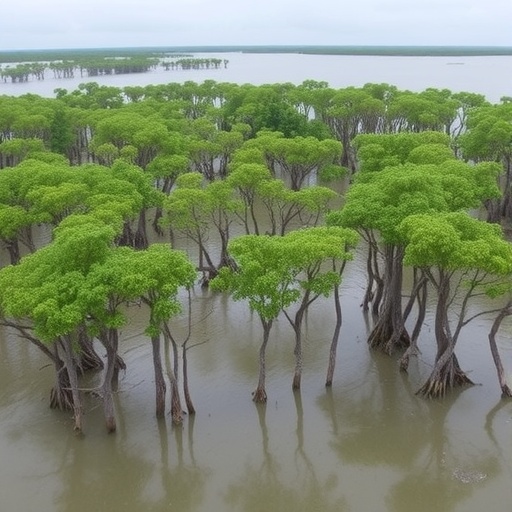
Amidst the intricate interplay of climatic forces and marine ecosystems, a groundbreaking study published in Communications Earth & Environment has illuminated the profound impact of monsoon-driven waves on the vast mangrove forests of the Ganges-Brahmaputra-Meghna (GBM) Delta. This extensive research uncovers a predominantly negative trend—an accelerating recession of these crucial coastal ecosystems, intricately tied to the seasonal monsoon dynamics that define South Asia’s environmental landscape.
Mangrove forests serve as critical buffers between terrestrial and marine environments, supporting biodiversity, stabilizing shorelines, and mitigating the effects of climate change through carbon sequestration. However, these vital habitats are increasingly vulnerable to natural and anthropogenic stressors. The GBM Delta, one of the largest and most densely populated deltaic regions globally, is especially sensitive due to its unique exposure to the powerful South Asian monsoon system. According to this new study by Xiong, Dai, Long, and colleagues, the monsoon-induced wave action emerges as a dominant agent driving a progressive retreat of mangrove boundaries in the area.
The researchers combined remote sensing analysis with in situ hydrodynamic measurements and climate data stretching over recent decades to unravel the mechanisms underpinning mangrove recession. Their findings pinpoint a complex convergence of intensified wave energy during monsoon seasons with geomorphic and sediment transport changes, leading to sustained erosion and vulnerability in the delta’s mangrove belts. This phenomenon challenges prior assumptions that mangrove health was primarily threatened by anthropogenic clearance or freshwater scarcity, placing monsoon wave dynamics at the forefront of ecological risk factors.
Waves generated by the southwest monsoon bring an amplified force to the delta’s coastline, heightening the frequency and magnitude of shoreline disturbances. The study identifies that these wave surges not only physically damage mangrove root systems crucial for anchoring soil but also disrupt sediment deposition patterns that maintain delta stability. Over time, this process results in landward retreat and fragmentation of once-continuous mangrove forests. Such fragmentation has significant ecological ramifications, reducing habitat connectivity and resilience against additional environmental pressures like salinity intrusion and sea-level rise.
An interesting dimension of this research lies in its multidisciplinary methodology. Through satellite imagery analysis, the authors tracked changes in mangrove cover with unprecedented temporal and spatial resolution. Parallel hydrodynamic simulations provided insights into how seasonal monsoon wind patterns generate nearshore wave climates, illustrating a clear causal relationship between wave intensity peaks and mangrove erosion episodes. This integrative approach sets a new benchmark for studying coastal eco-hydrodynamics under the influence of climatic variables.
Furthermore, the study emphasizes the socioeconomic implications of mangrove degradation in the GBM Delta. This region supports millions of livelihoods, including fishing communities and subsistence farmers, who depend on mangrove ecosystem services such as storm protection and fish nursery grounds. As the forests recede, these communities face heightened risks from cyclonic storms and saline water intrusion, which could exacerbate poverty and food insecurity in an already vulnerable population.
The authors highlight that the monsoon-driven wave impact is likely to intensify in future scenarios under climate change, as alterations in atmospheric circulation could amplify monsoon strength and variability. This prospective increase in wave energy threatens to accelerate mangrove degradation unless adaptive management strategies are devised. Their study urges policymakers to incorporate hydrodynamic models into coastal conservation planning to better anticipate and mitigate these emerging threats.
In addressing potential mitigation efforts, the research advocates for restoration approaches that consider hydro-morphodynamic feedbacks. Conventional reforestation may fail if wave energy continues to erode sediment foundations essential for mangrove establishment. Instead, nature-based solutions such as enhancing natural sediment accretion and engineering wave attenuation structures compatible with mangrove growth are proposed as promising avenues. These strategies could help stabilize compromised shoreline segments and facilitate ecosystem recovery.
Another critical insight from the paper is the temporal window for intervention. The cyclical nature of the monsoon and its wave regimes imply that management efforts should be timed to avoid peak erosion periods and capitalize on quiescent intervals when mangrove regeneration prospects are higher. Understanding these temporal dynamics demands continuous monitoring, underscoring the need for integrated observational networks combining in situ sensors and remote platforms.
Importantly, the study situates the GBM Delta within a global context of coastal ecosystem vulnerability. Mangrove losses worldwide have been linked to multiple drivers, but the distinct role of seasonal monsoon-induced hydrodynamics as a recession factor is a novel revelation. This finding prompts reexamination of similar deltaic regions influenced by monsoon or comparable seasonal winds, potentially redefining conservation priorities internationally.
The nuanced interaction of natural wave regimes with human activities also emerges as a vital aspect. Infrastructure development, river damming, and land reclamation in the delta alter sediment flows and potentially exacerbate the effects of monsoon waves on mangrove stability. The authors underline that comprehensive management must integrate environmental, infrastructural, and social dimensions to effectively safeguard these ecosystems.
Additionally, the research contemplates the broader climatic implications of mangrove loss. Mangroves are among the most carbon-dense forests on Earth. Their degradation translates to substantial carbon release, thus constituting a positive feedback to greenhouse gas accumulation. The propagation of monsoon wave-induced mangrove recession may, therefore, represent a heretofore underestimated climate feedback loop.
Beyond physical and climatic interactions, the paper also calls attention to biodiversity concerns. Mangroves in the GBM Delta harbor diverse faunal assemblages, including several endemic and endangered species. Their fragmentation and retreat not only jeopardize these species but also impair ecosystem functions essential for overall deltaic health, such as nutrient cycling and water filtration.
The significance of this study extends towards shaping future research agendas. It underscores the imperative to combine climatic, geomorphological, and ecological data to formulate a holistic understanding of coastal ecosystem dynamics. Moreover, elucidating the mechanistic pathways by which monsoon dynamics shape mangrove ecosystems provides a template applicable to other monsoon-dominated coastal systems in Southeast Asia and beyond.
In conclusion, the study by Xiong et al. unveils a paradigm-shifting perspective on the challenges confronting mangrove forests in the GBM Delta. By positioning monsoon-driven waves as a principal driver of widespread mangrove recession, the research compels a reevaluation of coastal conservation frameworks under evolving climatic forces. The march toward sustainable stewardship of these invaluable ecosystems will depend on embracing interdisciplinary analyses and adaptive, science-based interventions that anticipate the complexities of monsoon-coastal interactions.
Cite Scienmag News
Violet Maxwell. (March 25, 2026). Monsoon Waves Cause Mangrove Loss in Delta. Scienmag. https://scienmag.com/monsoon-waves-cause-mangrove-loss-in-delta/
Violet Maxwell. "Monsoon Waves Cause Mangrove Loss in Delta." Scienmag, 25 March 2026, https://scienmag.com/monsoon-waves-cause-mangrove-loss-in-delta/. Accessed 4 September 2026.
Violet Maxwell. "Monsoon Waves Cause Mangrove Loss in Delta." Scienmag. March 25, 2026. https://scienmag.com/monsoon-waves-cause-mangrove-loss-in-delta/


