


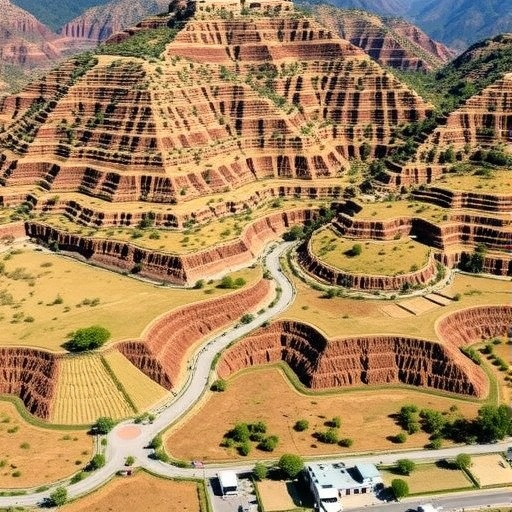
In an era where climate change mitigation has become an urgent global priority, the race to identify and optimize natural carbon sinks has reached new heights. A groundbreaking study published in Communications Earth & Environment in 2026 reveals that plantations on the Loess Plateau in China have achieved their peak carbon sequestration rate, marking a critical milestone in understanding how reforestation can contribute to carbon capture on a large scale.
The Loess Plateau, historically one of the most degraded ecosystems on Earth due to centuries of intense erosion and human activity, has been the subject of ambitious ecological restoration programs since the late 20th century. These efforts involved extensive afforestation and soil conservation measures aimed at reversing land degradation. The recent findings demonstrate that these plantations are not only rehabilitating the land but are also operating at the highest efficiency observed in carbon sequestration rates for similar ecosystems worldwide.
Carbon sequestration is the process by which ecosystems absorb atmospheric carbon dioxide (CO2) and store it in vegetation and soil organic matter, thus playing a vital role in reducing greenhouse gas concentrations. Quantifying the peak sequestration rate provides essential insight into the temporal dynamics of plantation effectiveness. The study shows that after several decades of growth, the vegetation and soil on the Loess Plateau have reached their maximum annual carbon uptake, which has profound implications for forest management and climate policy.
What differentiates the Loess Plateau plantations from other reforestation projects is the unique combination of semi-arid climate conditions, soil type, and targeted restoration techniques, which together create a distinct carbon sequestration trajectory. Early in the plantation lifecycle, carbon uptake rates increase rapidly as young trees grow and develop biomass. Over time, as forests mature, this rate tends to slow due to a balance between photosynthesis and respiration processes in the ecosystem. The data from the Loess Plateau suggest that the timing and magnitude of this peak carbon sequestration are affected by both natural factors and human intervention policies.
A key technical aspect of the research was the application of advanced remote sensing technology alongside ground-based measurements. Satellite imagery and LiDAR (Light Detection and Ranging) were used to monitor changes in vegetation structure and biomass density across vast and often inaccessible regions of the plateau. Simultaneously, soil carbon content was analyzed through detailed field sampling, integrating results in a comprehensive carbon budget model. This multi-disciplinary approach allowed the researchers to accurately capture the complex carbon fluxes involved.
The authors highlight that the numerical peak observed corresponds to an average annual carbon sequestration rate higher than those recorded in temperate forests of comparable latitudes. This finding challenges existing generalizations about carbon dynamics in dryland afforestation projects and emphasizes the global significance of the Loess Plateau as a carbon sink. It also underscores the importance of regional specificity when developing climate action strategies involving ecosystem restoration.
Importantly, the study’s temporal scope, spanning over three decades, offers rare insight into long-term carbon cycle processes. Many previous studies of forest carbon uptake were limited to short-term or single-site observations that can overlook the temporal variability inherent in ecosystem development phases. By tracking the plantations over a sufficient duration, the researchers provide robust evidence supporting the theory of carbon sequestration saturation and its ecological drivers.
Beyond its climatological value, reaching peak carbon sequestration illuminates the potential limits of plantation-driven carbon capture efforts. Once this peak is surpassed, additional carbon uptake rates are likely to decline or stabilize, potentially requiring adaptive forest management interventions. These could include selective thinning, species diversification, or enhancing soil carbon storage through organic matter amendments to prolong high sequestration efficiency.
The study also delves into the biogeochemical interactions underlying this peak rate. For instance, nitrogen availability—a crucial nutrient regulating plant growth and microbial activity—was identified as a modulating factor. As young plantations mature, soil nutrient cycles evolve, sometimes leading to nitrogen constraints that affect photosynthetic capacity and thus carbon uptake. Recognizing these feedbacks is critical for optimizing restoration practices to maintain ecosystem productivity over longer periods.
Furthermore, climate variability throughout the study period added a layer of complexity to carbon flux patterns. Fluctuations in temperature and precipitation directly influenced growth rates and soil respiration. The researchers modeled these influences using advanced statistical tools to separate climate-driven effects from plantation age-related trends. Their work exemplifies how integrated climate-ecosystem models support refined projections of future carbon sink potentials under different climate scenarios.
Strategically, the evidence from the Loess Plateau projects guides national-level afforestation policies in China, which aims to balance economic development with ecological sustainability. Understanding when and how peak carbon sequestration occurs informs target setting for carbon neutrality goals, reducing uncertainty in accounting for terrestrial carbon sinks. This aligns with international climate commitments where transparent and science-based carbon accounting is paramount.
On a global scale, the findings contribute to the growing body of research emphasizing the critical roles of dryland and semi-arid ecosystems in the global carbon cycle. Historically, these landscapes were underappreciated regarding their carbon storage dynamics due to assumptions about limited carbon gain potential. The Loess Plateau data challenge these paradigms and highlight the potential for large-scale dryland restoration to contribute meaningfully to climate mitigation.
Moreover, the social benefits stemming from successful restoration, including improved water retention, enhanced biodiversity, and soil erosion control, were underscored in the article as multifaceted incentives. Carbon sequestration, while a key metric, integrates into a broader framework of ecosystem services that plantations provide, reinforcing the need for holistic ecosystem-based management approaches.
Looking forward, ongoing monitoring of these plantations will be essential to detect any shifts away from peak sequestration rates due to climate change or land use pressures. The integration of cutting-edge sensor networks, artificial intelligence algorithms for data interpretation, and participatory community-based monitoring was recommended by the authors for effective landscape-scale carbon management.
In conclusion, reaching the peak carbon sequestration rate on the Loess Plateau plantations is a landmark achievement that illuminates the complexities of ecosystem restoration and carbon dynamics. It offers both a hopeful vision and a cautionary note regarding the limitations and optimization of natural carbon sinks. Scientists, policymakers, and environmental stakeholders alike will benefit from these insights as they sculpt strategies for a sustainable carbon-neutral future.
Cite Scienmag News
Sloane Callahan. (March 25, 2026). Loess Plateau Plantations Hit Peak Carbon Sequestration. Scienmag. https://scienmag.com/loess-plateau-plantations-hit-peak-carbon-sequestration/
Sloane Callahan. "Loess Plateau Plantations Hit Peak Carbon Sequestration." Scienmag, 25 March 2026, https://scienmag.com/loess-plateau-plantations-hit-peak-carbon-sequestration/. Accessed 4 September 2026.
Sloane Callahan. "Loess Plateau Plantations Hit Peak Carbon Sequestration." Scienmag. March 25, 2026. https://scienmag.com/loess-plateau-plantations-hit-peak-carbon-sequestration/


