


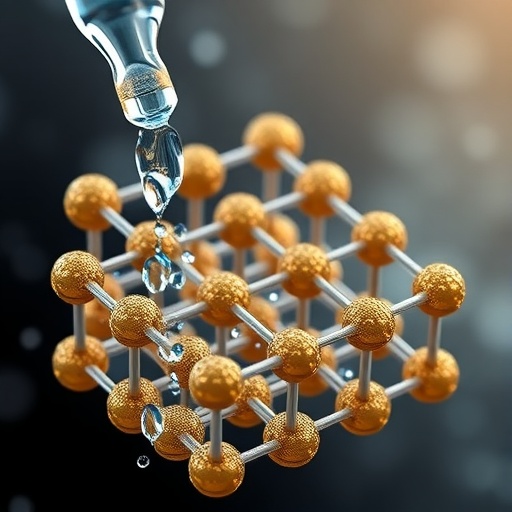
In the quest for sustainable and efficient water purification technologies, a groundbreaking advancement has emerged from a collaborative team of researchers led by Professor Kang Liang at The University of New South Wales. This innovative research, involving partnerships with South China Normal University, Harbin Institute of Technology, and the University of Science and Technology of China, introduces biocatalytic metal-organic framework (MOF) nanomotors engineered with tunable microenvironments. These nanomotors demonstrate unprecedented selectivity and transformative capabilities in water decontamination, signaling a new era in environmental remediation strategies.
Traditional water treatment methods often grapple with challenges such as high energy consumption, limited selectivity for specific pollutants, and significant carbon emissions. The conventional catalysts used in advanced oxidation processes require substantial chemical inputs and agitation, rendering them less efficient and environmentally sustainable for broad applications. Addressing these inherent limitations, the newly developed biocatalytic nanomotors operate efficiently under low concentrations of chemical fuel, notably hydrogen peroxide, without the need for external mechanical stirring. This energy-efficient operation places them at the forefront of next-generation catalytic technologies for water purification.
Central to the innovation is the strategic engineering of the nanomotor microenvironment. Through a unique synergistic approach combining etching and surface modification using tannic acid, the researchers successfully tailored both the surface charge characteristics and the porous architecture of the MOFs. The etching process transforms the dense frameworks into yolk-shell structures, introducing hierarchical porosity that significantly facilitates mass transport kinetics. Surface charge reversal from positive to negative enables targeted preconcentration of cationic contaminants, exemplified by effective methylene blue removal, while simultaneously repelling anionic species like methyl orange. This precise charge-based selectivity mechanism overcomes longstanding challenges in treating complex wastewater mixtures containing multiple pollutants.
The dual-enzyme system embedded within these MOF nanomotors represents another remarkable design feat. By encapsulating catalase and horseradish peroxidase within the ZIF-8 framework, the nanomotors mimic natural enzymatic pathways to achieve both propulsion and catalytic degradation. Catalase decomposes hydrogen peroxide to generate oxygen bubbles, propelling the nanomotors at velocities surpassing 1100 micrometers per second — more than double the speed of previously reported enzyme-incorporated MOFs. Simultaneously, horseradish peroxidase catalyzes selective oxidation reactions of target pollutants without direct competition for the hydrogen peroxide fuel, maintaining robust catalytic activity.
This biomimetic inspiration draws from bombardier beetles, which utilize a combination of catalase and peroxidase enzymes with hydrogen peroxide to generate a rapid defensive spray. Similarly, the nanomotor system capitalizes on enzymatic synergy to achieve enhanced mobility and efficient pollutant transformation. Notably, this catalytic system goes beyond conventional mineralization approaches by transforming toxic phenolic contaminants, specifically bisphenol A, into recoverable, oligomeric polymers. This enzymatic polymerization pathway not only detoxifies the water but also enables chemical energy recovery and reduces the overall carbon footprint of the treatment process.
Mechanistically, the peroxidase-catalyzed reaction involves hydrogen abstraction from bisphenol A, yielding phenoxy radicals that selectively couple into dimers, trimers, and tetramers. These oligomers exhibit increased hydrophobicity, facilitating easy separation via filtration. Advanced analytical techniques like UHPLC-MS/MS confirm the formation of these polymeric products, underlining the transformative potential of this approach for environmental applications beyond simple degradation.
The engineered nanomotors also demonstrate remarkable resilience and recyclability — maintaining over 80% of their initial catalytic activity after ten consecutive cycles with minimal enzyme leakage and intact structural integrity confirmed through PXRD, SEM, and FTIR analyses. Furthermore, their performance remains robust across a broad pH spectrum and in the presence of common background ions and natural organic matter, highlighting real-world applicability in diverse water matrices, including tap and river water.
In terms of scalability, the synthesis procedure is designed to be mild and enzyme-compatible, utilizing a self-limiting concentration of tannic acid to optimize the etching process while preserving enzyme structure and activity. This scalability ensures that the technology can transition from laboratory settings to industrial water treatment systems, with potential for continuous flow implementations that address large-scale environmental remediation needs.
The study underscores the transformative impact of combining materials science with biotechnology. By rationally designing the enzyme microenvironment within MOFs, the researchers have opened new avenues for the design of nanomotor systems that deliver superior catalytic performance, selectivity, and operational efficiency. Future research will likely extend this microenvironment engineering strategy to other enzyme-MOF combinations and refine multilevel microenvironment parameters through predictive modeling, pushing the boundaries of sustainable water treatment technologies.
Ultimately, the development of these biocatalytic MOF nanomotors represents a significant leap forward in addressing the urgent global demand for cleaner water. By harnessing biomimicry, advanced material design, and enzymatic synergism, this platform provides a versatile and eco-friendly solution for selective pollutant removal and energy-efficient remediation. The collaborative efforts led by Professor Kang Liang exemplify the power of interdisciplinary science in tackling environmental challenges and set the stage for continued advancements in nanotechnology-enabled water purification.
News Publication Date:
26-Jan-2026
Web References:
https://doi.org/10.1007/s40820-025-02064-w
Keywords
Metal-organic frameworks, Biocatalytic nanomotors, Water remediation, Enzyme engineering, Microenvironment tuning, Selective pollutant removal, Biomimetic catalysis, Environmental nanotechnology, Advanced oxidation process, Sustainable water treatment
Cite Scienmag News
Bethany Barker. (March 20, 2026). Nanomotor-Driven Metal–Organic Frameworks with Engineered Microenvironments Enable Targeted and Efficient Water Purification. Scienmag. https://scienmag.com/nanomotor-driven-metal-organic-frameworks-with-engineered-microenvironments-enable-targeted-and-efficient-water-purification/
Bethany Barker. "Nanomotor-Driven Metal–Organic Frameworks with Engineered Microenvironments Enable Targeted and Efficient Water Purification." Scienmag, 20 March 2026, https://scienmag.com/nanomotor-driven-metal-organic-frameworks-with-engineered-microenvironments-enable-targeted-and-efficient-water-purification/. Accessed 3 September 2026.
Bethany Barker. "Nanomotor-Driven Metal–Organic Frameworks with Engineered Microenvironments Enable Targeted and Efficient Water Purification." Scienmag. March 20, 2026. https://scienmag.com/nanomotor-driven-metal-organic-frameworks-with-engineered-microenvironments-enable-targeted-and-efficient-water-purification/


