


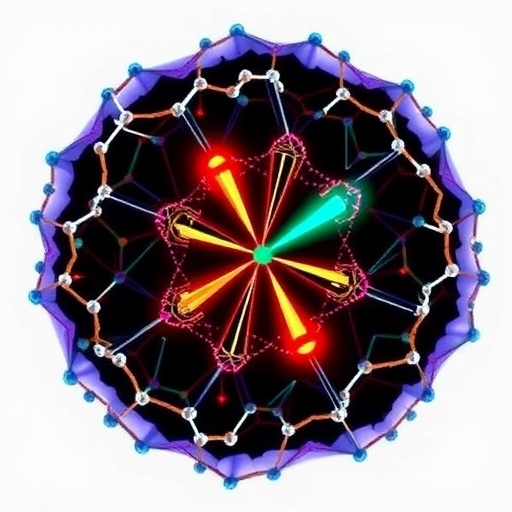
In a groundbreaking advancement that promises to reshape the landscape of photonics and optoelectronics, researchers at Rice University have successfully fabricated large-scale, highly ordered films composed exclusively of chiral carbon nanotubes (CNTs). These nanoscale cylindrical structures, defined by their left- or right-handed helical twists, have long been hypothesized to exhibit extraordinary nonlinear optical properties, particularly in second harmonic generation (SHG). However, until now, the lack of pure, aligned chiral CNT samples has obstructed direct empirical validation. The new findings confirm, with remarkable clarity, that these chiral films can convert the frequency of incoming light with an efficacy two to three orders of magnitude greater than materials conventionally employed.
Carbon nanotubes themselves, first discovered in the early 1990s, have captivated scientists due to their exceptional electrical conductivity, mechanical robustness, flexibility, and featherlight mass. Despite these promise-laden qualities, synthesizing pure, uniform batches with consistent chirality—essentially, a handed twist direction—has been a monumental hurdle. This randomness in chirality distribution means that macroscopic samples typically contain equal proportions of right- and left-handed nanotubes, causing their chiral optical effects to negate each other when observed as a collective ensemble.
This intrinsic cancellation effect has, until the present study, precluded precise measurement of the second harmonic generation phenomena in chiral CNTs. SHG is a nonlinear optical process wherein two photons interacting with a material merge to form a single photon with twice the frequency and half the wavelength. Practically, this means that two infrared photons invisible to the human eye can be upconverted into a visible photon. Theory long posited chiral carbon nanotubes as exceptional SHG materials, but experimental confirmation and quantification were elusive due to the lack of high-purity chiral nanotube crystals.
The breakthrough came through a multi-institutional collaboration spearheaded by Rice University’s Junichiro Kono and Hanyu Zhu, in partnership with Kazuhiro Yanagi’s team at Tokyo Metropolitan University. Yanagi’s group meticulously isolated nanotubes of a single chirality, which were then aligned meticulously by the Rice team to create thin films spanning several centimeters in diameter. This wafer-scale assembly exhibited uniform optical characteristics, establishing an unprecedented platform for probing chiral CNT properties.
When subjected to laser pulses, the aligned chiral CNT films exhibited a ‘giant’ second harmonic generation response, distinguished by their unique one-dimensional structure. Dimensionally, these materials possess two cross-sectional dimensions on the scale of a nanometer, yet extend significantly in the third dimension, forming wire-like tubes. This pronounced anisotropy catalyzes intense light-matter interactions, especially through exciton states—bound pairs of electrons and holes—that amplify nonlinear optical responses.
Two collaborators, Vasili Perebeinos of the University at Buffalo and Riichiro Saito from Tohoku University, provided critical theoretical work elucidating the pivotal role of excitons in driving the enhanced SHG effect observed. Their refined models allowed for accurately predicting the unusual strength of second-order nonlinear optical behavior exclusive to one-dimensional materials such as chiral CNTs. The confluence of theory and experiment marks a seminal validation of long-standing hypotheses in quantum nanophotonics.
The ramifications of these results reach beyond academic curiosity; SHG is a cornerstone technology in laser science and optoelectronic devices. Significantly stronger SHG materials enable the miniaturization of components responsible for controlling and converting light signals, fostering the development of more compact, energy-efficient systems. The demonstrated flexibility of carbon nanotube films further broadens their applicability to next-generation flexible electronics and photonics, sectors that increasingly demand materials capable of conforming to varied substrates.
Moreover, the compatibility of these chiral CNT films with existing silicon photonics infrastructures suggests a seamless route toward integrating advanced nonlinear optical functionality into optical communication networks. Such integration could underpin ultrafast optical information processing and herald novel architectures for light-based computation, potentially surpassing the speed limitations of contemporary electronic circuits.
While conventional nonlinear optical materials have served the industry adequately, they often present limitations in terms of mechanical rigidity, scaling, and integration flexibility. Chiral carbon nanotube films, by virtue of their one-dimensional morphology and intrinsic chirality, not only outperform these materials in SHG efficiency but also offer advantages in mechanical robustness, fabrication scalability, and functional versatility.
The interdisciplinary research was made possible through funding and support from several prestigious bodies, including the U.S. National Science Foundation, the Robert A. Welch Foundation, the Air Force Office of Scientific Research, the Chan Zuckerberg Initiative, and multiple Japanese scientific agencies. This collaborative framework underscores the global commitment to advancing nanotechnology and photonics.
The authors emphasize that their work, detailed in the journal ACS Nano, has opened avenues for both fundamental science and applied technology. The perfect alignment and purification of chiral CNTs represent a monumental stride in realizing the material’s full potential, transforming long-held theoretical predictions into practical demonstrations that can catalyze innovations in optical communications, flexible devices, and quantum information technology.
As research continues, the Rice team anticipates exploring additional nonlinear optical phenomena in chiral CNT films and investigating their integration into complex photonic circuits. The capacity to tune the chirality and arrangement of these nanotubes offers tantalizing prospects for custom-designed optical materials with capabilities hitherto unimaginable—heralding a new era in material science and applied physics.
News Publication Date: May 18, 2026
Web References:
https://dx.doi.org/10.1021/acsnano.6c06017
https://news.rice.edu/
References: Rui Xu, Jacques Doumani, Viktor Labuntsov, Nina Hong, Anna-Christina Samaha, Weiran Tu, Fuyang Tay, Elizabeth Blackert, Jiaming Luo, Mario El Tahchi, Weilu Gao, Jun Lou, Yohei Yomogida, Kazuhiro Yanagi, Riichiro Saito, Vasili Perebeinos, Andrey Baydin, Junichiro Kono, Hanyu Zhu, “Chip-Scale Aligned Chiral Carbon Nanotubes Exhibiting Giant Second Harmonic Generation,” ACS Nano, 2026.
Keywords
Carbon nanotube synthesis, Carbon nanotubes, Carbon nanotube applications, Physical properties, Chirality, Optics, High harmonic generation, Laser pulses, Excitons
Cite Scienmag News
Bethany Barker. (May 19, 2026). Scientists Observe Massive Light-Conversion Effect in Chiral Carbon Nanotubes. Scienmag. https://scienmag.com/scientists-observe-massive-light-conversion-effect-in-chiral-carbon-nanotubes/
Bethany Barker. "Scientists Observe Massive Light-Conversion Effect in Chiral Carbon Nanotubes." Scienmag, 19 May 2026, https://scienmag.com/scientists-observe-massive-light-conversion-effect-in-chiral-carbon-nanotubes/. Accessed 3 September 2026.
Bethany Barker. "Scientists Observe Massive Light-Conversion Effect in Chiral Carbon Nanotubes." Scienmag. May 19, 2026. https://scienmag.com/scientists-observe-massive-light-conversion-effect-in-chiral-carbon-nanotubes/


