


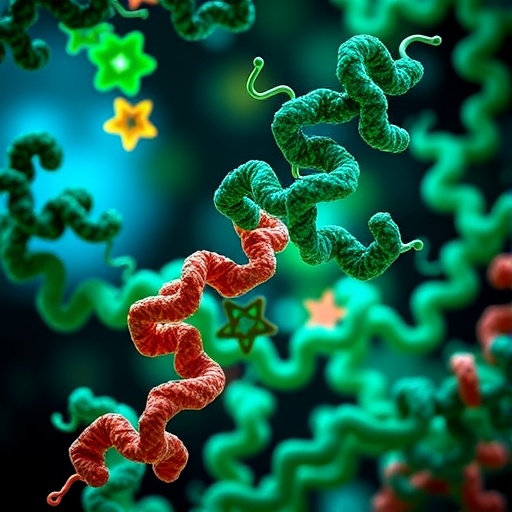
In a groundbreaking study published in Nature Chemistry, a team of researchers led by Wang, Z., He, X., and Zhang, X. has unveiled an innovative strategy to selectively degrade G-quadruplex-binding proteins (G4BPs) within chromatin. This pioneering approach leverages the design of proteolysis-targeting chimeras (PROTACs) based on G4 ligands, enabling unprecedented control over protein regulation directly at the chromatin interface. The implications of this work extend across molecular biology, epigenetics, and therapeutic development, signaling a new era in the targeted manipulation of DNA secondary structure-interacting proteins.
G-quadruplexes (G4s) are unique nucleic acid secondary structures formed by guanine-rich sequences in DNA or RNA. These four-stranded conformations have emerged as critical regulatory elements in genomic loci, influencing replication, transcription, and genome stability. Proteins that bind G-quadruplexes are instrumental in modulating these processes. Yet, until now, the ability to precisely manipulate G4-binding proteins within the native chromatin context has remained elusive, limiting our understanding and therapeutic targeting possibilities.
This novel research circumvents prior limitations by employing PROTAC technology, a method that harnesses the cell’s endogenous ubiquitin-proteasome system to selectively degrade proteins of interest. What distinguishes this study is the clever conjugation of G4 ligands, molecules known to bind specifically to G-quadruplex DNA sequences, to the PROTAC scaffold. This fusion effectively recruits E3 ubiquitin ligases to G4-binding proteins anchored to the DNA, triggering their ubiquitination and subsequent degradation.
The design of these G4-ligand-based PROTACs required meticulous optimization. The researchers synthesized a series of chimeric molecules wherein potent G4 ligands were chemically linked to ligase-recruiting moieties. These constructs had to balance affinity and specificity for G-quadruplexes, cellular permeability, and stability—all critical parameters for successful in-cell protein degradation. Using cutting-edge biophysical assays and cellular imaging, the researchers demonstrated that these PROTACs selectively recognize and degrade targeted G4-binding proteins without affecting other chromatin-associated factors.
Functional assays revealed profound biological effects following the depletion of specific G4-binding proteins. For instance, the degradation of a key helicase involved in G-quadruplex resolution led to replication stress and activation of DNA damage response pathways, underscoring the essential role of G4BPs in maintaining genomic integrity. Notably, the degradation was temporally controllable and reversible, highlighting the utility of this strategy in dissecting the dynamic functions of G4 structures during cellular processes.
The implications of this technology for cancer research are particularly compelling. Aberrant G-quadruplex formation and dysregulated G4BP activity have been implicated in oncogene expression and tumorigenesis. By providing a mechanism to selectively degrade these proteins, the newly developed PROTACs open avenues for therapeutic intervention in cancers where G4 proteins contribute to malignancy. This approach might complement or even surpass existing small-molecule inhibitors, offering higher specificity and reduced off-target effects.
Central to the researchers’ approach was the integration of comprehensive chromatin profiling techniques. By combining chromatin immunoprecipitation with mass spectrometry and next-generation sequencing, they meticulously mapped the interaction landscape of the G4-binding proteins pre- and post-degradation. This multi-layered analysis illuminated the downstream genomic and epigenomic consequences, revealing novel regulatory circuits modulated via G-quadruplex engagement.
The study also raises intriguing questions about the broader applicability of ligand-guided PROTACs targeting other DNA or RNA secondary structures. Given the vast repertoire of protein-nucleic acid interactions that govern gene expression and cellular homeostasis, this methodology could establish a platform for selective modulation of proteins involved in diverse nucleic acid architectures such as i-motifs or R-loops, potentially revolutionizing how molecular biologists dissect complex regulatory networks.
Furthermore, the researchers delved into structural aspects, using nuclear magnetic resonance (NMR) and X-ray crystallography to elucidate the conformation of the G4 ligand-PROTAC complexes bound to their G-quadruplex targets. These insights provided mechanistic understanding of how the chimeric molecules achieve simultaneous binding to DNA structures and recruitment of E3 ligase components. Such structural clarity will inform future rational design efforts to enhance efficacy and specificity.
The cellular delivery and pharmacokinetics of these G4 ligand-based PROTACs were also systematically characterized. Through live-cell imaging and biochemical assays, the study confirmed efficient nuclear localization and minimal cytotoxicity at functional doses. These promising in vitro data pave the way for in vivo evaluation, critical for therapeutic translation.
Importantly, the authors addressed potential challenges, such as off-target effects and resistance mechanisms. They proposed strategies including iterative chemical modifications and combinatorial targeting to refine selectivity and sustainability of protein degradation. By providing a detailed roadmap, this work anticipates hurdles in clinical applications and establishes a framework for safe and effective use.
In sum, this research represents a major leap forward in chemical biology and genomic regulation manipulation. By innovatively marrying G4 ligand selectivity with the robustness of PROTAC-mediated degradation, Wang and colleagues have expanded the toolkit available for probing and modulating intricate protein-DNA interactions. Their work not only enhances our fundamental understanding of G-quadruplex biology but also introduces a versatile platform with broad biomedical potential.
Future investigations inspired by this study are likely to probe the therapeutic scope of G4-targeted degradation in diverse pathological contexts, including neurodegenerative diseases and viral infections where G4 structures play pivotal roles. Additionally, coupling this degradation strategy with high-resolution single-cell and live-cell methodologies may unlock new dimensions in the spatiotemporal orchestration of genome regulation.
As the field moves forward, the convergence of chemical synthesis, structural biology, and chromatin dynamics epitomized by this work will serve as a beacon for interdisciplinary innovation. The implications of manipulating G4-binding proteins with such precision extend beyond basic science, promising impactful translational breakthroughs in precision medicine and targeted therapies.
Ultimately, the creation of G4-ligand-based PROTACs heralds a paradigm shift: proteins once considered challenging to target within the chromatin milieu are now accessible for controlled degradation. This milestone will undoubtedly accelerate discoveries in genome biology and foster novel therapeutic strategies against diseases rooted in genomic dysregulation.
Cite Scienmag News
Juliet Wilcox. (March 19, 2026). Targeting G-Quadruplex Proteins with G4-Ligand PROTACs. Scienmag. https://scienmag.com/targeting-g-quadruplex-proteins-with-g4-ligand-protacs/
Juliet Wilcox. "Targeting G-Quadruplex Proteins with G4-Ligand PROTACs." Scienmag, 19 March 2026, https://scienmag.com/targeting-g-quadruplex-proteins-with-g4-ligand-protacs/. Accessed 1 September 2026.
Juliet Wilcox. "Targeting G-Quadruplex Proteins with G4-Ligand PROTACs." Scienmag. March 19, 2026. https://scienmag.com/targeting-g-quadruplex-proteins-with-g4-ligand-protacs/


