


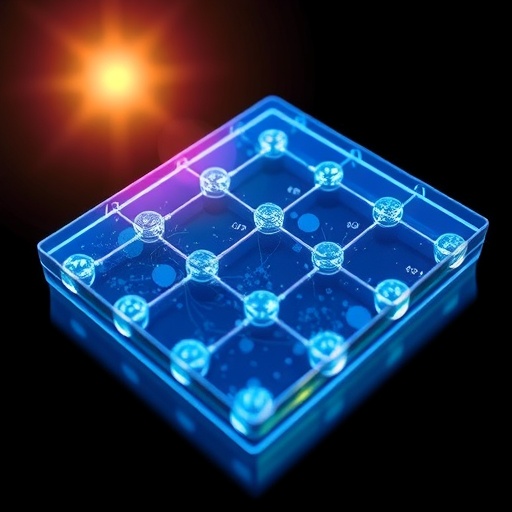
Researchers at Ludwig-Maximilians-Universität München (LMU) have pioneered a molecular engineering breakthrough that could revolutionize the durability of perovskite solar cells in extreme environments, particularly for space applications. Led by Dr. Erkan Aydin from LMU’s Department of Chemistry and Pharmacy, the team developed a sophisticated “anchored net” molecular architecture designed to enhance resistance against the harsh thermal cycling conditions experienced in Low Earth Orbit (LEO). This innovation promises to mitigate the longstanding issue of mechanical fatigue in these promising photovoltaic devices, ensuring sustained high performance despite extreme temperature fluctuations.
Perovskite solar cells have rapidly emerged as a transformative technology within the photovoltaic industry, owing to their high power conversion efficiencies and cost-effective production processes. Yet, one of the primary hurdles to their widespread deployment—especially in demanding operational contexts like aerospace—is their mechanical instability. Materials within these cells, when subjected to the drastic temperature swings characteristic of space environments, undergo differential expansion and contraction. This phenomenon generates substantial mechanical stresses that precipitate delamination, micro-cracking, and overall degradation in photovoltaic performance.
Understanding the severe thermal stress conditions in orbit, which typically range from −80°C to +80°C as satellites alternately endure direct solar irradiation and cold shadowed phases, the LMU team sought to replicate these extremes in their experimental frameworks. Their goal was to create a solar cell architecture resilient enough to maintain integrity and efficiency after repeated thermal cycling—a critical requirement to ensure the viability of perovskite-based photovoltaics in space and other extreme environments such as high-altitude airborne platforms.
Central to their approach was the strategic manipulation at the molecular level of two critical regions within the solar cells: the grain boundaries within the perovskite layer and the interface between the perovskite and its underlying substrate. The researchers introduced α-lipoic acid molecules into the perovskite during fabrication, which undergo in situ partial polymerization, forming an interlinked network that reinforces the grain boundaries. This molecular “mesh” acts as a stabilizing scaffold, reducing the formation of defects and bolstering the mechanical resilience of the perovskite matrix as it experiences thermal expansion and contraction.
Complementing this grain boundary reinforcement, the team innovated at the interface level by designing sulfonium-based molecules that chemically bond the perovskite to the electrode substrate with exceptional strength. The molecule dimethylsulfonium-lipoic acid (DMSLA) emerged as particularly effective, functioning as a tenacious molecular tether. This “anchored net” scaffold not only mitigates interfacial delamination but also accommodates the dynamic mechanical strains induced by cycling temperatures, thereby preserving the device’s structural and functional coherence.
Dr. Aydin analogizes this molecular system to a “flexible, anchored net” that secures and maintains the integrity of the light-absorbing perovskite layer on its substrate. This nuanced molecular interlacing enables the solar cells to adapt to dramatic thermal oscillations without succumbing to the typical pathways of mechanical failure. The result is a solar cell architecture that can endure the rigors of repeated thermal stress while sustaining operational efficiency.
The performance data are compelling. The modified perovskite solar cells achieved power conversion efficiencies reaching 26%, a notable improvement over the 23% efficiency benchmark set by untreated control devices. Crucially, after undergoing 16 rigorous thermal cycles between −80°C and +80°C, the engineered cells retained 84% of their initial efficiency, whereas the reference cells exhibited a significantly more pronounced degradation. This demonstrates not only the effectiveness of the molecular reinforcements in enhancing thermal fatigue resistance but also underscores the practical longevity gains for perovskite solar cells.
One insightful revelation from the study pertains to the dynamics of material degradation. The degradation was predominantly front-loaded during the initial thermal cycles, emphasizing that the total duration of thermal stress exposure may have a greater impact than merely the number of cycles. This finding suggests that material and interface engineering strategies must focus on mitigating early-stage mechanical failures to maximize lifespan.
The implications of this research extend beyond the laboratory. The innovative molecular anchoring strategy offers a viable pathway for implementing perovskite solar cells in harsh environments where weight, mechanical resilience, and efficiency are paramount. Space exploration missions, in particular, stand to benefit from this technology, as it addresses the acute challenge of thermal fatigue. Moreover, this approach opens new avenues for developing lightweight, flexible solar modules deployable on airborne platforms operating in the stratosphere and other terrestrial applications exposed to severe temperature variability.
Importantly, this development aligns with the pressing demand for robust, efficient, and cost-effective photovoltaic technologies in the global pursuit of sustainable energy solutions. By enhancing the fundamental durability of perovskite solar cells without compromising their intrinsic efficiency advantages, the LMU research team has provided a critical advancement on the path towards commercializing next-generation photovoltaics for both terrestrial and extraterrestrial applications.
Dr. Aydin emphasizes the significance of addressing both interfacial and grain boundary weaknesses to achieve a mechanically resilient device. This dual-pronged molecular strategy marks a new paradigm in the materials science of perovskites, highlighting how careful chemical design at the molecular interface can translate to macroscale performance gains. Future research by the group is set to delve deeper into the molecular mechanisms governing degradation under extreme conditions and to expand the applicability of these findings.
In summary, this breakthrough represents a milestone in photovoltaic research, demonstrating that perovskite solar cells can be molecularly engineered for enhanced robustness in extreme thermal environments. By integrating α-lipoic acid networks at grain boundaries and sulfonium-based anchoring molecules at critical interfaces, LMU’s innovative approach stabilizes these cells against mechanical fatigue and unlocks their potential for reliable use in space and beyond.
This work, published on March 9, 2026, in Nature Communications, charts a promising course toward realizing durable, high-efficiency perovskite solar cells designed to meet the demanding conditions of space travel and other challenging environments. The convergence of molecular chemistry and materials engineering embodied in this research is paving the way for transformative advances in renewable energy technologies.
—
News Publication Date: 9-Mar-2026
Web References: DOI: 10.1038/s41467-026-70293-7
Keywords
Perovskite solar cells, thermal fatigue resistance, molecular engineering, α-lipoic acid, dimethylsulfonium-lipoic acid, DMSLA, mechanical stability, grain boundary reinforcement, interface stabilization, Low Earth Orbit, photovoltaic durability, space solar cells, thermal cycling
Cite Scienmag News
Bethany Barker. (March 19, 2026). Perovskite Solar Cells Enhanced for Stability Amid Extreme Temperature Swings. Scienmag. https://scienmag.com/perovskite-solar-cells-enhanced-for-stability-amid-extreme-temperature-swings/
Bethany Barker. "Perovskite Solar Cells Enhanced for Stability Amid Extreme Temperature Swings." Scienmag, 19 March 2026, https://scienmag.com/perovskite-solar-cells-enhanced-for-stability-amid-extreme-temperature-swings/. Accessed 4 September 2026.
Bethany Barker. "Perovskite Solar Cells Enhanced for Stability Amid Extreme Temperature Swings." Scienmag. March 19, 2026. https://scienmag.com/perovskite-solar-cells-enhanced-for-stability-amid-extreme-temperature-swings/


