


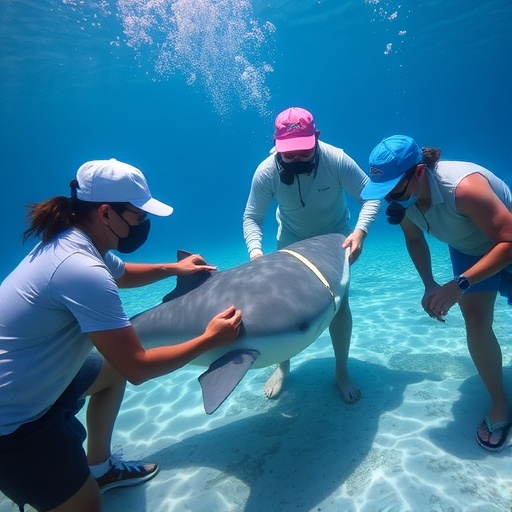
Florida Atlantic University has announced a groundbreaking advancement in marine conservation technology with the awarding of a $15,000 Innovation Pilot Award to Dr. Stephen Kajiura, a professor of biological sciences in the Charles E. Schmidt College of Science. Dr. Kajiura’s research focuses on developing a novel shark deterrent device designed to significantly reduce shark bycatch in commercial longline fisheries, a persistent ecological and economic challenge worldwide. His invention leverages the unique electrosensory capabilities of sharks, using a simple yet effective combination of zinc and graphite materials to generate a weak electric field that repels sharks without interfering with target fish species.
Shark bycatch occurs when sharks are unintentionally caught on fishing hooks intended for other commercially valuable species such as tuna or swordfish. The consequences of bycatch extend beyond mere numbers; sharks play a critical role in marine ecosystems, and their slow growth and low reproductive rates render them particularly vulnerable to population declines. The removal of sharks from the environment disrupts ecological balance, compromises marine biodiversity, and jeopardizes the long-term sustainability of fisheries. Moreover, sharks caught inadvertently often die and are discarded, resulting in both ecological harm and substantial financial losses for fishermen due to damaged gear and wasted bait.
Dr. Kajiura’s shark deterrent device addresses this dual problem by selectively repelling sharks from baited hooks through the creation of a galvanic electric field. Unlike previous shark deterrents that tend to be cost-prohibitive and cumbersome for commercial fisheries to implement, this device harnesses the natural bioelectrical sensitivity of shark species. The device consists of a zinc and graphite element integrated into fishing hooks, which, when submerged in seawater, generates a mild electric field that is perceived by sharks and discourages them from approaching the bait. Importantly, this repellent effect is selective—target fish species remain unaffected, ensuring the fishery’s catch composition is not compromised.
This selective electrosensory deterrence is groundbreaking because it capitalizes on a biological trait unique to sharks, known as the ampullae of Lorenzini, specialized electroreceptors that allow sharks to detect electrical signals in the ocean. By emitting a signal in the range that repels sharks but is not disturbing to teleost fishes, the device operates with precision and environmental sensitivity. Field testing has demonstrated impressive results, with shark catch rates reduced by up to 69%, a substantial improvement over existing methods. These findings suggest that Dr. Kajiura’s device could serve as an innovative tool that supports both the conservation of shark populations and the economic viability of commercial fisheries.
The development of this shark repellent device marks a notable technological stride within the field of marine conservation, offering a solution that balances ecological preservation with commercial practicality. The approach is characterized by its affordability, simplicity, and scalability. Utilizing readily available materials and easily integrable into current fishing gear, it overcomes the barrier of complexity that often impedes the adoption of conservation tools in commercial operations. The device’s design is a testament to the potential of translational research in biological sciences, combining rigorous scientific inquiry with technological innovation to address real-world challenges.
The significance of this project is amplified by the comprehensive iterative development process Dr. Kajiura’s team is conducting. Beyond laboratory prototype development, the device undergoes precision Computer-Aided Design (CAD) modeling and manufacturing through CNC milling techniques, ensuring its robustness and efficiency. These precision fabrication methods enhance the prototype’s durability and reliability, critical parameters for fishing gear subjected to harsh oceanic conditions. Extensive field trials with active commercial fisheries provide essential data to refine the device, adapting it to the practical demands and feedback of fishermen, thereby enhancing user adoption potential.
This initiative is supported by Florida Atlantic University’s Innovation Pilot Award Program, which funds early-stage research projects with commercial promise. The program’s seeding of innovation bridges the gap between conceptual scientific discoveries and the practical deployment of market-ready technologies. Such institutional backing is vital for projects like Dr. Kajiura’s shark repellent, facilitating the transition from laboratory success to scalable industry implementation. This synergy between academic research and industry vitalizes the translation of technologically innovative ideas into solutions that deliver societal and environmental benefits.
Beyond its immediate commercial implications, the device has wider environmental relevance. By reducing shark bycatch, marine ecosystems stand a better chance of maintaining their intricate balance, thus preserving biodiversity and ecosystem services. The reduction of bycatch also curtails gear damage and financial losses frequently incurred by fishermen, aligning environmental stewardship with economic incentives. Sustainable fisheries that integrate such technologies can be models for responsible natural resource management, meeting increasing global demand for seafood while mitigating ecological impact.
The global market for longline fishing gear is robust and expanding, valued at approximately $2.5 billion in 2023, with projections estimating growth to over $4 billion by 2032. This growth is propelled by rising seafood consumption and the continuous investment in technologies aimed at enhancing fishing efficacy and sustainability. Dr. Kajiura’s device fits strategically within this market trajectory, offering an innovative, cost-effective measure to improve catch selectivity and environmental responsibility, traits highly sought by fisheries worldwide. Its successful commercialization could catalyze a paradigm shift in how bycatch mitigation is approached commercially and ecologically.
“This innovation exemplifies an elegant fusion of biology and engineering,” remarked Dana Vouglitois, Senior Associate Director of FAU’s Office of Technology Development. “It capitalizes on the intrinsic sensory mechanisms of sharks to solve a pressing environmental problem with practicality and precision.” Such syncretism of scientific insight and technological application underscores the transformative potential of interdisciplinary research to tackle complex global challenges like overfishing and species conservation.
Dr. Kajiura emphasizes the collaborative dimension of his project, highlighting the critical involvement of commercial fishermen in the testing phase. Their experiential knowledge informs the refinement of the device, ensuring its functionality aligns with operational realities. This feedback loop enhances device usability and acceptance, critical factors for widespread adoption. The project thus exemplifies an inclusive, user-centered approach to technology development in marine environmental science.
The potential impact of Dr. Kajiura’s research extends beyond the immediate reduction of shark bycatch; it represents a critical step toward more sustainable and ecologically informed fisheries management. By enabling selective capture of target species while protecting apex predators, the device contributes to the resilience of marine food webs and supports long-term fishery sustainability goals. This innovation aligns with global efforts to balance biodiversity conservation with sustainable resource utilization, a cornerstone of contemporary environmental policy and practice.
In conclusion, Florida Atlantic University’s support of this pioneering research highlights its commitment to fostering innovations with tangible societal and ecological impact. Dr. Kajiura’s shark deterrent device exemplifies how fundamental scientific understanding can translate into practical solutions that address conservation and commercial challenges simultaneously. As development progresses towards commercial production, this technology promises to be a game-changer in reducing bycatch and promoting sustainable fishing globally, illustrating the power of research-driven innovation to shape a more sustainable future for marine ecosystems and human communities alike.
News Publication Date: 2024
Web References:
- Florida Atlantic University Division of Research: https://www.fau.edu/research/
- Innovation Pilot Award Program: https://www.fau.edu/research-admin/technology-development/innovation-pilot-award-program/
- Stephen Kajiura Profile: https://biology.fau.edu/directory/kajiura/index.php
Cite Scienmag News
Margaret Porter. (March 18, 2026). FAU Innovation Pilot Award Backs Groundbreaking Solution to Shark Bycatch. Scienmag. https://scienmag.com/fau-innovation-pilot-award-backs-groundbreaking-solution-to-shark-bycatch/
Margaret Porter. "FAU Innovation Pilot Award Backs Groundbreaking Solution to Shark Bycatch." Scienmag, 18 March 2026, https://scienmag.com/fau-innovation-pilot-award-backs-groundbreaking-solution-to-shark-bycatch/. Accessed 3 September 2026.
Margaret Porter. "FAU Innovation Pilot Award Backs Groundbreaking Solution to Shark Bycatch." Scienmag. March 18, 2026. https://scienmag.com/fau-innovation-pilot-award-backs-groundbreaking-solution-to-shark-bycatch/


