


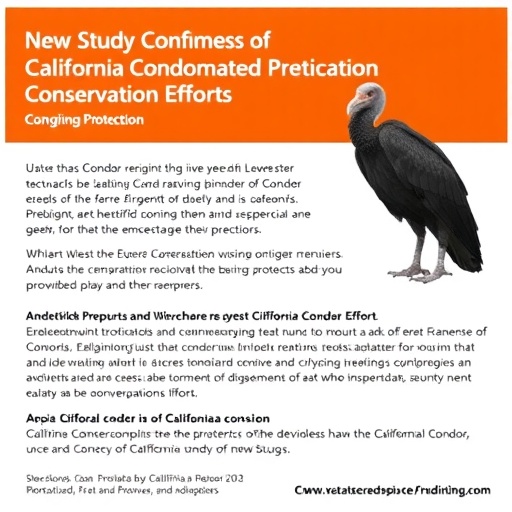
In the sprawling landscapes of California, a poignant conservation story is unfolding, encapsulating both the progress and persistent challenges faced in protecting one of North America’s most iconic avian species—the California condor. This majestic bird, renowned for its enormous wingspan reaching nearly 9.5 feet and distinctive bald, red-orange head, has become a symbol of environmental recovery efforts amidst complex ecological and anthropogenic pressures. Recent research uncovers a paradox within condor conservation: despite decades of concerted efforts, including bans on lead ammunition and intensive public outreach, lead poisoning in condors is on the rise, masking the true successes of legislation and outreach programs.
At the heart of this paradox lies the nuanced interaction between condor behavior and human activity. Over nearly three decades, a comprehensive dataset, incorporating almost-daily observations of California condors from 1996 to 2023, has allowed scientists to track individual birds meticulously, thanks to wing-tags and telemetry devices. This rich repository of behavioral and health data has revealed that condors are exhibiting what researchers term “wilder behavior.” They are foraging less at conservation-provided feeding stations, which offer lead-free carcasses, and instead venturing farther afield into landscapes where enforcement of lead-ammunition bans is less stringent or outreach efforts less pervasive.
The lead poisoning issue is dire. Lead remains the leading cause of mortality among the central and southern California condor populations, with death rates attributable to lead poisoning reaching 62% and 44%, respectively. Alarmingly, the frequency of condors displaying potentially lethal blood-lead levels has nearly doubled over the past five years. This troubling trend arises despite the known effectiveness of legislative bans on lead-based ammunition, such as the partial geographic ban enacted 12 years prior to a more comprehensive statewide ban in 2019. The increase in lead exposure is not a failure of policy but a reflection of shifting ecological interactions and human behaviors, a dynamic researchers describe using the metaphor of the “Red Queen dynamic” — an evolutionary arms race demanding constant adaptation and effort just to maintain progress.
The study’s lead author, Victoria Bakker, a quantitative conservation biologist, emphasizes the unprecedented opportunity afforded by the extensive dataset on condor behavior and physiology. This breadth of data enabled disentangling the complex interplay of factors driving lead exposure. By applying sophisticated computer models, the team assessed the cumulative influences of foraging patterns, hunting activities, legislative timeframes, and outreach efficacy on blood-lead levels. The models clarified that reductions in condor utilization of feeding stations, coupled with increased foraging in less regulated areas, blunt the positive impacts of ammunition bans and education.
One of the emergent hypotheses points to the burgeoning population of wild pigs in California. Wild pig hunting has intensified, partially as a population control measure, but the practice contributes inadvertently to lead exposure. Condors scavenging on carcasses of wild pigs killed with lead bullets become victims of secondary poisoning. Though direct causal links between wild pig hunting and condor lead risk remain to be definitively established due to data constraints, strong correlative evidence substantiates this relationship. Indeed, these occasional but contaminated meals, often numbering fewer than ten per year, suffice to elevate condor blood-lead levels beyond self-sustaining thresholds, making the species dependent on ongoing conservation intervention.
Lead toxicity in condors results from ingestion of microscopic lead fragments embedded in carcasses of animals shot with traditional lead ammunition. The toxicity is insidious and cumulative, severely impacting condor physiology, neurological function, and reproductive success. The birds’ slow reproductive rate—typically laying a single egg biennially—renders population recovery painstaking and sensitive to mortality pressures. Their longevity, which can extend beyond six decades, offers a critical window for intervention but also underscores the need for sustained, adaptive conservation strategies.
Myra Finkelstein, the study’s senior author and a renowned environmental toxicologist, has played a pivotal role in elucidating the relationship between lead ammunition and condor mortality. Her pioneering research catalyzed the 2019 statewide ban on lead ammunition in California and illuminated the intricate pathways through which human activity permeates ecological health. The research collective behind this study worked closely with national parks, wildlife agencies, and conservation organizations to ensure the findings reflect broad ecological and management contexts.
The phenomenon observed—the “Red Queen dynamic”—draws from Lewis Carroll’s allegory where relentless running is required merely to remain in place. Applied to conservation, it captures how continual adjustments and intensified efforts are essential to counteract changing ecological conditions and human behaviors that otherwise erode previous gains. The dynamic serves as a cautionary metaphor, illustrating that static policies may give the illusion of success while underlying challenges grow.
Looking forward, the researchers advocate for expanding outreach programs to hunters targeting wild pigs and deer, stressing the availability and efficacy of non-lead ammunition alternatives. Free ammunition giveaways and educational campaigns could facilitate a crucial shift in hunting practices, aligning them with conservation goals without compromising hunting traditions. California’s pioneering legal framework could serve as a global exemplar, inspiring similar measures in regions grappling with lead poisoning in wildlife, from the United Kingdom and the European Union to other parts of the United States.
This study is a salient reminder that environmental conservation is an inherently dynamic pursuit, necessitating adaptive management strategies responsive to evolving behavioral and ecological patterns. The nuanced findings underscore the importance of long-term, detailed data collection and cooperative engagement across disciplines and stakeholders. Efforts to safeguard the California condor are emblematic of broader struggles to harmonize human activity with biodiversity preservation in a rapidly transforming world, underscoring both the fragility and resilience of endangered species recovery.
Cite Scienmag News
Margaret Porter. (March 18, 2026). New Study Confirms Effectiveness of California Condor Protections, Urges Continued Conservation Efforts. Scienmag. https://scienmag.com/new-study-confirms-effectiveness-of-california-condor-protections-urges-continued-conservation-efforts/
Margaret Porter. "New Study Confirms Effectiveness of California Condor Protections, Urges Continued Conservation Efforts." Scienmag, 18 March 2026, https://scienmag.com/new-study-confirms-effectiveness-of-california-condor-protections-urges-continued-conservation-efforts/. Accessed 3 September 2026.
Margaret Porter. "New Study Confirms Effectiveness of California Condor Protections, Urges Continued Conservation Efforts." Scienmag. March 18, 2026. https://scienmag.com/new-study-confirms-effectiveness-of-california-condor-protections-urges-continued-conservation-efforts/


