


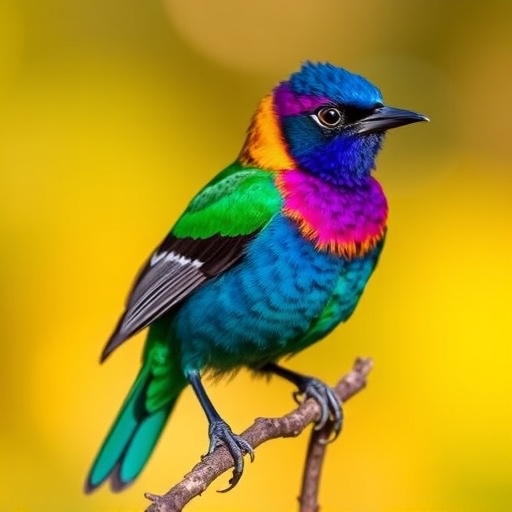
As climate change relentlessly drives global temperatures upward, the biological imperative to understand thermoregulation in avian species has never been more critical. In a groundbreaking fusion of material science and museum biology, researchers have pioneered the first-ever comprehensive exploration of the mid-infrared (MIR) spectrum in birds—a realm of light invisible to both humans and birds. Revealed in a recent study published in Integrative Organismal Biology, this interdisciplinary investigation exposes how bird feathers interact with heat radiation, opening a new chapter in thermal ecology and evolutionary biology.
Historically, the scientific discourse on bird coloration has predominantly focused on the visible and ultraviolet spectra—wavelengths that inform behaviors such as mate selection and camouflage. This new research broadens the horizon by delving into the mid-infrared domain, a segment of the electromagnetic spectrum central to thermal radiation emission but heretofore understudied in avian subjects. The team meticulously measured both the reflective and emissive properties of feathers, illuminating how different populations regulate heat through their integumentary surfaces.
“This collaboration bridges a crucial gap,” elucidates Thomas Lee, co-lead author and UCLA PhD candidate. “Engineers excel at developing passive cooling technologies, inspired by nature’s own sophisticated adaptations, but they often lack access to the biological materials that underpin these systems. This partnership merges expertise, leveraging advanced spectrometry tools traditionally beyond biology’s reach.”
The technical challenge was immense. Mid-infrared wavelengths, typically ranging from 3 to 8 micrometers, are notoriously difficult to measure, especially on delicate biological samples. To overcome these obstacles, the team employed state-of-the-art spectrometers capable of quantifying both MIR reflectance and emittance, which permitted a nuanced examination of heat transfer dynamics through feathers. These measurements were complemented by assessments in the near-infrared and visible-UV ranges to provide a holistic understanding of bird coloration’s thermal and optical functions.
The study’s focal species represent a diverse cross-section of North American avifauna—five species spanning multiple geographic loci. Northern bobwhites, great horned owls, stellar’s jays, song sparrows, and common ravens were analyzed using museum specimens from disparate regions, providing a rare glimpse into intraseasonal and interspecies variability in infrared radiation handling. Notably, bobwhites displayed pronounced differences in mid-infrared emittance, correlating strongly with their exposure to open sky environments, which contrast with the shaded, forested habitats of other birds.
Dr. Allison Shultz, curator of ornithology at the Natural History Museum of Los Angeles County and co-author, explains the ecological significance: “Birds in open habitats like grasslands are subjected to unimpeded radiative cooling to the cold vacuum of space. This selective pressure likely drives adaptations in feather microstructure to optimize mid-infrared emission, a mechanism akin to nature’s passive cooling technology.”
The research underscores an often-overlooked facet of thermoregulation: the role of space as a thermal sink. Since outer space is near absolute zero, species exposed directly to the sky can radiate heat efficiently via the mid-infrared spectrum, an evolutionary advantage under rising thermal stress. Conversely, forest-dwelling birds exhibit less mid-infrared variability, as canopy cover shields them, mitigating selection for enhanced MIR emissivity.
Further insights were obtained from near-infrared reflectance analyses, which revealed surprising diversity within subspecies, notably in common ravens. These birds, which visually appear uniformly black, possess feathers that differentially absorb heat, a discovery that challenges assumptions about the relationship between visible coloration and thermal properties. This heterogeneity suggests microstructural or compositional feather differences that modulate heat gain in their respective habitats.
These findings portend significant implications for biomimetic engineering. Understanding how birds naturally optimize heat emission to navigate climatic challenges informs innovations in passive cooling materials, critical for sustainable architecture and technology development. As Dr. Terry McGlynn of Cal State Dominguez Hills elaborates, “Unraveling how feather microstructures operate at microscopic scales to channel heat into space could revolutionize material science, paralleling nature’s evolutionary solutions.”
The study’s interdisciplinary methodology exemplifies the power of collaboration across biological and physical sciences. By utilizing museum specimens—historically preserved biological materials—and cutting-edge thermal spectrometry, the research transcends conventional boundaries, opening fertile ground for future investigations. It challenges the scientific community to reconceptualize avian thermoregulation beyond traditional visible-light paradigms and to embrace the full electromagnetic spectrum’s role in ecological adaptation.
Despite the small sample size in some populations, notably the trio of individual bobwhites per location, the statistical significance in mid-infrared emission differences, marked at p < 0.001 between Iowa and Mexican populations, affirms the robustness of these thermal adaptations. The team’s cautious interpretation calls for expanded sampling to refine these observations, underscoring the preliminary yet groundbreaking nature of the work.
This research beckons a redefinition of how animal coloration and heat management co-evolve under the pressures of climate change. The intricate interplay between feather microstructure, pigmentation, and thermal emissivity narrates a story of survival encoded within the invisible layers of light and heat. As global temperatures escalate, such knowledge holds promise for conserving vulnerable species and inspiring human technologies emulating life’s elegant solutions.
In summary, the revelation that bird feathers function as passive mid-infrared emitters—effectively radiating excess heat directly into the cosmic abyss—introduces a new dimension to our understanding of adaptation and resilience. This discovery reaffirms that nature remains the quintessential engineer, masterfully crafting multifunctional traits that harmonize optical aesthetics with thermal exigencies. The door is now open for future research to dissect the microscopic architecture enabling these phenomena and to harness these principles for cutting-edge thermal regulation technologies.
News Publication Date: 18-Mar-2026
Web References: 10.1093/iob/obag006
Keywords
Bird thermoregulation, mid-infrared radiation, near-infrared reflectance, avian coloration, passive cooling, biomimicry, climate adaptation, feather microstructure, thermal ecology, electromagnetic spectrum, museum biology, interdisciplinary research
Cite Scienmag News
Gavin Prescott. (March 18, 2026). Scientists Measure How Birds Radiate Heat into Space for the First Time: New Study Uncovers Hidden Reflectance of Feathers Through Light, Heat, and Color Analysis. Scienmag. https://scienmag.com/scientists-measure-how-birds-radiate-heat-into-space-for-the-first-time-new-study-uncovers-hidden-reflectance-of-feathers-through-light-heat-and-color-analysis/
Gavin Prescott. "Scientists Measure How Birds Radiate Heat into Space for the First Time: New Study Uncovers Hidden Reflectance of Feathers Through Light, Heat, and Color Analysis." Scienmag, 18 March 2026, https://scienmag.com/scientists-measure-how-birds-radiate-heat-into-space-for-the-first-time-new-study-uncovers-hidden-reflectance-of-feathers-through-light-heat-and-color-analysis/. Accessed 4 September 2026.
Gavin Prescott. "Scientists Measure How Birds Radiate Heat into Space for the First Time: New Study Uncovers Hidden Reflectance of Feathers Through Light, Heat, and Color Analysis." Scienmag. March 18, 2026. https://scienmag.com/scientists-measure-how-birds-radiate-heat-into-space-for-the-first-time-new-study-uncovers-hidden-reflectance-of-feathers-through-light-heat-and-color-analysis/


