


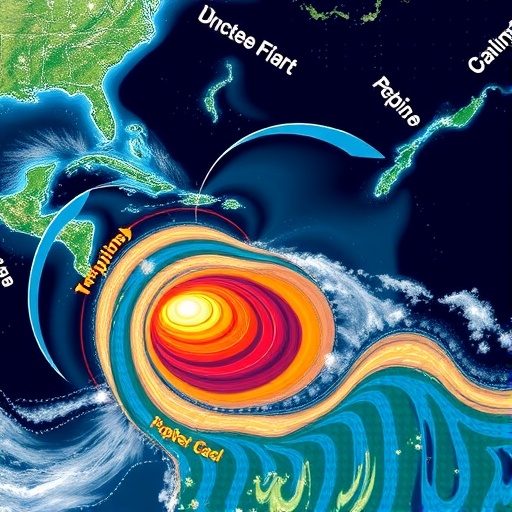
Tropical cyclones, among the most formidable natural phenomena on Earth, exert profound influences not only on local weather patterns but also on the broader planetary systems that regulate energy and water balance. Recent comprehensive reviews, such as the seminal work by Ma et al., underscore the intricate roles these cyclones play across multiple spatial and temporal dimensions. Far beyond their immediate destructive potential, tropical cyclones act as significant drivers of large-scale energy fluxes and hydrological cycles, reshaping our understanding of their function within the Earth system.
At the core of their impact is the enormous extraction of oceanic heat and moisture. Annually, tropical cyclones draw between 0.17 to 0.25 petawatts (PW) of heat from the ocean surface. This massive energy uptake is coupled with a staggering removal of water on the order of 1.9 to 2.8 quadrillion kilograms per year, which they redistribute through intense precipitation systems. Collectively, tropical cyclones contribute to between 8 and 17% of the tropical precipitation budget, underscoring their fundamental role in modulating the hydrological cycle in these regions.
The immediate aftermath of a tropical cyclone reveals intricate dynamical interactions within the atmosphere and ocean. One such phenomenon is the generation of Rossby wave trains, which propagate through the atmosphere up to a month following the event. These wave trains can significantly influence atmospheric circulation patterns, thereby modulating the genesis and intensity of successive tropical cyclones. This interplay hints at a complex feedback mechanism where one storm potentially seeds conditions for the next, contributing to seasonal variability in tropical cyclone activity.
Beneath the ocean’s surface, tropical cyclones leave behind a signature known as a cold wake—a localized region of sea surface temperature depression caused by the intense mixing and cooling of surface waters. These cold wakes have been observed to exert a suppressive effect on subsequent tropical cyclone development by altering the regional thermal environment. Additionally, they influence atmospheric parameters such as prevailing winds, cloud cover, rainfall distributions, and surface radiation fluxes, thereby affecting local and regional climate.
Looking beyond individual storms, the cumulative influence of tropical cyclones manifests over longer timescales. Over periods exceeding one month, these storms contribute to the global ocean heat uptake, with estimations ranging from 0.13 to 1.4 PW annually. This oceanic heat absorption is a critical component of the global climate system, affecting ocean circulation patterns, including thermohaline dynamics and large-scale phenomena such as the El Niño–Southern Oscillation (ENSO). The interaction between tropical cyclone activity and ENSO introduces complexity into climate variability predictions.
Climate change introduces further layers of uncertainty and complexity. Anthropogenic warming is anticipated to modify tropical cyclone characteristics fundamentally—altering frequency, intensity, and tracks, as well as associated rainfall patterns. While theory and modeling predict an increase in cyclone intensity due to warmer sea surface temperatures available to fuel these storms, the exact future trajectories of tropical cyclone activity remain elusive. Uncertainties stem from interplay with other dynamic systems and the sensitivity of coupled ocean-atmosphere processes.
To navigate these uncertainties, it is imperative to improve observational and modeling capabilities. Quantifying energy flows, moisture transport, and feedback mechanisms during and after tropical cyclone occurrences is essential. Improved parameterization of tropical cyclone processes within global climate models will enhance their fidelity and predictive power. This advancement is crucial not only for understanding evolving tropical cyclone roles but also for delineating future climate risks and informing mitigation strategies.
A deeper understanding of tropical cyclones also demands integrated, interdisciplinary approaches that bridge meteorology, oceanography, and climate science. The recognition that these storms operate as engines within the global energy and water cycles invites holistic perspectives that capture their multi-scale impacts. Such perspectives move past traditional hazard-focused narratives and towards appreciating tropical cyclones as critical modulators within the Earth system.
Moreover, tropical cyclones contribute dynamically to the redistribution of heat and moisture, which are fundamental drivers of weather and climate systems globally. Their effects ripple through atmospheric circulation patterns, including jet streams and monsoon systems, influencing conditions far beyond the tropics. This expansive reach underscores the necessity of global cooperation in monitoring, researching, and modeling tropical cyclones.
As climate warming advances, feedback loops involving tropical cyclones and ocean-atmosphere interactions will likely intensify. Enhanced evaporation rates and increased sea surface temperatures may provide more energy for storm intensification, while altered wind shear patterns might reshape cyclone tracks. These modifications hold consequences for regional climate variability, affecting ecosystems, agriculture, and human settlements broadly.
The role of tropical cyclones in oceanic heat uptake also interlaces with biogeochemical processes. Cooler waters from cold wakes can influence marine ecosystems by modifying nutrient availability and primary productivity. Understanding how these changes unfold at ecosystem scales provides further motivation for research that bridges physical and ecological disciplines.
With advances in remote sensing and high-resolution coupled climate models, researchers are better equipped than ever to dissect the complex interactions involving tropical cyclones. Satellite observations enhance tracking and characterization of storm properties and their aftermath. Coupled with in situ measurements and innovative modeling efforts, these tools enable unprecedented insights into the evolving roles of these storms under changing climate regimes.
Ultimately, accounting for the dynamic and multi-faceted roles of tropical cyclones promises to enrich climate prediction frameworks and risk assessment tools. This progression supports preparedness and resilience strategies tailored to the emerging realities of a warming world. As the scientific community deepens its grasp on these energetic phenomena, society benefits from enhanced understanding and mitigation of tropical cyclone impacts.
The continued emergence of interdisciplinary research initiatives and international collaborations will be pivotal in addressing outstanding questions. Bridging gaps in understanding how tropical cyclones modulate and respond to global energy and water cycles will unlock predictive capabilities critical to climate adaptation. This knowledge frontier lies at the heart of confronting the intertwined challenges of extreme weather and climate change in the 21st century.
In summary, tropical cyclones are more than episodic weather hazards; they are powerful agents in the Earth’s climate machinery. Their influence extends from localized precipitation extremes to global energy redistributions, playing a foundational role in shaping Earth’s environment. Integrating their dynamics into broader climate narratives sharpens our comprehension of atmospheric and oceanic processes amid a changing planet.
Cite Scienmag News
Violet Maxwell. (March 17, 2026). Tropical Cyclones Impact Global Energy and Water Cycles. Scienmag. https://scienmag.com/tropical-cyclones-impact-global-energy-and-water-cycles/
Violet Maxwell. "Tropical Cyclones Impact Global Energy and Water Cycles." Scienmag, 17 March 2026, https://scienmag.com/tropical-cyclones-impact-global-energy-and-water-cycles/. Accessed 4 September 2026.
Violet Maxwell. "Tropical Cyclones Impact Global Energy and Water Cycles." Scienmag. March 17, 2026. https://scienmag.com/tropical-cyclones-impact-global-energy-and-water-cycles/


