


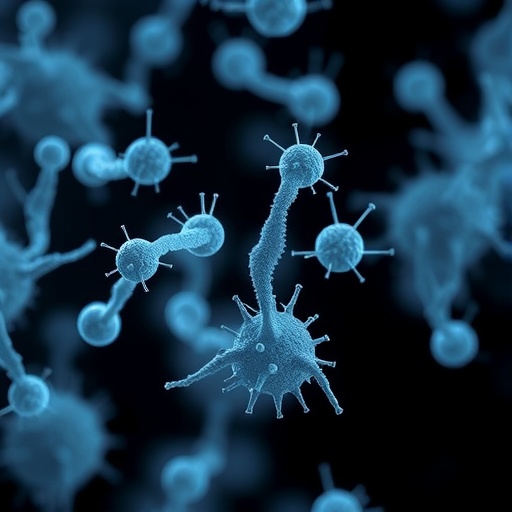
Scientists at Osaka Metropolitan University have unveiled a groundbreaking optical technique that dramatically enhances the ability to collect and concentrate minute particles such as bacteria and nanoparticles in liquid samples. Employing a novel gold-coated optical fiber module, this innovation harnesses light-induced thermal effects to orchestrate a sophisticated three-dimensional condensation of microscopic entities. The technology promises rapid and highly efficient gathering of particles, potentially revolutionizing fields from biomedical diagnostics to environmental monitoring by enabling faster and more sensitive detection.
The technique addresses a critical challenge in microbiology and nanoparticle research: identifying and analyzing targets that exist only in trace amounts. Harmful pathogens like Escherichia coli O157 can instigate severe illnesses even when occurring in minuscule concentrations. Detecting such organisms swiftly and with high sensitivity is essential for early diagnosis and risk mitigation. Conventional methods for bacterial identification typically entail laborious culture processes lasting days or immunoassays that require multiple hours and sophisticated equipment, often with constraints related to the spatial area of collection.
The ingenuity of this method lies in its creation of a photothermal source localized at the tip of a slender optical fiber. By coating the fiber’s end with an ultrathin layer of gold, the fiber converts focused laser light energy into heat. This localized photothermal effect generates tiny bubbles and induces fluid convection currents within the surrounding liquid medium. The resultant micro-scale thermal and fluid dynamic forces work synergistically to draw particles from the liquid volume and aggregate them concentrically between the bubble boundary and the fiber tip.
This three-dimensional capture strategy is what sets the system apart from previous photothermal approaches. Prior techniques generally concentrated particles along planar surfaces or confined focal regions, limiting efficiency and volume throughput. Here, the optical fiber’s localized heating summons particles from the entire surrounding volume in a volumetric, isotropic fashion, enabling a significant leap in collection speed and efficiency.
In controlled experiments, the research team demonstrated an ability to concentrate between thousands and hundreds of thousands of microparticles or bacterial cells from merely a 20-microliter fluid sample in just one minute. This performance represents an enhancement exceeding tenfold compared to traditional methods. Such rapid assembly facilitates downstream analysis by effectively increasing local target concentration, thus improving signal detection sensitivity in analytical platforms, including optical sensing and spectroscopic modalities.
The simplicity and compactness of the fiber-based design are additional notable advantages. Complex optical setups or bulky instrumentation are unnecessary, which could ease integration into portable or point-of-care diagnostic devices. The system’s modularity opens pathways to tailor the approach for various liquid environments and target species, broadening its applicability beyond bacterial detection to encompass nano- and microparticles implicated in diverse biomedical and environmental contexts.
Fundamentally, the system operates by leveraging photothermal conversion at the nanoscale, where the gold nanofilm absorbs energy from a laser input and transduces it into localized heat. This initiates microscopic bubble nucleation and robust three-dimensional convection within the surrounding medium. These flows act as conveyor belts, shepherding dispersed particles towards the aggregation zone. The interplay of thermal and hydrodynamic forces orchestrates efficient particle convergence with remarkable spatial precision.
The research spearheaded by Professor Takuya Iida and his team is a testament to the powerful convergence of photonics, nanomaterials, and fluid dynamics to overcome longstanding limitations in particle collection methodologies. By capitalizing on fundamental physical phenomena and nano-engineered materials, the approach offers a versatile platform not only for biosensing but also for advancing bioanalytical research and environmental surveillance, where early and sensitive detection of microorganisms or contaminants is paramount.
Looking ahead, the Osaka Metropolitan University team envisions embedding this optical condensation technology within integrated sensing systems, combining it with various optical detection techniques to deliver compact, rapid, and highly sensitive analytical tools. Further investigations are planned to optimize the system’s operation across an expanded array of biological and synthetic target particles under diverse fluidic and environmental conditions, aiming to widen both academic inquiry and practical application horizons.
This breakthrough marks a significant stride in the ongoing quest to develop next-generation diagnostic and analytical platforms. By dramatically reducing the time and complexity required to amass trace particulate matter from small-volume samples, this photothermal fiber module technology stands poised to transform sectors reliant on rapid microbial or nanoparticle identification, from healthcare and food safety to environmental quality control.
Published in the journal Communications Physics, this pioneering work not only highlights a remarkable leap in optical particle manipulation techniques but also sets the stage for the future of precision bioanalysis. The synergy between optical physics and biotechnological needs demonstrated in this work exemplifies how multidisciplinary research can forge innovative tools capable of reshaping diagnostic paradigms.
Cite Scienmag News
Bethany Barker. (May 18, 2026). Sharpening Our View of Bacteria. Scienmag. https://scienmag.com/sharpening-our-view-of-bacteria/
Bethany Barker. "Sharpening Our View of Bacteria." Scienmag, 18 May 2026, https://scienmag.com/sharpening-our-view-of-bacteria/. Accessed 4 September 2026.
Bethany Barker. "Sharpening Our View of Bacteria." Scienmag. May 18, 2026. https://scienmag.com/sharpening-our-view-of-bacteria/


