


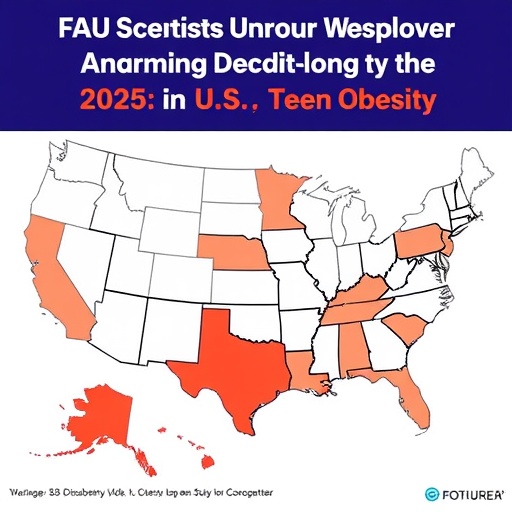
A disturbing surge in adolescent obesity rates in the United States has been uncovered through an extensive analysis encompassing a decade of data, underscoring an urgent public health crisis that demands immediate attention. Recent research carried out by Florida Atlantic University’s Charles E. Schmidt College of Medicine delves deeply into the evolving patterns of obesity, overweight status, and weight-loss efforts among high school students, painting a complex portrait of rising health risks combined with diminishing attempts at weight management among youth.
This comprehensive study analyzed data harvested from the Youth Risk Behavior Survey, a robust and nationally representative dataset managed by the U.S. Centers for Disease Control and Prevention (CDC). The sample encompassed 85,588 high school students spanning grades nine through twelve over an eleven-year period from 2013 to 2023. Through this meta-analytical approach, researchers intricately examined trends in obesity and overweight prevalence, the respective demographic variations influenced by gender, grade, race, and ethnicity, as well as shifts in adolescents’ engagement with weight-loss behaviors.
The findings warrant grave concern. Over the decade, obesity prevalence among American high school students rose from 13.7% in 2013 to 15.9% in 2023, peaking notably at 16.3% in 2021. This rising trajectory is disproportionately borne by Black and Hispanic adolescents, who exhibit the highest rates, peaking at 21.2% and 20.2%, respectively. Interestingly, Asian adolescents, while presenting the lowest obesity prevalence, experienced an alarming near doubling from 5.6% to 11% over the same period. Meanwhile, overweight status — a condition delineating a less severe but still clinically relevant excess body weight — has seen a modest decline from 16.6% to 14.7%, primarily driven by decreases in male students.
This disparity between the trends of overweight and obesity implies a troubling intensification of the severity of weight-related health issues, as more adolescents transition from merely overweight into the obesogenic category, which correlates with significantly elevated risks of chronic pathologies. In parallel, the researchers illuminated stark gender differences in weight management behaviors. Female students consistently display higher rates of weight-loss attempts compared to their male counterparts, reflecting greater societal pressures and body image concerns among adolescent girls. However, a discouraging overall decline was observed in the proportion of teens attempting to lose weight, dropping from 47.7% in 2013 to 44.5% a decade later.
This downtrend in weight-loss engagement is especially pronounced among tenth and twelfth graders, indicative of diminished motivation for healthy behaviors as adolescents age — a concerning signal that may exacerbate future health disparities. The temporal fluctuations in obesity rates between genders further illustrate these complex dynamics. Male adolescents’ obesity rates ascended steadily to a zenith of 18.9% in 2019, followed by a slight recoil to 18.2% in 2023. Female obesity rates displayed more variability, ranging between lows of 10.8% and highs of 13.7%, highlighting the multifactorial nature of obesity progression influenced by biological, psychological, and environmental factors.
Grade-wise analyses reveal that 11th graders exhibit the highest prevalence of obesity at 17.3%, with ninth graders following closely. Intriguingly, ninth and twelfth graders have the lowest proportions classified as overweight — a pattern suggesting potential grade-specific influences on adolescent weight trajectories, whether through developmental, social, or behavioral mechanisms.
Mechanistically, the rise in adolescent obesity is intricately linked to a constellation of physiological and psychosocial consequences that severely jeopardize long-term health. Obesity during adolescence is a pivotal risk factor for the onset of type 2 diabetes mellitus, systemic hypertension, obstructive sleep apnea, and a spectrum of psychological afflictions including depression and reduced self-esteem. These co-morbidities not only persist into adulthood but exacerbate cumulative morbidity and mortality over the lifespan, imposing substantial burdens on healthcare infrastructure and society.
The study’s senior academic advisor, Dr. Charles H. Hennekens, highlights the critical public health implications, stating that the simultaneous increase in obesity and decline in weight-loss motivation represent escalating clinical challenges that necessitate strategically targeted intervention programs. He underscores the exigency for multidimensional strategies combining clinical, educational, and policy-driven efforts to arrest and reverse these distressing trends.
Social factors, particularly those mediated through digital and social media exposure, likely amplify body dissatisfaction and distorted self-image, especially among female adolescents. The researchers point to these platforms as potential drivers of negative body comparisons, which paradoxically may undermine healthy weight management by fostering unhealthy psychological pressures and inconsistent behavioral patterns.
To combat this multifaceted epidemic, the investigators advocate for enhanced school-based programs that focus not only on nutrition education but also emphasize improving body image resilience and addressing mental health needs. Such programs should cultivate positive self-perception and sustainable healthy habits, empowering adolescents to navigate the complex psychosocial landscape that strongly influences weight and health behaviors.
Additionally, public health policies must be finely attuned to demographic nuances. Initiatives such as the CDC’s State Physical Activity and Nutrition program require tailoring to address the distinct patterns observed — namely, addressing males’ persistently higher obesity rates and counteracting the declining weight-loss endeavors among females. This precision public health framework promises to allocate resources more effectively and maximize behavioral intervention success.
This pivotal research reflects a broader societal imperative: the necessity to foster environments conducive to holistic adolescent health. As young people confront unprecedented challenges in a digitally saturated, fast-paced world, supporting their physical and mental well-being through evidence-based programs is paramount to mitigating the looming public health crisis posed by escalating adolescent obesity.
Authored by Jack Yang and colleagues from Florida Atlantic University along with collaborators from George Mason University, this study was published in the Ochsner Journal on March 11, 2026. It constitutes a clarification of the current epidemiological landscape and an urgent call to action for clinicians, educators, policymakers, and families committed to improving adolescent health outcomes across the nation.
Cite Scienmag News
Daisy Hatcher. (March 16, 2026). FAU Scientists Uncover Alarming Decade-Long Surge in U.S. Teen Obesity. Scienmag. https://scienmag.com/fau-scientists-uncover-alarming-decade-long-surge-in-u-s-teen-obesity/
Daisy Hatcher. "FAU Scientists Uncover Alarming Decade-Long Surge in U.S. Teen Obesity." Scienmag, 16 March 2026, https://scienmag.com/fau-scientists-uncover-alarming-decade-long-surge-in-u-s-teen-obesity/. Accessed 3 September 2026.
Daisy Hatcher. "FAU Scientists Uncover Alarming Decade-Long Surge in U.S. Teen Obesity." Scienmag. March 16, 2026. https://scienmag.com/fau-scientists-uncover-alarming-decade-long-surge-in-u-s-teen-obesity/


