


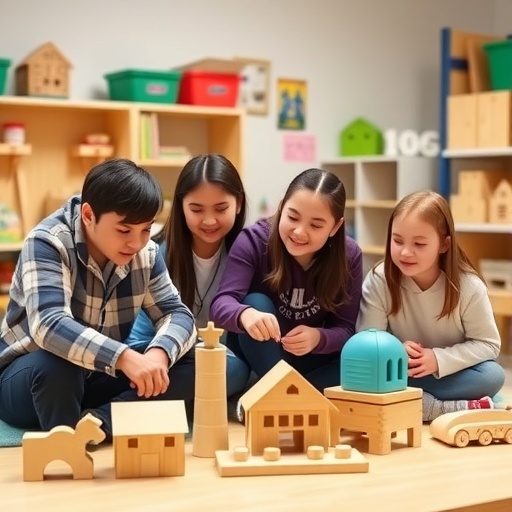
In a heartwarming initiative that bridges education, sustainability, and child development, students from the Faculty of Management at Okayama University of Science have undertaken a remarkable project aimed at enriching the lives of children in their community. By leveraging modern crowdfunding techniques, these students successfully acquired wooden toys that embody both the tactile warmth of natural materials and the joys of imaginative play. On March 18, these toys were distributed among five children’s centers within Okayama City, managed by the Okayama City Fureai Public Corporation, thereby fostering a deeper connection between academia, local craftsmanship, and early childhood enrichment.
The project’s genesis lies in an intricate understanding of the sensory and developmental benefits of wooden toys, which have long been favored for their natural textures, durability, and environmental friendliness. Unlike plastic alternatives, wood provides a tactile experience that engages children’s senses more comprehensively, aiding cognitive and motor skill development. Recognizing this, the students purposefully collaborated with Asunaro Workshop, a distinguished toy manufacturer situated in Soja City, celebrated for crafting artisanal wooden toys from locally sourced timber. This partnership ensured that the toys not only met stringent quality standards but also promoted sustainable forestry and local industry synergy.
Central to the donation are two types of toys: dinosaur-themed stacking blocks and traditional chestnut wood block sets. The dinosaur blocks introduce an element of gamification through a stacking challenge where players assemble dinosaur-shaped pieces to build the tallest stable structure possible. This dynamic requires strategic planning, balance, and fine motor skills, heightening the play’s cognitive demand. The chestnut wood blocks, meanwhile, serve as open-ended construction materials that stimulate creativity, spatial reasoning, and dexterity in young children. The thoughtful design and selection of these toys reflect an awareness of developmental psychology and pedagogical principles.
Each of the five children’s centers received two sets of both toy types, ensuring equitable distribution and ample opportunity for diverse play experiences. These centers, located throughout Okayama City, cater to a broad demographic of children, often including those from vulnerable backgrounds. The inclusion of such sustainably produced toys thus serves dual purposes: providing durable educational resources and fostering environmental consciousness from an early age.
The official presentation ceremony at the Okayama Fureai Center was a testament to the collaborative ethos underpinning this initiative. Directors from all five children’s centers convened to accept the donations directly from the student representatives, marking a moment of shared commitment to community welfare. Observers noted a palpable atmosphere of excitement as children promptly engaged with the toys, underscoring the immediate positive impact of the donation. The lively cheers and animated play validated the intuitive appeal of wooden toys even in a digital age dominated by electronic entertainment.
Yumiko Tanabe, a spokesperson for the Okayama Fureai Children’s Centers, eloquently articulated the broader significance of the donation. She emphasized that the value of the wooden blocks transcended their physical form, embodying the compassion and conscientious efforts of the students. Such gestures, she noted, nurture not only the children’s developmental journey but also the societal fabric by fostering empathy and communal responsibility. This attests to the multidimensional benefits of integrative projects that combine educational outreach with sustainable material use.
From the students’ perspective, the endeavor was a profound learning experience. The crowdfunding campaign they orchestrated surpassed its financial target by 60%, amassing approximately 320,000 yen against an initial goal of 200,000 yen. This success reflects both effective community engagement strategies and the resonance of sustainability-themed projects with contemporary donors. The students expressed heartfelt gratitude for the widespread support, affirming their intention to leverage this experience in future socially impactful initiatives.
Scientifically, the initiative underscores the significance of materiality in early childhood development. Research in developmental neuroscience confirms that multisensory engagement—such as the tactile feedback from wooden blocks—enhances neural plasticity, motor coordination, and problem-solving capabilities. Moreover, introducing sustainability concepts through the use of locally sourced timber adds an environmental education dimension, sensitizing children to ecological stewardship from an early age.
The choice of chestnut wood for the blocks is particularly noteworthy due to its favorable mechanical properties. Chestnut is a resilient hardwood with a fine grain structure that resists splintering, ensuring safety and longevity in toys subject to vigorous handling. Its natural aesthetic also fosters an emotional connection to nature, which has been linked to improved psychological well-being in educational settings.
Furthermore, the dinosaur-themed stacking game integrates elements of cognitive challenge and competitive play, contributing to socialization and strategic thinking skills. The risk element—where a collapsing structure signifies a player’s loss—introduces lessons in cause and effect, patience, and precision. Such interactive dynamics are essential for holistic child development, blending fun with learning in effective ways.
By supporting local craftsmanship through Asunaro Workshop, the project also highlights the critical role of regional industries in sustainable development. This model showcases how educational institutions can act as catalytic agents, promoting circular economies and preservation of traditional artisanal skills while meeting contemporary educational needs.
In contemplative reflection, this collaborative project reveals how interdisciplinary initiatives can generate meaningful impact at the community level. It seamlessly integrates academic learning, sustainable resource management, childhood education, and social responsibility. The success serves as a replicable model for similar universities and communities worldwide, illustrating how grassroots efforts can catalyze positive social change through thoughtful design and broad-based support.
In conclusion, the Okayama University of Science students have demonstrated inspiring leadership and innovation by merging crowdfunding technology, sustainable materials, and educational toys to enrich community child care centers. Their work reaffirms the powerful role that wooden playthings can assume in nurturing children’s development while promoting ecological consciousness and community engagement. This initiative sets a vibrant precedent for future collaborations that aspire to harmonize human development with environmental integrity.
News Publication Date: March 18, 2024
Web References:
https://mediasvc.eurekalert.org/Api/v1/Multimedia/3f613ac8-ee48-485b-b9f0-37e56043cdea/Rendition/low-res/Content/Public
Cite Scienmag News
Courtney Benton. (May 18, 2026). OUS Management Students Leverage Crowdfunding to Donate Wooden Toys to Children’s Centers. Scienmag. https://scienmag.com/ous-management-students-leverage-crowdfunding-to-donate-wooden-toys-to-childrens-centers/
Courtney Benton. "OUS Management Students Leverage Crowdfunding to Donate Wooden Toys to Children’s Centers." Scienmag, 18 May 2026, https://scienmag.com/ous-management-students-leverage-crowdfunding-to-donate-wooden-toys-to-childrens-centers/. Accessed 4 September 2026.
Courtney Benton. "OUS Management Students Leverage Crowdfunding to Donate Wooden Toys to Children’s Centers." Scienmag. May 18, 2026. https://scienmag.com/ous-management-students-leverage-crowdfunding-to-donate-wooden-toys-to-childrens-centers/


