


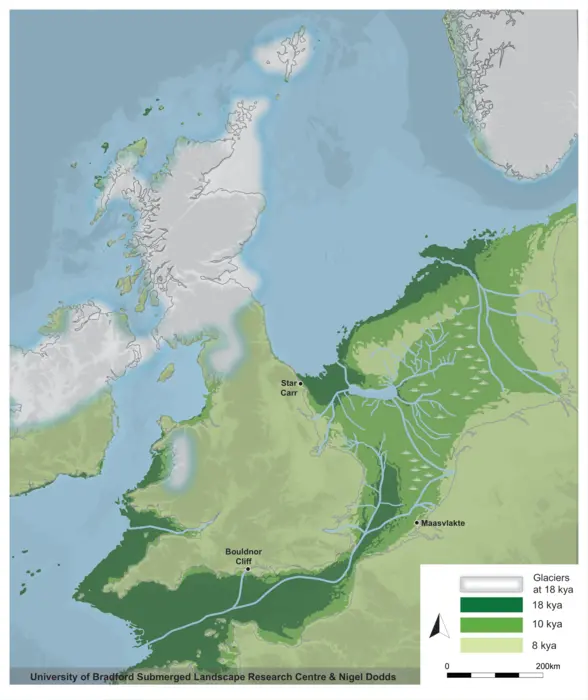
A groundbreaking study led by the University of Warwick has substantially reshaped our understanding of the ancient submerged landscape known as Doggerland, revealing that temperate forests flourished there thousands of years earlier than previously documented. Utilizing an unprecedented scale of sedimentary ancient DNA (sedaDNA) sampling, the research team reconstructed a rich ecological history of this lost landmass, offering fresh insights into the environmental and human dimensions of prehistoric Europe.
Doggerland, once a vast land bridge connecting Britain to mainland Europe, was gradually inundated by rising sea levels following the last Ice Age, giving rise to the present-day North Sea. Until now, the timeline of forest establishment and the region’s suitability for early human habitation remained subjects of much debate. The Warwick-led study, published in the Proceedings of the National Academy of Sciences (PNAS), marks a significant step forward by identifying temperate tree species such as oak, elm, and hazel as early inhabitants of Doggerland more than 16,000 years ago—far predating previous pollen-based records.
What sets this study apart is its innovative use of sedimentary ancient DNA extracted from 252 samples gathered from 41 marine sediment cores along the ancient Southern River, a former watercourse running through Doggerland. These cores, selected for their exceptional preservation of organic material, allowed researchers to chart ecological shifts with remarkable precision. The resulting genetic evidence paints a picture of a landscape teeming with diverse woodland species thousands of years prior to their known widespread appearance in northern Europe.
Among the most striking revelations was the detection of DNA from the genus Pterocarya—a walnut relative thought to have vanished from northwestern Europe approximately 400,000 years ago. This unexpected finding suggests that Doggerland functioned as a glacial refugium where certain tree species survived the harsh climatic oscillations of the Ice Age far longer than previously assumed. The presence of warmth-loving tree species such as lime (Tilia) more than 2,000 years earlier than mainland British records corroborates this notion, underscoring Doggerland’s unique ecological role as a sanctuary during glacial maxima.
These findings also bear significant implications for resolving longstanding botanical puzzles, such as Reid’s Paradox, which concerns the rapid recolonization of northern Europe by temperate trees after the Ice Age. The study introduces compelling evidence of “microrefugia”—small, ecologically favorable pockets that provided safe havens allowing species to persist through glaciations. These sanctuaries likely facilitated the swift post-glacial spread of forests across Europe as climatic conditions improved.
This research further challenges existing models regarding the timing of the complete inundation of Doggerland. Evidence indicates that segments of the landscape survived major flooding events, including the catastrophic Storegga tsunami roughly 8,150 years ago, and remained above sea level until as recently as 7,000 years ago. This suggests that the North Sea’s formation was a more gradual and complex process than traditionally thought, reshaping our narratives of prehistoric environmental change.
From an anthropological perspective, the woodland habitats identified provide new context for the human occupation of Doggerland. The rich forested environment likely offered abundant resources such as game animals, including boars, long before the documented emergence of Mesolithic cultures like the Maglemosian. This suggests Doggerland could have served as a hospitable refuge for early hunter-gatherer communities well in advance of their recognized archaeological presence in mainland Britain.
Professor Robin Allaby from the University of Warwick, the study’s lead author, emphasized that the detection of these trees thousands of years earlier than expected not only alters perceptions of the region’s ecology but also informs hypotheses about human settlement patterns. By reconstructing Doggerland’s environment at an unprecedented resolution, this work provides a vital framework for understanding how prehistoric communities might have interacted with their changing landscape.
Complementing this viewpoint, Professor Vincent Gaffney of the University of Bradford highlighted Doggerland’s role beyond a mere transit route for early humans. As a pivotal landscape feature, Doggerland formed a critical ecological nucleus and cultural fulcrum for prehistoric societies, influencing settlement and migration patterns across northern Europe for millennia.
The study’s methodological innovation lies chiefly in its application of sedaDNA analysis, allowing for direct genetic identification of past vegetation from marine sediments unlike traditional palynology, which relies solely on pollen. This molecular approach bypasses challenges associated with fossil pollen degradation and misidentification, providing a clearer, more comprehensive picture of prehistoric ecosystems. Moreover, the use of multiple sediment cores across the Southern River basin enabled a spatial and temporal resolution unattainable by previous studies.
Funding for this research was provided by the European Research Council through the Horizon 2020 program under the Lost Frontiers project. This initiative integrates archaeo-geophysics, molecular biology, and computational simulations to investigate submerged landscapes and transitions in prehistoric human societies, extending its focus from the southern North Sea to broader regions of northwest Europe.
This transformative work not only enriches our understanding of Ice Age refugia and post-glacial recolonization but also reframes Doggerland as a dynamic and life-supporting landscape rather than a mere drowned land bridge. The study’s insights will undoubtedly fuel renewed archaeological explorations and inspire interdisciplinary research that bridges paleoecology, genetics, climatology, and human history.
As modern technology enables us to peer beneath the waves and ancient sediments, Doggerland emerges from obscurity as a vibrant, vital ecosystem and cradle for early human civilization. Recognizing its ecological complexity and historical significance opens new pathways to delve deeper into the dramatic story of how humans and nature adapted to one of Earth’s most profound environmental transformations.
News Publication Date: 10-Mar-2026
Web References: https://doi.org/10.1073/pnas.2508402123, https://lostfrontiers.teamapp.com/
Cite Scienmag News
Courtney Benton. (March 11, 2026). New Discovery Reveals Habitable Forests in North Sea ‘Lost World’ During Last Ice Age. Scienmag. https://scienmag.com/new-discovery-reveals-habitable-forests-in-north-sea-lost-world-during-last-ice-age/
Courtney Benton. "New Discovery Reveals Habitable Forests in North Sea ‘Lost World’ During Last Ice Age." Scienmag, 11 March 2026, https://scienmag.com/new-discovery-reveals-habitable-forests-in-north-sea-lost-world-during-last-ice-age/. Accessed 4 September 2026.
Courtney Benton. "New Discovery Reveals Habitable Forests in North Sea ‘Lost World’ During Last Ice Age." Scienmag. March 11, 2026. https://scienmag.com/new-discovery-reveals-habitable-forests-in-north-sea-lost-world-during-last-ice-age/


