


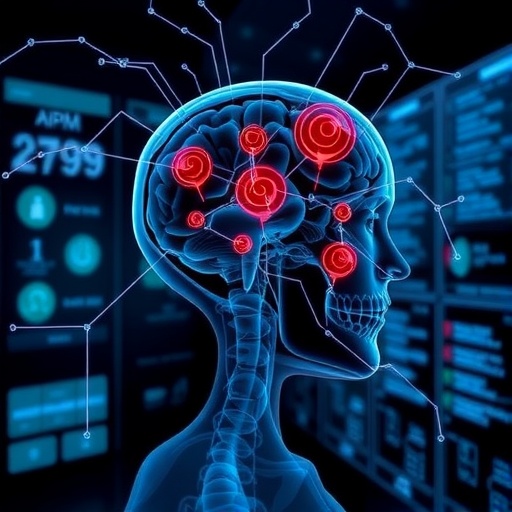
In a groundbreaking advance poised to transform the landscape of mental health care, a recent systematic scoping review illuminates the burgeoning role of artificial intelligence (AI) in the rehabilitation management of schizophrenia. The study, authored by Yang, Chang, Muroi, and colleagues, methodically surveys the integration of AI technologies in therapeutic frameworks designed for schizophrenia—a complex psychiatric condition characterized by disruptions in thought processes, perceptions, and emotional responsiveness. This comprehensive review, published in Translational Psychiatry in 2026, underscores how AI is not only enhancing the precision of clinical interventions but is also reshaping the trajectory of patient recovery through innovative data analytics and personalized treatment strategies.
Schizophrenia, a chronic and often debilitating mental disorder, affects millions worldwide, imposing significant challenges on both patients and healthcare systems. Traditional rehabilitation management has relied heavily on clinical observations, standardized scales, and medication adherence, often falling short of capturing the nuanced heterogeneity of individual patient responses. Enter AI, which offers an unprecedented opportunity to transcend these limitations by leveraging vast datasets and machine learning algorithms to tailor rehabilitation efforts with greater finesse. This review meticulously catalogs diverse AI applications, ranging from predictive modeling and symptom monitoring to cognitive remediation and social functioning enhancement.
A pivotal highlight of the review is the use of machine learning classifiers to predict relapse episodes and medication non-adherence. By analyzing longitudinal electronic health records and real-time behavioral data, these AI models enable clinicians to identify early warning signs with remarkable accuracy. This proactive approach facilitates timely interventions, potentially averting full-blown psychotic episodes and reducing hospitalization rates. The technical ingenuity lies in the integration of multi-modal datasets, including neuroimaging, genetic profiles, and wearable sensor data, into cohesive predictive frameworks—ushering in a new era of precision psychiatry.
Moreover, natural language processing (NLP), a subfield of AI that interprets human language, has been effectively utilized to analyze speech patterns and written communication in individuals with schizophrenia. Subtle anomalies in semantics, syntax, and prosody often precede clinically evident relapses. The review details how NLP algorithms detect these linguistic markers with high sensitivity, empowering clinicians to monitor disease progression remotely and unobtrusively. This technological breakthrough simplifies continuous assessment and may significantly reduce the burden on mental health services by enabling telehealth-based rehabilitation programs.
Virtual reality (VR) and AI-driven cognitive training emerge as another transformative frontier. The review outlines several studies wherein immersive VR environments, augmented by adaptive AI, offer personalized cognitive remediation therapies targeted at improving attention, memory, and executive functioning. These AI systems dynamically adjust task difficulty based on user performance, ensuring optimal challenge levels and maximizing therapeutic efficacy. Importantly, such interactive platforms stimulate social skills in controlled, simulated scenarios—addressing one of the core deficits in schizophrenia with a level of engagement seldom achievable through conventional methods.
The review also addresses ethical considerations intrinsic to AI implementation in this sensitive domain. Data privacy, algorithmic transparency, and the potential for bias are thoughtfully analyzed, advocating for stringent governance frameworks. The authors emphasize the importance of maintaining a human-centric approach, wherein AI acts as an augmentative tool rather than a replacement for clinician judgment. This balance is crucial to foster patient trust and ensure equitable access to AI-powered rehabilitation interventions.
An intriguing technical aspect covered is the role of reinforcement learning algorithms in optimizing rehabilitation schedules. These algorithms iteratively learn from patient responses to refine therapy timing and content delivery, enhancing adherence and outcomes. The review notes preliminary trials demonstrating that reinforcement learning-guided programs outperform static rehabilitation protocols in sustaining long-term functional improvements. This adaptive methodology exemplifies the potential of AI to personalize mental health care beyond symptom management towards holistic recovery.
Data integration emerges as a recurring theme, with AI acting as the nexus linking disparate clinical, behavioral, and biological data streams. The review elaborates on architectures that facilitate interoperability and real-time analytics, highlighting the challenges of curating high-quality training datasets. It underscores the necessity for multidisciplinary collaboration among psychiatrists, data scientists, and engineers to devise clinically relevant AI models that align with the complex pathophysiology of schizophrenia.
The authors also spotlight AI-driven mobile applications that enable continuous symptom tracking through self-reporting and passive data collection, such as smartphone usage patterns and geolocation analytics. These tools empower patients with real-time feedback and facilitate remote monitoring by clinicians, thereby reducing barriers imposed by geographic and mobility constraints. The review highlights promising pilot studies indicating improved patient engagement and early detection of symptom exacerbation through these mobile platforms.
From a computational perspective, the review discusses the use of convolutional neural networks (CNNs) and recurrent neural networks (RNNs) in analyzing neuroimaging and time-series data, respectively. CNNs have proved adept at identifying subtle structural brain abnormalities linked to schizophrenia, while RNNs capture temporal patterns of symptom fluctuations. Such sophisticated deep learning architectures offer unparalleled granularity in understanding disease dynamics and tailoring individualized rehabilitation pathways.
Importantly, the review does not overlook the challenges facing widespread AI adoption in schizophrenia rehabilitation. Variability in data quality, scarcity of longitudinal datasets, and the need for robust validation across diverse populations remain pressing hurdles. The authors call for large-scale, multi-center prospective studies to rigorously evaluate AI interventions’ efficacy and safety. Additionally, they advocate for developing explainable AI models that can transparently communicate decision-making processes to clinicians and patients alike.
The convergence of AI and schizophrenia rehabilitation marks a paradigm shift that extends beyond clinical efficacy. By enabling data-driven, personalized, and scalable rehabilitation solutions, AI holds the promise of democratizing access to quality mental health care globally. The review envisions a future where AI-assisted tools seamlessly integrate into conventional psychiatric practice, empowering clinicians with enhanced diagnostic precision and tailored therapeutic strategies, ultimately improving patient quality of life.
In closing, Yang and colleagues’ systematic scoping review serves as a clarion call to the scientific and clinical communities, illustrating the immense potential and intricate challenges of deploying AI in schizophrenia rehabilitation management. As AI technologies continue to evolve and mature, their thoughtful application could redefine mental health care, transforming rehabilitation outcomes and ushering in a new chapter in scientific psychiatry.
Cite Scienmag News
Glenn Wilkins. (March 10, 2026). AI Advances in Schizophrenia Rehabilitation Management. Scienmag. https://scienmag.com/ai-advances-in-schizophrenia-rehabilitation-management/
Glenn Wilkins. "AI Advances in Schizophrenia Rehabilitation Management." Scienmag, 10 March 2026, https://scienmag.com/ai-advances-in-schizophrenia-rehabilitation-management/. Accessed 3 September 2026.
Glenn Wilkins. "AI Advances in Schizophrenia Rehabilitation Management." Scienmag. March 10, 2026. https://scienmag.com/ai-advances-in-schizophrenia-rehabilitation-management/


