


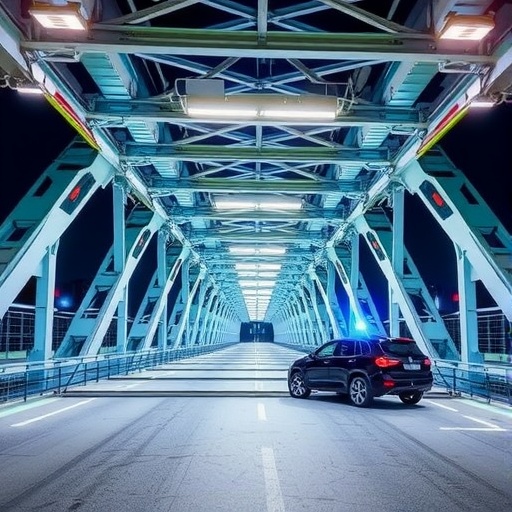
In the fast-evolving landscape of infrastructure maintenance and monitoring, a groundbreaking approach integrating robotic technology and digital twin simulations is charting a new course for the fatigue prognosis of in-service steel bridges. This innovative closed-loop framework, recently detailed by Li, Fu, Guo, and colleagues in a 2026 publication in Communications Engineering, signifies a transformative leap in how engineers predict and mitigate structural degradation. It holds vast potential not only for improving bridge safety but also for optimizing maintenance operations and extending the lifespan of critical infrastructure.
The worldwide network of steel bridges forms the backbone of modern transportation systems, but these structures face relentless stress from heavy traffic, environmental conditions, and material aging. Traditional inspection methods, often reliant on manual visual checks and intermittent data collection, are limited by accessibility, human error, and the sheer scale of monitoring tasks. These challenges create an urgent need for advanced methodologies able to provide continuous, precise, and actionable health assessments throughout a bridge’s operational life.
This research confronts these challenges head-on by marrying two cutting-edge domains: robotic inspection platforms and digital twin technology. Robots equipped with high-resolution sensors and nondestructive evaluation tools navigate complex bridge geometries, collecting dense data on surface and subsurface defects, crack initiation, and fatigue progression. This real-time sensor data feeds directly into a dynamic digital twin, a high-fidelity virtual replica of the physical bridge that evolves in parallel with the structure itself.
The digital twin acts as the brain of this system, integrating multifaceted datasets through sophisticated algorithms to simulate material behavior under operational stresses. Unlike static models, this twin continuously updates based on live inspection inputs, environmental factors, and historical load records. It applies advanced fatigue analysis and fracture mechanics principles to predict how and when critical damage may propagate, thereby forecasting remaining useful life with enhanced precision.
One of the most remarkable features of this closed-loop approach is its ability to close the feedback gap between physical inspection and prognostics. Insights derived from the digital twin inform the operational parameters of the robots, optimizing subsequent inspections by focusing on deteriorated regions of concern and adapting scan frequency based on predicted fatigue rates. This iterative process creates a self-refining maintenance regime that focuses resources efficiently and prevents unforeseen catastrophic failures.
The integration also harnesses machine learning techniques that improve model accuracy over time by learning from observed discrepancies between predicted and actual bridge conditions. This capability enables continuous refinement of fatigue damage models that traditionally relied heavily on laboratory data and conservative assumptions, which often do not fully represent the complexities of in-service environments.
Beyond predictive maintenance, the framework supports decision-making at multiple scales. Structural engineers can simulate various “what-if” scenarios to assess the impact of increased traffic loads, environmental changes, or repair interventions before implementation. This virtual experimentation reduces costs, mitigates risks, and informs policymakers about infrastructure resilience strategies in the face of climate change and evolving transportation demands.
The robustness of this framework was illustrated in pilot studies on operational steel bridges subjected to heavy traffic and cyclic loads. Data collected by autonomous inspection robots revealed micro-cracks and corrosion patterns that conventional methods overlooked. The aligned digital twins accurately projected fatigue crack growth trajectories validated by subsequent physical inspections, underscoring the model’s reliability and practical utility.
Industry experts point to this development as a critical enabler of smart infrastructure systems, where sensing, computing, and robotics synergize to transform asset management paradigms. This approach addresses the growing infrastructural maintenance backlog worldwide by providing scalable and automated solutions that extend beyond steel bridges to other civil engineering structures vulnerable to fatigue, such as wind turbines and offshore platforms.
However, implementing such sophisticated technology at scale requires overcoming several hurdles, including interoperability standards for sensor and data platforms, cybersecurity risks for digital twins, and the high initial investments in robotic systems. Ongoing interdisciplinary collaborations, governmental support, and pilot deployments will be indispensable to translating this promising research into widespread practice.
Looking forward, integrating this cyber-physical system with emerging 5G networks and edge computing technologies promises real-time data processing with minimal latency, enabling truly autonomous bridge health management. Further advancements in artificial intelligence will likely deepen predictive capabilities, eventually allowing infrastructure to self-diagnose and even self-heal through embedded smart materials and robotic interventions.
In conclusion, the closed-loop framework presented by Li, Fu, Guo, and their team represents a paradigm shift toward predictive, automated, and integrated infrastructure maintenance. By blending robotics with digital twinning, this system not only enhances structural safety but also revolutionizes how engineers approach the lifespan management of critical assets. As infrastructure worldwide grapples with aging challenges and increasing demands, such intelligent technologies become paramount to building resilient and sustainable societies.
Cite Scienmag News
Denise Maddox. (March 10, 2026). Robotic Inspections and Digital Twins Predict Bridge Fatigue. Scienmag. https://scienmag.com/robotic-inspections-and-digital-twins-predict-bridge-fatigue/
Denise Maddox. "Robotic Inspections and Digital Twins Predict Bridge Fatigue." Scienmag, 10 March 2026, https://scienmag.com/robotic-inspections-and-digital-twins-predict-bridge-fatigue/. Accessed 5 September 2026.
Denise Maddox. "Robotic Inspections and Digital Twins Predict Bridge Fatigue." Scienmag. March 10, 2026. https://scienmag.com/robotic-inspections-and-digital-twins-predict-bridge-fatigue/


