


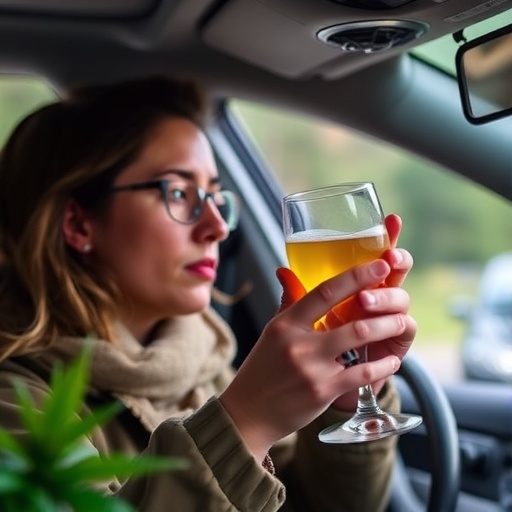
A recent investigation led by researchers at Johns Hopkins Medicine has uncovered compelling evidence regarding the enhanced impairing effects on driving ability when cannabis edibles and alcohol are consumed concomitantly. Funded by the National Institute on Drug Abuse of the NIH, this research emphasizes the critical differences in impairment when these substances are combined as opposed to their isolated intake. Published in JAMA Network on May 1, the study reveals that while cannabis alone or paired with alcohol significantly impacts driving skills, traditional field sobriety tests frequently fail to detect the impairment induced by cannabis use.
This pioneering study addresses a gap in existing research by focusing on cannabis edibles rather than smoked cannabis, acknowledging the growing prevalence of edible cannabis products in legal markets. Participants ingested cannabis-infused brownies containing either 10 or 25 milligrams of THC, alongside controlled doses of alcohol designed to reach specific breath alcohol concentrations (BrAC) of 0.05% or 0.08%. The use of edibles is particularly relevant given their distinct pharmacokinetics, including delayed onset and prolonged duration of action compared to inhaled cannabis, which may influence the dynamics of co-intoxication with alcohol.
The cohort consisted of healthy adults aged 21 to 55, rigorously screened to exclude confounding factors such as recent illicit drug use and cannabis tolerance. These individuals had a documented history of binge drinking and prior experience with co-usage of alcohol and cannabis. The investigators implemented a randomized, placebo-controlled, crossover design, ensuring each participant underwent multiple sessions to receive varied combinations of cannabis, alcohol, and respective placebos. This approach facilitated a robust within-subject comparison across conditions.
To meticulously quantify impairment, participants performed simulated driving tests coupled with cognitive and psychomotor evaluations administered repeatedly over a 7.5-hour period post-consumption. Blood samples taken throughout sessions allowed quantification of THC and its metabolites, strengthening correlations between pharmacokinetic data and behavioral outcomes. The timing of alcohol administration—45 minutes after edible ingestion—was deliberately chosen to coincide with peak THC plasma concentrations, thereby mimicking real-world co-use patterns.
The findings demonstrate a synergistic rather than merely additive interaction between cannabis edibles and alcohol, producing significantly greater deficits in driving performance. Specifically, measures such as lane deviation, reaction time, and hazard detection were more profoundly impaired during combined substance use. Subjective intoxication levels mirrored objective findings, with participants reporting heightened feelings of being impaired when consuming both substances together compared to either substance alone.
Crucially, standard field sobriety tests—widely employed by law enforcement—did not reliably detect impairment from cannabis use, whether alone or combined with alcohol. Intoxication was only consistently identified under the highest alcohol dose condition (0.08% BrAC), suggesting that existing regulatory thresholds based on alcohol alone may be insufficient to address combined substance impairment scenarios. This discrepancy emphasizes the need for novel, sensitive detection tools that can accurately assess driving impairment in the context of contemporary substance use behaviors.
The public health implications are profound given the expanding legalization and accessibility of cannabis products, particularly edibles, and the prevalent social co-consumption with alcohol. The study authors advocate for the integration of these insights into educational frameworks, highlighting the augmented risks associated with co-use on road safety. Policy and regulatory strategies must adapt to these nuanced findings, potentially reevaluating legal intoxication limits and enforcement methodologies.
Additionally, the research underscores urgent gaps in current knowledge, advocating for continued exploration into the mechanistic underpinnings of cannabis-alcohol interactions on neurocognitive and motor functions relevant to driving. The development of innovative biologic markers or behavioral assessments tailored for combined substance effects is a priority to mitigate road traffic injuries and fatalities linked to impaired driving.
The presence of a rigorous, controlled experimental paradigm combined with a comprehensive assessment battery provides compelling evidence to inform stakeholders, including clinicians, lawmakers, and the general public. By delineating the extent and duration of impairment caused by edible cannabis and alcohol co-use, this research offers a critical step toward evidence-based interventions and informed policy decisions.
Johns Hopkins Medicine researchers involved in the study include Austin Zamarripa, Ph.D., who emphasizes the potential synergistic nature of impairment from these substances, and Tory Spindle, Ph.D., the principal investigator who highlights the public health urgency due to the increasing prevalence of edible cannabis product use. The study also involved experts such as Ryan Vandrey, Ph.D., Elise Weerts, Ph.D., David Wolinsky, M.D., and Denis Antoine, M.D., whose collective expertise lent rigor and depth to the multidisciplinary investigation.
In conclusion, as cannabis legalization continues its global trajectory and patterns of co-use evolve, it is imperative to address the compound effects on road safety. This research signifies a call to action for multifaceted interventions encompassing scientific research, technological innovation in impairment detection, and comprehensive public education to enhance traffic safety and reduce adverse outcomes linked to cannabis and alcohol co-use.
News Publication Date: May 1, 2024.
Web References: https://jamanetwork.com/journals/jamanetworkopen/fullarticle/10.1001/jamanetworkopen.2026.9842
Cite Scienmag News
Ophelia Keating. (May 1, 2026). New Study Reveals Dangers of Driving After Consuming Cannabis Edibles and Alcohol. Scienmag. https://scienmag.com/new-study-reveals-dangers-of-driving-after-consuming-cannabis-edibles-and-alcohol/
Ophelia Keating. "New Study Reveals Dangers of Driving After Consuming Cannabis Edibles and Alcohol." Scienmag, 1 May 2026, https://scienmag.com/new-study-reveals-dangers-of-driving-after-consuming-cannabis-edibles-and-alcohol/. Accessed 4 September 2026.
Ophelia Keating. "New Study Reveals Dangers of Driving After Consuming Cannabis Edibles and Alcohol." Scienmag. May 1, 2026. https://scienmag.com/new-study-reveals-dangers-of-driving-after-consuming-cannabis-edibles-and-alcohol/


