


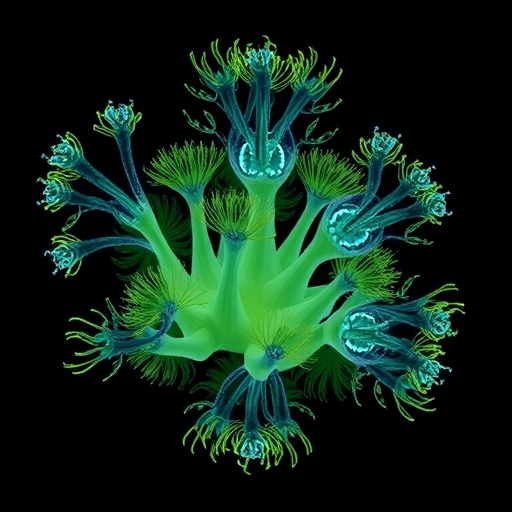
In the vast expanse of the oceans, microscopic organisms play monumental roles in ecosystem dynamics and global biogeochemical cycles. Marine diatoms, a dominant group of phytoplankton, have long fascinated scientists due to their unusual blend of simplicity and complexity. Recent groundbreaking research reveals that these unicellular algae exhibit social behaviors intricately governed by phytochromes, light-sensitive proteins previously characterized mainly in plants. This discovery not only revolutionizes our understanding of diatom ecology but also sheds light on the evolutionary underpinnings of communication and collective behavior in the marine microbial world.
For decades, diatoms have been scrutinized primarily as solitary photosynthetic cells, contributing significantly to global carbon fixation and oxygen production. However, emerging evidence indicated that diatoms do not function in isolation as rigidly autonomous individuals. Instead, they partake in coordinated activities such as colony formation and resource sharing, pointing to a form of ‘sociality’ previously unappreciated in single-celled algae. The mechanistic basis underlying these behaviors remained enigmatic until the latest study illuminated the role of phytochromes as pivotal molecular mediators.
Phytochromes are photoreceptor proteins best known from terrestrial plants, where they regulate growth and developmental responses based on red and far-red light perception. Their presence in marine diatoms was intriguing yet poorly understood, sparking scientific curiosity about whether these proteins could perceive environmental light cues beyond simple energy harvesting. The new research articulates that diatom phytochromes detect subtle shifts in the light spectrum caused by the presence and proximity of neighboring cells, enabling the algae to gauge population density and initiate communal responses.
By employing sophisticated molecular biology tools and advanced spectroscopy techniques, the investigators demonstrated that activation of phytochromes triggers signaling cascades which modulate gene expression profiles linked to adhesion, motility, and extracellular matrix production. This constellation of responses facilitates the aggregation of individual diatoms into cohesive clusters, enhancing nutrient access and offering protection from predation. These findings mark a paradigm shift, portraying marine diatoms as active decision-makers engaging in complex social interactions mediated by light perception.
Light plays a multifaceted role in aquatic ecosystems, not only fueling photosynthesis but also acting as a communication channel. The study reveals that diatom phytochromes finely discriminate wavelengths altered by cell shading and spectral filtering, effectively using an optical language to coordinate behavior. This capability allows diatoms to synchronize activities such as collective movement toward optimal light conditions or coordinated release of signaling molecules that modify the chemical microenvironment, optimizing survival strategies in fluctuating marine habitats.
The implications of phytochrome-mediated sociality stretch beyond ecological curiosity, intersecting with global environmental processes. Diatom blooms profoundly influence carbon sequestration by transporting organic carbon to ocean depths. Understanding the molecular underpinnings that govern diatom aggregation affords insights into bloom dynamics and resilience, potentially informing climate models that integrate microbial interactions. This knowledge could improve predictions of ocean health under stressors like warming, acidification, and nutrient shifts induced by human activities.
Moreover, the discovery spotlights evolutionary questions about the origin and conservation of photoreceptive systems. The presence of phytochromes in marine diatoms suggests an ancient lineage of light-sensing mechanisms predating terrestrial plant evolution. This ancestral heritage implies that social behavior mediated by light perception may be a widespread, fundamental trait extending across diverse aquatic microorganisms, highlighting convergent evolutionary strategies to harness environmental cues for communal benefits.
Methodologically, the research combined genome editing via CRISPR-Cas9 to generate diatom strains lacking functional phytochromes with time-lapse microscopy to visualize behavioral changes. The loss of phytochrome function disrupted the formation of cell aggregates and diminished coordinated responses to light gradients, confirming the essential role of these proteins. Transcriptomic analyses further identified downstream genes implicated in cellular adhesion and biofilm formation, framing a detailed molecular network that orchestrates diatom sociobiology.
This interdisciplinary approach underscores the value of integrating molecular genetics, photobiology, and ecological modeling to unravel complex phenomena in microorganisms. By bridging scales from molecular structures to community-level behaviors, the study exemplifies modern marine biology’s capacity to decode the hidden lives of microbes. Such innovations pave the way for future research aimed at manipulating diatom social systems to enhance biotechnological applications in biofuels, biosensors, and water quality management.
The rhythmic patterns of diatom sociality driven by phytochrome signaling also emphasize the intricate relationship between environmental rhythms and microbial life cycles. Light availability ebbs and flows daily and seasonally, and these temporal variations appear to be synchronized with diatom community assembly and dispersal mechanisms. The ability to ‘listen’ to light cues through phytochromes allows diatoms to optimize performance in a highly competitive seascape, enhancing ecological fitness and ensuring ecosystem stability.
Finally, the revelation that marine diatoms possess complex social attributes similar in concept to multicellular organisms challenges traditional biological classifications. It advocates for a broader recognition of sociality that transcends organismal size and complexity, broadening the canvas of behavioral ecology. As science continues to pierce the veil on microbial interactions, the paradigm of life on Earth expands — portraying even the smallest cells as extraordinary communicators in the grand web of life.
The study led by Font-Muñoz, Jaubert, Sourisseau, and their colleagues unveiled a hidden dimension of marine diatom biology, emphasizing phytochrome photoreceptors as facilitators of social behavior. Published in Nature Communications in 2026, this research stands as a testament to the extraordinary sophistication harbored within seemingly simple organisms and heralds a new era of marine microbial ecology where light is not only energy but dialogue.
The future promises further revelations as scientists delve deeper into the molecular dialogues that govern aquatic microbial societies, with potential applications ranging from ecosystem conservation to innovative technologies inspired by nature’s own communicative networks. The ocean’s microscopic realm, once thought to be solitary and silent, is now recognized as a vibrant stage of interaction powered by light and life, forever changing our perception of the marine microscopic world.
Cite Scienmag News
Violet Maxwell. (March 10, 2026). Phytochromes Drive Social Behavior in Marine Diatoms. Scienmag. https://scienmag.com/phytochromes-drive-social-behavior-in-marine-diatoms/
Violet Maxwell. "Phytochromes Drive Social Behavior in Marine Diatoms." Scienmag, 10 March 2026, https://scienmag.com/phytochromes-drive-social-behavior-in-marine-diatoms/. Accessed 6 September 2026.
Violet Maxwell. "Phytochromes Drive Social Behavior in Marine Diatoms." Scienmag. March 10, 2026. https://scienmag.com/phytochromes-drive-social-behavior-in-marine-diatoms/


