

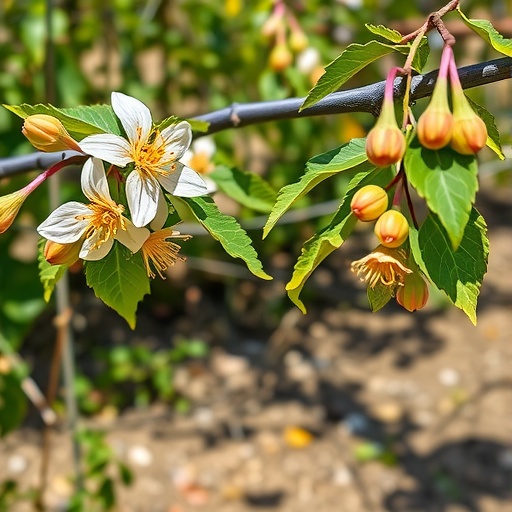
In a landmark study that deepens our understanding of how climate warming intricately reshapes plant life cycles, researchers Ji, Peng, Li, and colleagues have illuminated the nuanced impacts of rising global temperatures on flowering and fruiting phenology. Their work, recently published in Communications Earth & Environment, unravels the paradoxical nature of climate influences, revealing that while warmer climates tend to advance the onset of flowering and fruiting phases, they concurrently drive complex and divergent changes in the lengths of reproductive seasons across plant species. This investigation not only enhances our grasp on how ecosystems might reorganize in a warming world but also signals profound implications for biodiversity, agriculture, and ecological stability.
The research pivots on the fundamental biological events of flowering and fruiting, processes vital for plant reproduction and ecosystem functioning. It is widely recognized that phenological events—timed biological activities such as blooming or seed dispersal—are sensitive indicators of climatic changes. However, Ji et al.’s work moves beyond merely observing shifts in timing to dissect the resultant variations in the duration of reproductive phases, a domain less thoroughly explored yet critical for predicting species resilience. Their findings challenge the simplistic assumption that warming uniformly accelerates or lengthens reproductive periods, instead highlighting a more fragmented and species-specific response landscape.
Employing a robust and comprehensive dataset that spans multiple biomes and species, the study combines field observations with advanced modeling techniques to capture the temporal dynamics of plant reproductive cycles under warming scenarios. One striking revelation is that while earlier flowering and fruiting events were consistently recorded— a predictable response to increased thermal sums—the length of reproductive seasons exhibited marked heterogeneity. This divergence involved some species experiencing truncated reproductive durations, while others displayed prolonged periods of reproductive activity, a phenomenon the authors attribute to variations in physiological and ecological traits as well as interspecies interactions.
Delving deeper, the mechanisms underlying these divergent reproductive length responses appear multifaceted. The study posits that temperature-driven shifts in resource allocation, phenophase overlap, and stress tolerance thresholds collectively modulate reproductive length outcomes. For instance, certain species might hasten seed maturation to avoid late-season drought stress exacerbated by warming, thereby shortening their reproductive window. Conversely, others could exploit extended favorable conditions to protract fruiting phases, potentially enhancing reproductive output but also exposing themselves to novel risks such as predation or pathogen susceptibility over longer durations.
The spatial heterogeneity documented in this work is equally compelling. Ji and co-authors demonstrate that plant populations in distinct climatic regions respond dissimilarly to warming-induced phenological shifts. Species inhabiting temperate zones showed pronounced advancements in reproductive timing but faced a tendency towards compressed reproductive seasons. Tropical counterparts, in contrast, exhibited more flexible timing adjustments with some instances of extended reproductive phases, underscoring the influence of baseline climate variability and local adaptation. These findings underscore the potential for climate warming to reshape community structures by altering temporal niches and competitiveness among coexisting species.
One of the study’s noteworthy methodological strengths lies in its integration of long-term phenological records with process-based vegetation models calibrated for temperature sensitivity. This hybrid approach allowed the team to project not only past and present phenological trends but also forecast future trajectories under various warming scenarios. The predictive capability emphasizes that reproductive timing advances may accelerate even further with sustained warming, yet the directionality of reproductive season length changes remains less predictable. Such uncertainty reveals critical gaps in our predictive ecology frameworks, emphasizing the need for targeted physiological and ecological studies.
Beyond the ecological ramifications, these phenological shifts bear important consequences for agricultural productivity and food security. Crops and wild relatives may experience altered flowering and fruiting periods, influencing pollination dynamics, pest outbreaks, and yield timing. For instance, species exhibiting shortened reproductive windows could face reduced fecundity and synchronization with mutualistic pollinators, while prolonged reproductive phases might encounter elevated pest loads or abiotic stresses. Consequently, Ji et al.’s work implicitly calls for the integration of phenological data into agricultural adaptation strategies to enhance resilience under a changing climate.
Importantly, the authors also touch upon potential feedback mechanisms whereby altered plant reproductive cycles can influence broader ecosystem processes. Changes in fruiting periods impact food availability for frugivores and seed dispersers, potentially disrupting trophic interactions and seed dispersal networks, which in turn affect forest regeneration and landscape connectivity. The differential extension or contraction of reproductive seasons may therefore cascade through multiple ecological layers, ultimately reshaping biodiversity patterns and ecosystem services essential to human well-being.
The study further highlights the importance of phenological plasticity and evolutionary adaptability in mediating climate impacts. Species capable of adjusting reproductive timing and duration dynamically may buffer some negative consequences of warming, while those with rigid phenological schedules could suffer declines. This insight underscores the urgency of conserving genetic diversity and promoting habitats that facilitate adaptive responses, which are critical for sustaining resilient ecosystems amid accelerating climate perturbations.
Future research directions outlined by Ji and colleagues advocate for a more nuanced understanding of interactive drivers influencing reproductive phenology. Besides temperature, factors such as photoperiod sensitivity, soil moisture variability, atmospheric CO₂ concentrations, and biotic interactions require deeper exploration to disentangle their combined effects. Additionally, expanding spatial coverage to underrepresented regions and functional groups will enhance model generalizability and predictive accuracy, vital for crafting global and regional conservation and management policies.
This groundbreaking work reshapes the conventional narrative around climate change and plant phenology, emphasizing complexity, variability, and the intricate balancing act plants perform in response to warming. The notion that global warming simply accelerates biological clocks is supplanted by a richer, multifaceted picture where reproductive seasons can contract, extend, or shift asynchronously depending on species-specific traits and environmental contexts. Such insights beckon a reevaluation of how we model, predict, and mitigate the ecological consequences of a warming planet.
In conclusion, Ji et al.’s meticulous exploration into the phenological adaptions imposed by climate warming offers a pivotal advancement in ecological science. Recognizing that earlier flowering and fruiting coexist with divergent reproductive season length changes allows scientists, conservationists, and policymakers to refine their strategies toward fostering resilient ecosystems. As climate-driven phenological changes ripple through the biosphere, this study stands as a crucial beacon guiding efforts to anticipate and manage the biological complexities awaiting humanity and nature in an increasingly warm world.


