


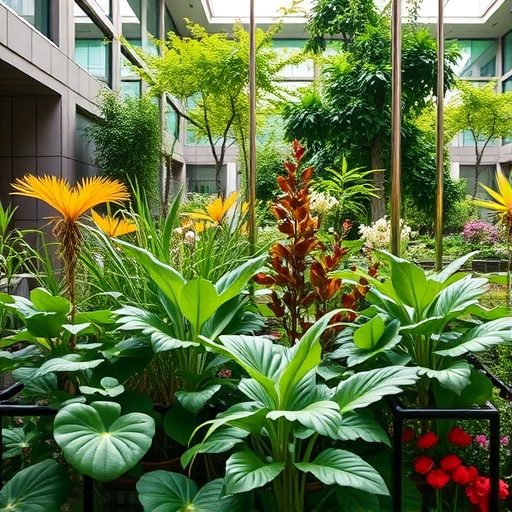
In an era marked by rapid urbanization and climatic shifts, understanding the ecological nuances of urban green spaces has never been more critical. A groundbreaking study by Zhao, Jumpponen, Setälä, and colleagues, recently published in Nature Communications (2026), reveals how the beta-diversity of urban vegetation profoundly influences microbial heterogeneity, offering invaluable insights for sustaining healthier urban environments.
Urban environments often appear as biological deserts amidst the concrete expanse of cities, but beneath this surface lies an intricate web of ecological interactions. Beta-diversity, a concept describing the variation in species composition between habitats, emerges as a vital determinant of microbial community structures in these urban green pockets. The study meticulously dissects how shifts in plant community diversity across urban landscapes drive corresponding changes in microbial diversity and function, thereby shaping ecosystem health.
The researchers delved into the complexity of urban flora, revealing that different patches of vegetation, even within a single metropolitan area, host markedly distinct communities of microorganisms. This microbial heterogeneity, governed by beta-diversity among plants, plays a crucial role in maintaining soil health, nutrient cycling, and even pathogen suppression — all factors pivotal to ecosystems nested within our cities.
One of the pivotal technical findings concerns the spatial scale at which beta-diversity operates. The research team employed high-throughput DNA sequencing and advanced spatial analytic models to uncover patterns of microbial distribution corresponding to plant species turnover across various urban scales. This discovery underscores the importance of preserving diverse vegetation clusters across city landscapes rather than isolated green spots to enhance microbial vitality.
Microbial communities serve as the invisible workforce of ecosystems, mediating essential biogeochemical processes. The interplay between plant beta-diversity and microbial heterogeneity revealed in this study unveils a feedback mechanism where diverse urban plant assemblages promote resilient microbial networks, which in turn bolster vegetation health. This dynamic has profound implications for urban planning, suggesting that fostering diverse plant communities can serve as natural allies in the fight against urban environmental stressors.
Furthermore, beta-diversity influences several microbial functions beyond mere presence or absence of species. The study identified functional traits linked to nutrient acquisition, stress tolerance, and organic matter decomposition were enriched in microbial communities associated with higher vegetation beta-diversity. This functional heterogeneity enhances the urban ecosystem’s adaptability, providing a buffer against disturbances such as pollution or extreme weather events.
The implications of microbial heterogeneity driven by plant beta-diversity extend to public health as well. Diverse microbial communities in urban soils can regulate pathogenic microbes, reducing disease reservoirs that might otherwise threaten human populations. Hence, urban green spaces with a mosaic of plant species compositions may act as natural bioremediation zones, supporting not only environmental but also human well-being.
In addressing urban sustainability, the study’s findings propel a paradigm shift by emphasizing the interconnectedness of aboveground vegetation diversity and belowground microbial dynamics. Traditional urban greening strategies often prioritize aesthetic uniformity and recreational space, but this research advocates for ecological heterogeneity as a cornerstone for resilient and healthy urban ecosystems.
Methodologically, the research harnessed an innovative combination of landscape ecology tools, molecular microbiology, and statistical ecology. By integrating metagenomic sequencing of soil samples with spatial vegetation surveys, the team quantified beta-diversity at unprecedented resolution. This approach allowed them to correlate microbial community assembly processes directly with patterns of plant species turnover across the urban matrix.
Additionally, the researchers highlight the significance of specific plant functional groups in modulating microbial communities. For instance, herbs and shrubs with varied root exudation profiles foster distinct microbial assemblages compared to monoculture tree canopies. These nuances reveal that urban biodiversity interventions should consider plant functional traits to maximize microbial benefits.
The study also underscores temporal dynamics by tracking microbial heterogeneity in relation to seasonal shifts in plant communities. This reveals that beta-diversity is not static but fluctuates with phenological changes, influencing microbial-mediated ecological processes throughout the year. Such insights could inform urban green space management to maintain ecological functions year-round.
Significantly, the research draws attention to the challenges of environmental stressors in urban contexts. Pollution, soil compaction, and heat islands can dampen both plant and microbial diversity. However, the evidence suggests that enhancing beta-diversity of urban vegetation may mitigate some of these impacts, fostering microbial assemblages that confer environmental resilience.
Finally, this pioneering study opens avenues for interdisciplinary collaborations between urban ecologists, microbiologists, landscape architects, and policymakers. It impels a holistic vision of urban green infrastructure—one that harnesses biodiversity at multiple trophic levels to sustain ecosystem services, promote human health, and counterbalance the ecological footprint of urban sprawl.
As cities continue to expand dramatically worldwide, integrating findings such as those presented by Zhao et al. (2026) into urban design frameworks could revolutionize how we conceive urban habitats. By championing beta-diversity as an ecological lever for microbial heterogeneity, this research offers a blueprint for nurturing vibrant, healthy urban ecosystems that stand resilient against future environmental challenges.
Cite Scienmag News
Morgan Morrow. (April 30, 2026). Urban Plant Diversity Drives Microbial Health, Ecosystem Stability. Scienmag. https://scienmag.com/urban-plant-diversity-drives-microbial-health-ecosystem-stability/
Morgan Morrow. "Urban Plant Diversity Drives Microbial Health, Ecosystem Stability." Scienmag, 30 April 2026, https://scienmag.com/urban-plant-diversity-drives-microbial-health-ecosystem-stability/. Accessed 5 September 2026.
Morgan Morrow. "Urban Plant Diversity Drives Microbial Health, Ecosystem Stability." Scienmag. April 30, 2026. https://scienmag.com/urban-plant-diversity-drives-microbial-health-ecosystem-stability/


