


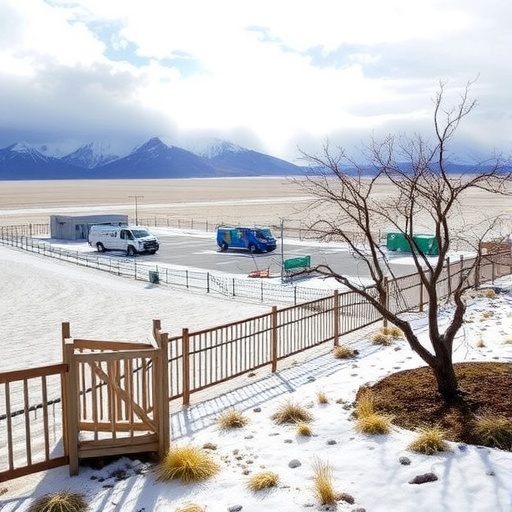
The Qinghai-Tibet Plateau, often referred to as the “Third Pole” of the Earth due to its vast ice fields and unique climatic conditions, has become a focal point for climate research in recent years. Rising temperatures in this high-altitude region have prompted scientists to investigate the broader ecological consequences of warming, with particular attention to the delicate interplay between soil moisture dynamics and plant life cycles. In groundbreaking research published in Nature Communications, Zhao, Sun, Song, and colleagues unveil how freeze-thaw cycles drive the return of soil moisture, profoundly influencing the timing of spring phenology across this critical landscape.
This study sheds new light on a previously underappreciated mechanism by which soil moisture resurges during the transition from winter to spring. Traditionally, studies have emphasized temperature and precipitation as primary factors dictating phenological shifts—the seasonal timing of biological events such as leaf unfolding, flowering, and bud burst. However, the Qinghai-Tibet Plateau’s unique environmental setting, characterized by extreme cold and alternating freeze-thaw events, challenges conventional understanding. The research team presents compelling evidence that repeated freeze-thaw cycles redistribute and replenish soil moisture, thus providing critical hydration precisely when emerging flora require it most.
At the core of this discovery lies a series of complex soil physical and hydrological processes. During the freezing phase, water within porous soil layers solidifies, pushing unfrozen water and nutrients into deeper strata. Upon thawing, these reservoirs release moisture back to the root zone, facilitating an early-season water supply that is not directly dependent on spring precipitation. This freeze-thaw-driven soil moisture return appears to moderate the soil water availability, a key determinant of plant physiological responses and growth patterns. It creates a feedback mechanism wherein soil moisture status, modulated by freeze-thaw dynamics, becomes a pivotal factor controlling phenological responses to warming.
The implications of this mechanism are far-reaching because the Qinghai-Tibet Plateau acts as a climatic and hydrological hub for much of Asia. Its ecosystems influence river flows downstream, affecting billions of people. With accelerated warming trends documented in this region—temperatures rising at twice the global average—the delicate balance between freeze-thaw cycles and soil moisture dynamics is increasingly vulnerable. The study highlights how warming not only advances spring phenophases but may also alter the very hydrological processes that sustain them, adding a layer of complexity to predicting future ecosystem responses under climate change scenarios.
Methodologically, the researchers utilized a combination of in situ soil moisture measurements, remote sensing phenological data, and climate modeling to validate their hypothesis. They employed sophisticated sensors capable of capturing minute fluctuations in soil water content across different depths throughout seasonal freeze-thaw transitions. Simultaneously, satellite-derived greenness indices provided high-resolution records of vegetation phenology over multiple years, allowing detection of subtle shifts linked to soil moisture dynamics. Climate models integrated with these datasets enabled simulations projecting how ongoing warming might reshape the freeze-thaw-moisture-phenology nexus on a decadal scale.
Their results revealed a striking consistency between the timing of soil moisture resurgence following freeze-thaw events and the onset of key spring phenophases, such as leaf-out. This synchrony suggests a causative connection rather than mere correlation. Notably, years with pronounced freeze-thaw-driven moisture return exhibited earlier and more robust plant growth, underscoring the ecological importance of this mechanism. Conversely, anomalously warm winters with diminished freeze-thaw occurrences disrupted soil moisture patterns, leading to less predictable phenological outcomes.
Intriguingly, the physiological mechanisms underlying plant uptake of this freeze-thaw-derived moisture appear finely tuned to cold environments. Roots become more active with the return of moisture, enabling rapid mobilization of resources that jumpstart photosynthetic activity. This early activation can confer competitive advantages to species adapted to exploit transient high soil water availability. Conversely, species lacking such adaptations risk phenological mismatches that may cascade through trophic interactions, affecting pollinators and herbivores alike. The study therefore also frames these findings within broader ecosystem resilience and biodiversity conservation contexts.
The researchers further explored how microbial communities in the soil respond to these freeze-thaw cycles. Microbial metabolism is sensitive to temperature and moisture fluctuations, influencing nutrient cycling and organic matter decomposition rates. The freeze-thaw-driven moisture return fosters microbial activity peaks that synchronize with plant phenology, enhancing nutrient availability at crucial growth stages. Such biogeochemical feedbacks amplify the significance of freeze-thaw phenomena beyond physical hydrology, linking soil biology directly to vegetation dynamics amid climate warming.
Importantly, the authors emphasize that the ecological role of freeze-thaw cycles may vary regionally within the plateau depending on altitude, soil composition, and vegetation type. High-elevation zones with permafrost are particularly susceptible to alterations in freeze-thaw frequency and intensity. As permafrost thaws, it can disrupt established moisture regimes and soil structure, potentially destabilizing plant communities. The study warns that these localized changes could trigger cascading effects at larger spatial scales, affecting not only natural ecosystems but also pastoral livelihoods reliant on seasonal forage availability.
The paper also critiques the limitations of current climate models that often overlook freeze-thaw-driven hydrological feedbacks. By integrating detailed soil moisture dynamics related to freeze-thaw events, the authors call for more nuanced modeling approaches to improve predictions of phenological shifts in cold regions. They argue that incorporating these processes is essential to anticipate the timing and extent of ecosystem responses, providing critical information for climate adaptation strategy planning in vulnerable mountain environments.
Beyond scientific circles, these findings hold substantial implications for regional agriculture and water resource management. Timely knowledge of soil moisture availability can guide planting schedules and irrigation practices, optimizing crop yields under changing climate conditions. Moreover, understanding the drivers behind spring onset can enhance forecasts for water flow timing, which impacts hydropower generation and flood control operations downstream. Hence, the research delivers actionable insights transcending ecological theory, reaching into socio-economic domains.
In summary, Zhao and colleagues’ study unveils a sophisticated ecological mechanism through which freeze-thaw cycles renew soil moisture at critical phenological junctures, shaping the seasonal rhythms of vegetation on the warming Qinghai-Tibet Plateau. By linking physical soil processes with biological timing and ecosystem functionality, this work enriches our comprehension of climate change impacts in alpine environments. It underscores the urgency to embed detailed hydrological feedbacks into ecological models and conservation policies to safeguard these fragile landscapes under accelerating global warming.
As climate shifts continue to alter freezing patterns globally, the insights provided by this research will resonate beyond the Qinghai-Tibet Plateau, offering a template for understanding similar ecological processes in other cold regions. This deeper grasp of freeze-thaw influences on soil-plant interactions could revolutionize phenological forecasting and environmental stewardship worldwide, marking a pivotal advance in climate science.
Cite Scienmag News
Violet Maxwell. (May 1, 2026). Freeze-Thaw Boosts Spring Growth on Qinghai-Tibet Plateau. Scienmag. https://scienmag.com/freeze-thaw-boosts-spring-growth-on-qinghai-tibet-plateau/
Violet Maxwell. "Freeze-Thaw Boosts Spring Growth on Qinghai-Tibet Plateau." Scienmag, 1 May 2026, https://scienmag.com/freeze-thaw-boosts-spring-growth-on-qinghai-tibet-plateau/. Accessed 5 September 2026.
Violet Maxwell. "Freeze-Thaw Boosts Spring Growth on Qinghai-Tibet Plateau." Scienmag. May 1, 2026. https://scienmag.com/freeze-thaw-boosts-spring-growth-on-qinghai-tibet-plateau/


