


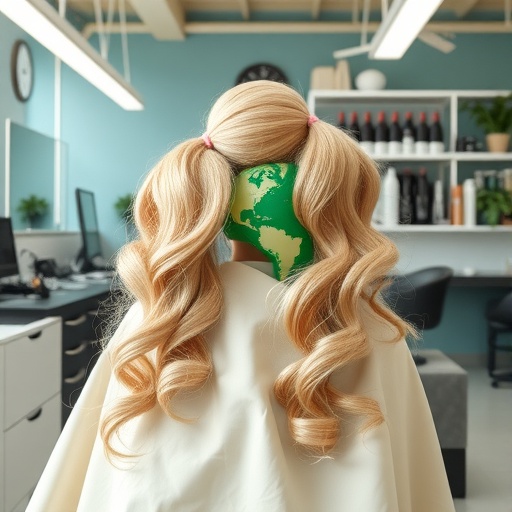
In the evolving battle against climate change, researchers have uncovered a surprising yet powerful ally: hairdressers. Recent research conducted by teams from the University of Bath’s Centre for Climate Change and Social Transformations (CAST), along with colleagues from the Universities of Oxford, Southampton, and Cardiff, has revealed that hair salons are more than just places for personal grooming—they are influential community hubs capable of fostering meaningful dialogue around sustainability and climate action. This novel insight opens up innovative possibilities for grassroots engagement in environmental issues.
Hairdressers cultivate long-standing, trust-based relationships with their clients, often spanning years or even decades. From a psychological perspective, this social bond positions hairdressers uniquely as confidants who can subtly influence attitudes and behaviors. Utilizing this rapport, they are well-placed to introduce and normalize conversations about sustainable practices in everyday life. The intimate environment of salons provides a setting where clients are relaxed and receptive, thus amplifying the potential impact of climate-related discourse.
The interdisciplinary study centered on qualitative interviews with 30 salon owners and directors combined with an applied intervention in 25 environmentally-conscious salons nationwide. Researchers introduced ‘Mirror Talkers’—eco-friendly informational prompts displayed strategically on salon mirrors—to incite dialogue about sustainable haircare and broader climate issues. The findings indicated a notable engagement, with nearly three-quarters of salon clients reporting intentions to modify their habits following these interactions, highlighting measurable shifts in consumer behavior facilitated by the salon environment.
Understanding the carbon footprint of beauty routines requires nuanced technical insights. Professor Denise Baden from the University of Southampton explains, “While consumers often associate ‘green’ products solely with recyclable packaging, the predominant environmental impact lies in indirect factors such as water heating during shampooing. Encouraging clients to reduce shampoo frequency and lower water temperatures can significantly diminish energy and water consumption, delivering multifaceted benefits including cost savings and improved hair health.” This technical perspective underscores the importance of integrating life cycle and usage-phase analyses when evaluating product sustainability.
The research challenges traditional perceptions of influence by introducing the concept of ‘everyday influencers’—individuals embedded within daily social networks whose consistent interpersonal interactions can catalyze significant societal change. Unlike celebrities or public figures whose impact is often sporadic or mediated by mass media, everyday influencers engage repeatedly on a personal level, fostering incremental yet sustained behavior modification within their communities.
From a sociological lens, salons function as microcosms of social interaction where conversations organically expand beyond haircare to encompass topics such as plastic waste reduction, dietary choices, transportation habits, and energy efficiency. This social dynamic transforms hairdressers into conduits for broader environmental awareness, leveraging the social psychology of trust and normative influence to promote eco-conscious living.
Economically, the hair and beauty sector in the UK is substantial, comprising over 61,000 businesses and contributing £5.1 billion annually. This economic footprint combined with salons’ social capital signifies an untapped potential for policy interventions aimed at sustainability promotion. The study advocates for embedding sustainability training into hairdressing education and apprenticeships, ensuring future professionals are equipped with both the knowledge and communication skills necessary to act as climate ambassadors.
Moreover, scaling up the deployment of conversational tools like Mirror Talkers could enhance nationwide engagement efforts, translating scientific insights into accessible, actionable guidance for everyday consumers. Policymakers are encouraged to recognize salons as key venues for climate action outreach, particularly targeting demographics such as women and community groups who frequent these spaces, thereby optimizing reach and inclusivity.
Innovative approaches like this underscore the paradigm shift in climate communication strategies from top-down mandates to community-centered, trust-based dialogues. Dr. Sam Hampton from CAST emphasizes the fundamental importance of everyday conversations, stating, “True societal transformation stems from conversations held in ordinary places, not solely within governmental institutions.”
The implications of this research extend beyond the haircare industry, signaling a broader need to identify and engage with other ‘everyday influencers’ embedded in the social fabric. This insight encourages climate communicators and social scientists to explore diverse professional and community networks as fertile grounds for fostering sustainable behavior change.
In conclusion, the study illuminates the critical role that hairdressers and salons play as agents of climate engagement. By harnessing their intrinsic relational capital and applying evidence-based communication techniques, they stand poised to drive substantive environmental impact on both individual and societal levels. This discovery broadens the landscape of climate action, emphasizing that combating climate change requires mobilizing influence at all levels—from parliament to personal care routines.
News Publication Date: 3 March 2026
Web References:
- Research article: https://www.nature.com/articles/s41599-026-06781-4
- CAST report: https://cast.ac.uk/wp-content/uploads/2026/02/the-centre-for-climate-change-and-social-transformations-cast-report-hairdressers-as-everyday-influencers-on-climate-change-and-sustainability.pdf
References:
Hampton, S., Latter, B., Baden, D., et al. (2026). Public engagement and climate change: exploring the role of hairdressers as everyday influencers. Humanities and Social Sciences Communications. DOI: 10.1057/s41599-026-06781-4
Cite Scienmag News
Sloane Callahan. (March 3, 2026). New Research Reveals Hairdressers as Unexpected Allies in the Fight Against Climate Change. Scienmag. https://scienmag.com/new-research-reveals-hairdressers-as-unexpected-allies-in-the-fight-against-climate-change/
Sloane Callahan. "New Research Reveals Hairdressers as Unexpected Allies in the Fight Against Climate Change." Scienmag, 3 March 2026, https://scienmag.com/new-research-reveals-hairdressers-as-unexpected-allies-in-the-fight-against-climate-change/. Accessed 3 September 2026.
Sloane Callahan. "New Research Reveals Hairdressers as Unexpected Allies in the Fight Against Climate Change." Scienmag. March 3, 2026. https://scienmag.com/new-research-reveals-hairdressers-as-unexpected-allies-in-the-fight-against-climate-change/


