


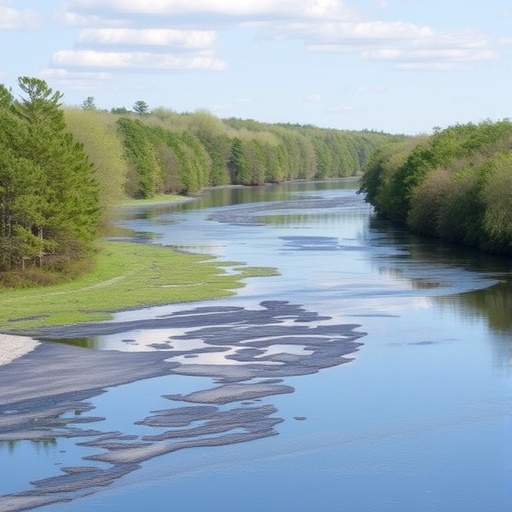
A recent groundbreaking study led by researchers from the University of Illinois Urbana-Champaign, in collaboration with Cornell University, has revealed a significant and encouraging decline in nitrate pollution across the vast Mississippi-Atchafalaya River Basin (MARB) over the past two decades. This considerable reduction signals promising advances in water quality within local watersheds and the Gulf of Mexico, offering renewed hope for the restoration of marine ecosystems and the mitigation of harmful environmental phenomena such as the notorious Gulf “dead zone.” Unlike conventional assumptions that attribute improvements primarily to diminished fertilizer application, this pioneering research highlights cleaner atmospheric conditions and enhanced nitrogen uptake facilitated by modern corn hybrids as primary drivers of this positive environmental trajectory.
Between the years 2000 and 2020, the MARB witnessed substantial increases in agricultural crop yields concomitant with a notable decrease in nitrogen oxide emissions emanating from industrial smokestacks and vehicular sources—a direct result of the Clean Air Act’s regulatory framework. Lead author Greg McIsaac, an associate professor emeritus at the University of Illinois’ Department of Natural Resources and Environmental Sciences, emphasizes that these reductions in nitrogen oxide emissions have consequentially curtailed the influx of bioavailable nitrogen into terrestrial soils and waterways through atmospheric deposition. This dynamic underscores a critical, albeit previously underappreciated, link between air quality regulations and watershed nitrogen dynamics.
Nitrate pollution in riverine systems is a major contributor to hypoxia in aquatic environments, particularly in the Gulf of Mexico, where oxygen-depleted zones can devastate local aquatic life by creating inhospitable conditions for fish and other marine organisms. The Gulf Hypoxia Task Force, alongside participating states bordering the Mississippi River, has strived to reduce nitrogen inflows by 45%, a goal that has experienced slow but steady progress over the last ten years. The reduction in nitrate flux documented by this study suggests that these ambitious targets may be within reach, if sustained efforts continue to focus on pollution control and agricultural practices.
A pivotal conceptual tool employed in this research is the Net Anthropogenic Nitrogen Inputs (NANI) framework, initially developed and refined by Robert Howarth from Cornell University, a co-author of the study. NANI provides a robust method for quantifying how human activities influence nitrogen input at the watershed scale. It encapsulates four principal contributors: synthetic nitrogen fertilizer application, biological nitrogen fixation by crops, atmospheric nitrogen deposition, and the net import or export of nitrogen through food and feed. This minimalist yet comprehensive approach enables researchers to link terrestrial nitrogen sources directly to downstream water quality metrics.
The research team meticulously applied the NANI model across 217 watersheds within the MARB, spanning a comprehensive temporal window from 2000 through 2020. Notably, the study introduces refined calculations of critical parameters such as crop nitrogen content and biological nitrogen fixation. This enhancement allows for more accurate estimations of nitrogen removed during crop harvest and nitrogen supplied via legumes like soybeans, thereby improving the fidelity of nutrient budgeting. Such precision in modeling is vital for advancing the understanding of nitrogen fluxes within complex agroecosystems.
Statistical analyses demonstrate a robust correlation between watershed NANI values and flow-normalized river nitrate concentrations, underscoring the predictive power of the NANI model. Flow normalization is a methodological approach that accounts for variability in annual precipitation and river discharge, enabling a clearer assessment of nitrogen trends independent of hydrological fluctuations. This relationship corroborates the premise that terrestrial nitrogen inputs are strong determinants of riverine nitrate levels, affirming the utility of land-based nitrogen budgets to forecast water quality outcomes.
Importantly, the study incorporates the role of tile drainage systems—subsurface channels installed in agricultural fields to quickly drain excess water—in transporting nitrates to waterways. Watersheds where tile drainage exceeded 20% exhibited an average annual decline of five pounds of nitrogen per acre, a finding that reveals the significance of drainage infrastructure in modulating nitrogen export. This insight is critical, as tile drainage represents an often overlooked pathway that can exacerbate nutrient pollution but can also be managed to optimize nitrogen retention and improve water quality.
The observed declines in nitrate pollution are attributed to a confluence of factors, including increased nitrogen use efficiency among farmers enabled by advances in crop genetics and agronomic practices. Modern corn hybrids demonstrate enhanced nitrogen uptake capabilities, reducing the surplus nitrogen left in soils to leach into water bodies. Furthermore, reductions in atmospheric nitrogen deposition—particularly in the eastern reaches of the Mississippi Basin—reflect successful air quality policies that have diminished external nitrogen loading pressures on watersheds.
The interplay between terrestrial nitrogen management and downstream ecosystem health is exemplified by the export of nitrogen contained within harvested crops and animal feed. As crops sequester more nitrogen in biomass that is subsequently removed from the watershed, fewer nitrogen compounds remain to contribute to river pollution. This export dynamic, coupled with reduced atmospheric inputs, collectively drives down nitrate concentrations in rivers, translating to improved aquatic conditions.
The collaborative nature of the progress observed in MARB is underscored by the concerted efforts among farmers, crop advisors, conservation agencies, and policymakers. This nexus of stakeholders has fostered adaptive management strategies and policy frameworks that integrate scientific innovation with practical field-level interventions. Federal policies targeting air pollution have synergistically complemented these initiatives, amplifying their efficacy in reducing nitrogen pollution.
In 2024, the basin achieved an interim milestone—20% reduction in nitrogen loading to the Gulf—signaling tangible progress toward long-term goals. However, to attain the targeted 45% reduction by 2035, continued commitment and investment in both conservation practices and agricultural research remain imperative. Achieving these targets will not only ameliorate hypoxic conditions in the Gulf but will improve water quality for millions of residents and diverse ecosystems within the basin.
Published in Ocean-Land-Atmosphere Research, the study “Changes in Terrestrial N Budgets and Riverine Nitrate-N Yields from Mississippi River Basin Watersheds 2000 to 2020” represents an important contribution to our understanding of nitrogen cycling and watershed management. Funded in part by USDA’s National Institute of Food and Agriculture and the Walton Family Foundation, the research draws upon extensive data integration facilitated by the National Great Rivers Research and Education Center and the National Center for Supercomputing Applications. This interdisciplinary endeavor showcases the critical intersection of environmental science, agriculture, and policy aiming to restore and preserve vital water resources.
The promising findings from this study illuminate a pathway toward sustainable nitrogen management that harmonizes agricultural productivity with environmental stewardship. By leveraging advancements in crop science, regulatory frameworks, and watershed-scale monitoring, stakeholders within the Mississippi River Basin can continue to drive down nitrogen pollution, fostering healthier watersheds, resilient ecosystems, and thriving communities well into the future.
News Publication Date: Not explicitly specified in the text (derived from the context, likely early 2024).
Web References:
- Study DOI: 10.34133/olar.0131
- Gulf Hypoxia Task Force: https://www.epa.gov/ms-htf
- University of Illinois Urbana-Champaign: http://illinois.edu/
- Cornell University: https://www.cornell.edu/
- Great Lakes to the Gulf Virtual Observatory: https://greatlakestogulf.org/
References:
- McIsaac, G., Swaney, D., Botero-Acosta, A., & Howarth, R. (2024). Changes in Terrestrial N Budgets and Riverine Nitrate-N Yields from Mississippi River Basin Watersheds 2000 to 2020. Ocean-Land-Atmosphere Research, DOI: 10.34133/olar.0131
Cite Scienmag News
Violet Maxwell. (March 2, 2026). Research Reveals Two-Decade Decrease in Nitrate Pollution in Mississippi River Basin. Scienmag. https://scienmag.com/research-reveals-two-decade-decrease-in-nitrate-pollution-in-mississippi-river-basin/
Violet Maxwell. "Research Reveals Two-Decade Decrease in Nitrate Pollution in Mississippi River Basin." Scienmag, 2 March 2026, https://scienmag.com/research-reveals-two-decade-decrease-in-nitrate-pollution-in-mississippi-river-basin/. Accessed 3 September 2026.
Violet Maxwell. "Research Reveals Two-Decade Decrease in Nitrate Pollution in Mississippi River Basin." Scienmag. March 2, 2026. https://scienmag.com/research-reveals-two-decade-decrease-in-nitrate-pollution-in-mississippi-river-basin/


