


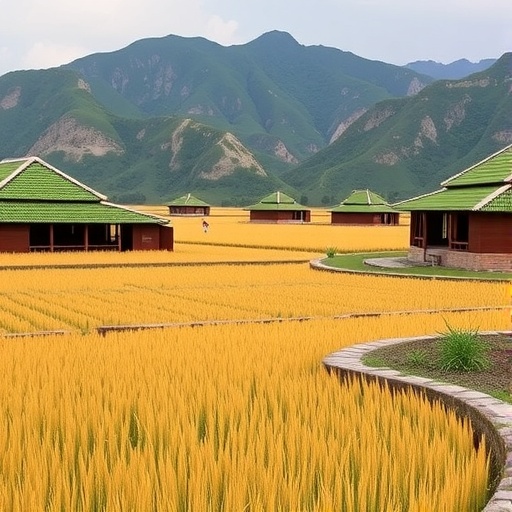
Millet has long held a pivotal role in the agricultural history of East Asia, serving as a staple crop throughout much of the Holocene epoch, which began around 11,700 years ago. Despite its importance, the broader climatic factors influencing the emergence, development, and spatial dispersal of millet farming have remained elusive. A groundbreaking study by researchers from the Institute of Earth Environment of the Chinese Academy of Sciences, alongside collaborators within and beyond China, sheds new light on this enduring question. By delving into the Chinese Loess Plateau—a vast region bearing thick deposits of wind-blown silt—the team reconstructed millennia of soil temperature fluctuations and correlated these environmental shifts with the archaeological record of millet agriculture.
This research, published in the prestigious Proceedings of the National Academy of Sciences (PNAS) on May 4, 2026, posits that variations in growing-season soil temperature played a crucial, yet previously underappreciated, role in shaping the trajectory of millet cultivation in prehistoric East Asia. The study identifies a distinct mid-Holocene cooling period, approximately between 7,500 and 6,000 years ago, during which dropping soil temperatures likely contracted the thermally viable zones for millet growth, especially given the crop’s susceptibility to frost. This climate downturn appeared to have driven a southward shift and temporal delay in millet farming expansion, only reversing when temperatures rebounded after 6,000 years ago.
To unravel this complex climate-agriculture interplay, the researchers examined loess deposits from the Longgugou (LGG) section within the Chinese Loess Plateau (CLP). Integrating a high-resolution chronological framework built upon 14 radiocarbon and 18 optically stimulated luminescence dates, their study spans an extensive timeframe from roughly 12,300 to 2,800 years before present. Within this temporal canvas, 114 biomarker analyses enabled a reconstruction of past growing-season soil temperatures and vegetation dynamics. The careful synthesis of these paleoecological proxies, archaeological datasets, and transient climate simulations underpinned their holistic approach to understand how soil temperature variability influenced early millet domestication and farming expansion.
Intriguingly, the results reveal three distinct phases with unique temperature and environmental signatures impacting millet agriculture. Initially, during the earliest period from about 12,300 to 7,500 years ago, soil temperatures were relatively elevated, but this warmth coincided with lower moisture availability and sparse vegetation cover. This combination of factors may have posed substantial subsistence challenges, yet evidence suggests early millet cultivation emerged in northeast regions like Yanshan and Liaoning, where communities were perhaps under heightened pressure to develop reliable food sources.
Between 7,500 and 6,000 years ago, the climate turned cooler and wetter, fostering denser vegetation growth. The progressive soil cooling during this interval is critically important; it appears to have compressed the thermal niches suitable for frost-sensitive millet species. This environmental bottleneck likely compelled a delayed, southward relocation of farming activities toward the Chinese Loess Plateau and nearby areas, demonstrating how shifting soil temperatures constrained the spatial distribution of agriculture. The competition between wild flora and cultivated millet for arable land under these conditions may have further influenced the agricultural strategies adopted by Neolithic populations.
Post-6,000 years ago, the research documents a rapid recovery and stabilization of growing-season soil temperatures extending for several millennia. This amelioration of thermal conditions, paired with a decline in vegetation density and advances in cultivation methods, catalyzed a broad expansion of millet agriculture during the late Neolithic period. The favorable environmental window aligned with technological innovations likely enabled farming communities to intensify cultivation, increase yields, and facilitate societal development across East Asia.
One of the study’s pivotal contributions is its emphasis on soil temperature as a decisive environmental constraint, a factor often overshadowed by precipitation or atmospheric temperature in agricultural and paleoclimate research. By reconstructing the detailed thermal history of soils integral to early millet farming zones, the work highlights how thermal thresholds dictated by crop physiology governed cultivation viability. This nuanced understanding deepens our grasp of how climate variability directly shaped human economic practices and settlement patterns thousands of years ago.
Moreover, by linking biomarker-derived soil temperature reconstructions with archaeological records, the researchers map a compelling narrative of how prehistoric societies responded adaptively to fluctuating environmental conditions. Their findings elucidate the complex interaction between natural climatic limits and human decision-making, illustrating that agriculture’s geographic spread was not merely a product of cultural diffusion but was fundamentally molded by biophysical constraints.
The study’s interdisciplinary approach—bridging paleoenvironmental science, archaeology, and climate modeling—sets a benchmark for future exploration of ancient food production systems. The identified strong correlation between soil thermal regimes and millet agriculture evolution underscores the importance of scrutinizing soil conditions when assessing ancient farming histories. As global climate change accelerates today, insights from such deep-time records offer valuable perspectives on how temperature dynamics at the soil-plant interface can influence crop resilience and agricultural sustainability.
By revealing that substantial soil temperature fluctuations during the Holocene significantly influenced where and when millet agriculture flourished, this research contributes profoundly to our understanding of early human-environment interactions in East Asia. It challenges researchers to reconsider the climatic variables prioritized in archaeological interpretations of agricultural origins and invites more detailed investigations of soil microclimate impacts on crop domestication pathways worldwide.
In sum, this compelling reconstruction of thermal history from the Chinese Loess Plateau not only enriches knowledge of millet’s domestication tale but also offers a broader template for examining how ancient farming systems responded to intricate climatic forcings. It eloquently demonstrates that ancient agricultural evolution involved a dynamic interplay of climate, ecological contexts, and human adaptation strategies, reminding us that past societies were intricately attuned to their environments.
Cite Scienmag News
Alan Morgan. (May 7, 2026). Study Reveals Soil Temperature Influenced Millet Farming in Neolithic East Asia. Scienmag. https://scienmag.com/study-reveals-soil-temperature-influenced-millet-farming-in-neolithic-east-asia/
Alan Morgan. "Study Reveals Soil Temperature Influenced Millet Farming in Neolithic East Asia." Scienmag, 7 May 2026, https://scienmag.com/study-reveals-soil-temperature-influenced-millet-farming-in-neolithic-east-asia/. Accessed 4 September 2026.
Alan Morgan. "Study Reveals Soil Temperature Influenced Millet Farming in Neolithic East Asia." Scienmag. May 7, 2026. https://scienmag.com/study-reveals-soil-temperature-influenced-millet-farming-in-neolithic-east-asia/


