


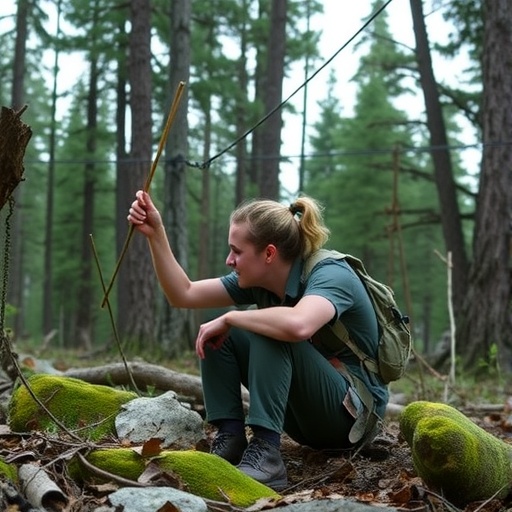
Adaptation stands as a cornerstone of survival in the natural world. Across countless species, the slow march of evolution and natural selection has sculpted organisms finely tuned to their environments over many generations. Yet, survival is not contingent solely on these gradual processes; individual animals possess the remarkable capacity to adapt within their own lifetimes through learning. This behavioral plasticity, especially prominent in humans but widespread in the animal kingdom, is essential for navigating the complexities and dangers of everyday life.
One of the most formidable challenges arises when adaptation involves mastering hazardous environments, such as those encountered during hunting. Juvenile animals face the daunting task of acquiring crucial survival skills in contexts where missteps can prove fatal. According to doctoral researcher Dharanish Rajendra, affiliated with Professor Chaitanya Gokhale at Julius-Maximilians-Universität Würzburg, the process of learning through direct exploration is not without risk. For young predators, trial-and-error can mean the difference between life and death, which raises the question: how do these animals safely acquire the necessary expertise to tackle dangerous prey?
Parental care emerges as a key evolutionary solution. Adults in certain species construct buffered learning environments that allow their offspring to practice and hone risky behaviors gradually, under protection. This developmental scaffolding facilitates a stepwise acquisition of competence, calibrating exposure to risk in harmony with the juvenile’s skill development. In a recently published study, Rajendra and Gokhale employ rigorous mathematical and computational models to decipher precisely how these protected learning settings optimize the transition from naive juvenile to capable adult.
Many predators specialize in prey that pose significant threats to inexperienced hunters due to size, defense mechanisms, or venom. Wolves challenge massive elk and bison, pythons tackle risky porcupines, and meerkats—a small but highly social mammal native to southern Africa—regularly hunt venomous scorpions. The remarkable social complexity of meerkats underlies their sophisticated parental strategies. Adults incrementally expose their young to prey of increasing danger, starting with dead scorpions, moving to live but venom-less individuals, and eventually graduating to fully viable, dangerous scorpions. This graduated exposure allows juveniles to progressively build the skills and confidence necessary for independent survival.
The researchers formalized this developmental process within a dual-phase model: a protected learning phase followed by an unprotected, real-world phase. Applying mathematical frameworks and computational simulations, they investigated how varying the safety and realism of the early environment impacts learning outcomes. Their results caution against excessive protection—akin to “helicopter parenting” in humans—which can inadvertently hamper skill acquisition. When the learning environment is artificially sanitized or too dissimilar from real conditions, juveniles risk maladaptation, entering adulthood ill-prepared for genuine threats and facing elevated mortality.
Central to the study is the concept that successful protected learning hinges on maintaining sufficient similarity between the developmental environment and the challenges of ultimate survival. The researchers emphasize that a gradual escalation in risk exposure serves as the critical bridge. Such a progression ensures continuous calibration of behavior toward the probabilistic and dynamic nature of real-world hazards. This mechanistic insight mirrors naturalistic observations and underscores the evolutionary logic behind nuanced parental investment in offspring development.
To unravel the complexities underlying these behavioral strategies, the study integrates two powerful computational methodologies. Dynamic programming, a mathematically rigorous optimization technique, was employed to determine the theoretical ideal strategy under varied environmental regimes. This approach allows for identifying optimal decisions by evaluating the expected payoff over time, factoring in risk and reward trade-offs across developmental stages. Complementing this, reinforcement learning simulations modeled how animals might realistically learn effective strategies through iterative trial-and-error shaped by environmental feedback.
Together, these computational perspectives illuminate the interplay between experience and strategy formation, revealing how early-life exposure calibrates risk sensitivity and decision-making efficacy. The dual modeling further validates that adaptive parental care strategies are not arbitrary but rest on quantifiable mathematical principles shaped by evolutionary pressures. This cross-disciplinary synthesis bridges biology, behavioral ecology, and computational theory to deepen our understanding of learning processes in nature.
The findings contribute profound theoretical underpinnings to observed parental behaviors that have long intrigued evolutionary and behavioral scientists. By formalizing the mathematics driving such strategies, the study offers a robust explanatory framework for species-specific variations in parental care and juvenile learning. These insights extend beyond animal behavior, offering parallel perspectives on early human development and educational practices where scaffolded learning and graduated exposure similarly optimize outcomes.
Beyond individual learning, the researchers envisage the next frontier lying in the intersection of protected developmental environments and social learning—when individuals acquire skills not just through direct experience, but also by observing conspecifics. Given the prevalence of sociality in species with extended parental care, unraveling how social information interfaces with risk-modulated learning promises to uncover deeper layers of behavioral adaptation and cultural transmission.
Ultimately, this research highlights the elegance with which nature balances risk and reward to ensure survival. It reveals that play, often seen as mere frivolity, serves a vital evolutionary function in preparing the next generation for the hazards they will inevitably face. By blending mathematical rigor with biological insight, Rajendra and Gokhale’s work elevates our appreciation for the subtleties of developmental plasticity, offering a foundational blueprint for future explorations into the dynamics of learning and adaptation.
News Publication Date:
26-Feb-2026
Web References:
http://dx.doi.org/10.1098/rspb.2025.3111
Cite Scienmag News
Gavin Prescott. (March 2, 2026). Mastering Survival Skills Within a Controlled Environment. Scienmag. https://scienmag.com/mastering-survival-skills-within-a-controlled-environment/
Gavin Prescott. "Mastering Survival Skills Within a Controlled Environment." Scienmag, 2 March 2026, https://scienmag.com/mastering-survival-skills-within-a-controlled-environment/. Accessed 4 September 2026.
Gavin Prescott. "Mastering Survival Skills Within a Controlled Environment." Scienmag. March 2, 2026. https://scienmag.com/mastering-survival-skills-within-a-controlled-environment/


