


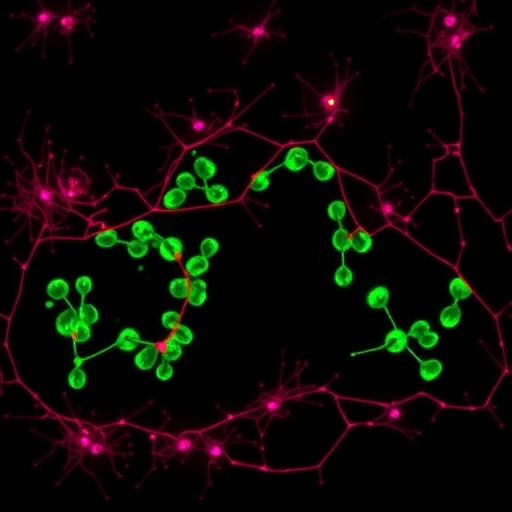
Recent findings in the field of cancer research have shed light on the intricate relationship between the immune system and tumor progression, particularly concerning a type of immune cell known as macrophages. A groundbreaking study conducted by Zhang et al. has delved into how senescent CXCL16^+ macrophages significantly influence the trajectory of lung adenocarcinoma, a common and often lethal form of lung cancer. This research encapsulates the emergence of advanced multiomics analysis as a transformative approach in understanding cancer biology.
Lung adenocarcinoma is characterized by complex genetic underpinnings and a highly dynamic tumor microenvironment. The study conducted by Zhang and colleagues underscores the pivotal role of macrophages, which are a ubiquitous component of the immune response. While traditionally perceived as protective agents against tumors, these researchers unearth a duality in their function, revealing that certain macrophage populations can actively facilitate tumor growth.
At the core of this research lies the phenomenon of cellular senescence, a state in which cells cease to divide but remain metabolically active. This state of senescence has been under intense scrutiny, particularly in the context of cancer. The recent findings highlight that senescent CXCL16^+ macrophages, which communicate through the TGF-β signaling pathway, hold significant sway over the progression of lung adenocarcinoma. It appears that rather than hindering cancer development, these macrophages set the stage for a permissive microenvironment that promotes tumor growth and metastasis.
The research team employed an innovative multiomics approach that integrates various biological fields—genomics, transcriptomics, proteomics, and metabolomics. This comprehensive methodology provides a holistic view of cellular interactions and the molecular landscape changes occurring in response to tumor development. By leveraging these advanced techniques, the authors identified a unique gene expression profile associated with senescent CXCL16^+ macrophages, enabling them to pinpoint specific pathways that could serve as therapeutic targets.
One of the most striking findings was the activation of the TGF-β signaling pathway within these macrophages. TGF-β, a multifunctional cytokine, has well-documented roles in both tumor suppression and promotion, depending on the context. In the case of lung adenocarcinoma, the authors demonstrated that TGF-β acts as a critical mediator through which senescent macrophages exert their pro-tumorigenic effects. This signaling cascade not only enhances cancer cell proliferation but may also contribute to immune evasion, allowing tumors to escape the body’s natural defenses.
Furthermore, the study elucidates the intricate ways in which these senescent macrophages interact with malignant lung cells. For instance, they found that communication between CXCL16^+ macrophages and lung adenocarcinoma cells leads to the secretion of various factors that stimulate tumor growth. This presents a self-reinforcing loop where the tumor cells encourage macrophage senescence, further fueling cancer progression.
As the implications of this research unfold, it raises critical questions about therapeutic strategies aimed at modulating the immune response in cancer treatment. The conventional wisdom has often leaned towards activating immune cells to mount a more robust attack against tumors. However, the findings from Zhang et al. suggest that in certain contexts, a nuanced approach is required—one that carefully considers the state of immune cells within the tumor microenvironment.
Innovatively, the study recommends targeting specific signaling pathways involved in macrophage senescence and function. By disrupting the TGF-β signaling in CXCL16^+ macrophages, it may be possible to reverse their pro-tumor effects and restore a more immune-stimulatory environment. This holds promise not only for lung adenocarcinoma but potentially for other cancers where similar mechanisms may be at play.
Moreover, these revelations point toward the necessity of personalized medicine approaches wherein the unique characteristics of an individual’s tumor microenvironment dictate the most effective therapeutic interventions. Advancements in precision medicine can harness insights gained from studies like these to develop targeted therapies that correspond to the specific immune landscape of a patient’s tumor.
The integration of multiomics approaches into cancer research marks a significant leap forward. It allows for a deeper understanding of the relationship between cancer cells and the immune system, particularly in the context of tumor-associated macrophages. The collaborative interplay of these complex biological systems unveils new therapeutic avenues that could fundamentally alter how lung adenocarcinoma—and potentially other malignancies—are treated in the future.
In conclusion, the work of Zhang et al. offers a compelling narrative about the dual nature of macrophages in cancer biology, challenging preconceived notions and opening up new realms of inquiry. As the field moves forward, continued exploration of cellular senescence and its implications for cancer treatment will be vital in tailoring strategies that not only combat tumors but also reinvigorate the immune response against them.
Together, this study illustrates the profound complexity of cancer biology and the promise of advanced methodologies in elucidating these challenging mechanisms. As researchers continue to decode the intricacies of tumor microenvironments, there’s hope that such insights will culminate in innovative therapies that leverage the immune system in the fight against cancer.
The significance of Zhang et al.’s findings cannot be overstated. By unveiling the role of senescent CXCL16^+ macrophages and their impact on lung adenocarcinoma progression through the TGF-β signaling pathway, the research sets the stage for breakthroughs that may redefine cancer treatment paradigms. As the scientific community continues to engage with these insights, the prospect of more effective and targeted cancer therapies becomes increasingly tangible.
In the dynamic field of cancer research, the meticulous work presented by this team exemplifies how collaborative efforts and advanced technologies can yield transformative insights. Their findings are a testament to the potential of multiomics in unraveling the complexity of tumor biology and the immune landscape, shaping the future of oncological therapeutics.
In summary, this research is not just an academic exercise but a beacon of hope for future strategies in cancer management, highlighting both the challenges and opportunities inherent in understanding the nuanced roles of immune cells in tumors. The pathway from scientific discovery to clinical application is fraught with obstacles, yet the promise of elucidating the multifaceted relationship between immune cells and cancer is more vital than ever.
Zhang, ZH., Yin, JZ., Li, W. et al. Multiomics analysis reveals that senescent CXCL16+ macrophages promote lung adenocarcinoma progression through TGF-β signalling.
J Transl Med (2026). https://doi.org/10.1186/s12967-026-07766-2
Cite Scienmag News
Nathaniel Bowman. (February 2, 2026). Senescent CXCL16+ Macrophages Drive Lung Cancer via TGF-β. Scienmag. https://scienmag.com/senescent-cxcl16-macrophages-drive-lung-cancer-via-tgf-%ce%b2/
Nathaniel Bowman. "Senescent CXCL16+ Macrophages Drive Lung Cancer via TGF-β." Scienmag, 2 February 2026, https://scienmag.com/senescent-cxcl16-macrophages-drive-lung-cancer-via-tgf-%ce%b2/. Accessed 3 September 2026.
Nathaniel Bowman. "Senescent CXCL16+ Macrophages Drive Lung Cancer via TGF-β." Scienmag. February 2, 2026. https://scienmag.com/senescent-cxcl16-macrophages-drive-lung-cancer-via-tgf-%ce%b2/


